Activity
Mon
Wed
Fri
Sun
May
Jun
Jul
Aug
Sep
Oct
Nov
Dec
Jan
Feb
Mar
Apr
What is this?
Less
More
Memberships
AI Architects
769 members • Free
Christian Success Club
130 members • Free
The AI Advantage
94.6k members • Free
85 contributions to The AI Advantage

9d •
Honor adds Pleasure
Anything you are invited into to learn the knowledge of to make a informed decision if it’s right for you or your business, Becoming a Pleasure of a planform to learn itself in general is a honor to at least try to understand where the world has already arrived- Do we judge it or discover it’s a plus and advantage that’s tools and skills that helps us be more interlectual informed of at least knowing the world has changed and these new opportunities are here if we choose to understand to put the tools as assisting us or to not at least be informed is the danger of AI is the not knowing- I had rather learn and know and honor the education of it and take pleasure in the fact at least I’m well studied in opportunity understanding my options -

⭐
22d •
🎉 Welcome to the Private AI Advantage Community!
First & foremost… We’re so glad you’re here with us in this incredible private community. You’re officially part of the AI Advantage movement, and there’s never been a better time to jump in and start creating TRUE AI Confidence in a world that’s shifting daily. With our brand new 2026 AI Advantage Summit happening April 23–25, this is the perfect place to get connected, get inspired, and get ready for an incredible event. If you found this community because you registered for the Summit, welcome… We’re thrilled to over deliver for you during this journey! If you’re an existing member and want to be part of the 2026 Summit, make sure you RSVP so you don’t miss your chance to join us live for this exciting experience. Over the coming weeks, this community is where the momentum starts. It’s where entrepreneurs, business owners, creators, and professionals come together to explore what’s possible with AI, especially when it comes to saving time, simplifying the way you work, and creating more space for what matters most. Whether you’re brand new to AI or already experimenting with it, you’re in the right place. The Summit is going to be packed with powerful ideas, practical strategies, and real-world ways to use AI to work smarter, move faster, and reduce the overwhelm that so many people feel in business and life right now. And while you’re here, we’d love for you to introduce yourself in the General Discussion section. Let the community know where you’re from, what you do, and what you’re most excited to learn at the Summit. This is your chance to meet like-minded people, build connections, and start learning alongside others who are also ready to embrace AI in a practical, empowering way. We’re excited to have you here, and we cannot wait to experience the Summit with you. Let’s get ready for an amazing April 23–25... and make sure you RSVP if you want to join us

2 likes • 22d
Whom all are any part in this group of great leaders are Blessed to learn first hand -
0 likes • 9d
@Igor Pogany I’m here Igor and wanting to accomplish each level and a lot of times I come to read everything as if I’m reading a book. It’s fascinating to read the thoughts and comments you and the team put forth to raise the bar for us all. Thank You So Kindly Igor -
⭐
10d •
⚙️ The Leverage Equation: How Top Entrepreneurs Multiply Their Time
The most successful entrepreneurs do not win by working every hour. They win by making each hour worth more. That is the real leverage equation. It is not about squeezing more into the day. It is about building systems, decisions, and support that multiply the value of our time. The shift is subtle, but it changes everything. Instead of asking, How can I get more done? top entrepreneurs ask, How can I make this happen with less friction, less rework, and less dependence on me? That is where real growth begins. At the start, most of us grow by effort. We do the selling, the building, the fixing, the follow-up, the planning, and the problem-solving. That phase teaches resilience, but it also creates a dangerous pattern. We start believing that our business grows only when we personally push harder. Over time, that becomes a ceiling. The calendar fills up, decisions bottleneck, and progress slows because everything still runs through us. Leverage breaks that pattern. It happens when we replace repetition with systems. When we replace guesswork with clear processes. When we replace scattered effort with focused priorities. And increasingly, it happens when we use AI to reduce low-value manual work, speed up first drafts, shorten research time, and support faster execution without sacrificing quality. This is what top entrepreneurs understand. They do not treat time as something to manage only. They treat it as something to invest. Every task gets evaluated differently. Does this create momentum? Can this be automated? Can this be delegated? Can this be simplified? Can this be turned into a repeatable workflow? Those questions are where multiplication starts. A single hour spent building a better system can save ten later. A single hour spent creating a reusable prompt, template, or process can reduce future rework every week. A single hour spent training a team member can remove a recurring bottleneck. That is leverage in action. It is also why the best entrepreneurs are careful about where their energy goes. They know that context switching eats time. Unclear communication creates delays. Weak systems generate rework. Constant reactive work keeps them trapped in motion without building real momentum. So they protect their attention. They simplify. They document. They build operating rhythms that make execution faster and cleaner.
2 likes • 9d
@Terri Wilson C for me to cut the noise to focus on the very thing I’m in the mist of accomplishing .

9d •
⚡ AI Has a Power Budget: Why Smarter Adoption Starts With High-Value Use Cases, Not Maximum Use
A lot of AI conversation still sounds like a race to use more, automate more, and generate more. But another major conversation is becoming harder to ignore: the infrastructure, power, and financial cost of scaling AI. Reuters has been reporting on Mistral’s data-center expansion, power supply deals involving Microsoft, and growing concern over the energy demands behind AI growth. That macro story creates a useful strategic question for teams. Not where can we use AI, but where should we use it to create the greatest time return? ------------- Context ------------- When a technology feels exciting, it is easy to slide into maximalism. Use it everywhere. Automate every corner. Generate every possible output. But scale changes the conversation. When AI becomes part of core operations, infrastructure, cost, and attention all start to matter more. That does not just matter at the industry level. It matters inside teams too. Every AI workflow has a cost, even if the user does not feel it directly. There is tool complexity, output volume, review burden, onboarding time, and cognitive load. If AI is used indiscriminately, those costs can rise faster than the actual value being returned. This is why the power-budget conversation is so useful. It reminds us that not every possible use case deserves equal attention. The strongest adoption strategy is not maximum use. It is high-value use. That is a powerful lens for a time-centered community. It pushes us to focus on where AI meaningfully reduces cycle time, rework, administrative burden, or time-to-decision, rather than where it simply looks impressive. ------------- More AI Is Not Always More Time Saved ------------- There is a common assumption that if AI can do something, it is worth using for that thing. In practice, that is not always true. Some use cases save meaningful time. Others generate marginal convenience while creating more to manage. Think about a team that uses AI to generate long option lists, extra versions, and large amounts of content that nobody truly needs. The tool may be working, but the humans are now filtering more than deciding. The output grows, but the time savings remain weak because attention has simply been redirected into review.

0 likes • 9d
Igor I believe I’m Dream Testing , If this is possible . Lately I been thinking and trying to see how We can align thoughts with dreams and for me it’s been worthwhile and may not be a conclusion to anything, yeah, is profound at least to me.

🔥
9d •
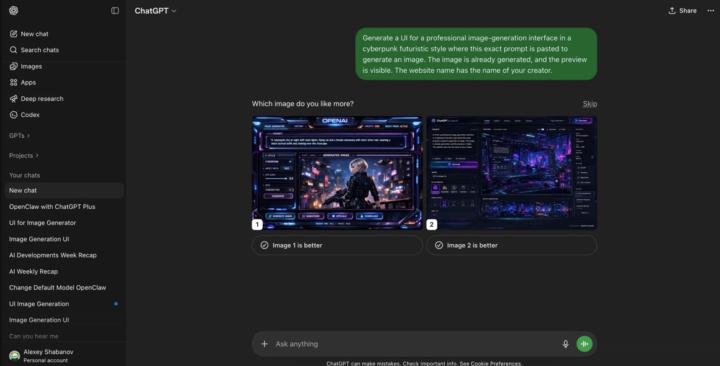
📰 AI News: OpenAI May Be Testing a New Image Model, and It Looks Built for Real Work
📝 TL;DR OpenAI appears to be quietly testing a next-gen image model inside ChatGPT and LM Arena, and early reactions are strong. The big story is not just prettier images, it is better prompt accuracy, cleaner text rendering, and visuals that could actually be useful for business. 🧠 Overview A new unreleased OpenAI image model is reportedly showing up in limited testing under internal-style names like packingtape-alpha, maskingtape-alpha, and gaffertape-alpha. Early testers say it performs noticeably better on prompt following, realistic layouts, and UI-style images, which has been a weak spot for many image tools. If this holds up at launch, it could push AI image generation further from fun experimentation into practical creative work. 📜 The Announcement The report says OpenAI has been testing this new model through ChatGPT experiments and LM Arena, where people compare outputs in blind matchups. There has been no official OpenAI announcement yet, so this should be treated as a test or leak, not a confirmed launch. That said, the timing matters, because OpenAI’s current official image model is GPT Image 1.5, so any stronger follow-up would signal that the image race is heating up fast. ⚙️ How It Works • Quiet A/B testing - Some users are reportedly seeing the model through side-by-side comparisons, which suggests OpenAI is testing performance before any public release. • Three mystery variants - The model appeared under names like packingtape-alpha, maskingtape-alpha, and gaffertape-alpha, which usually hints at internal experimentation. • Stronger prompt accuracy - Early testers say it follows instructions more closely, which is one of the biggest things that separates toy outputs from usable ones. • Better text in images - Reports highlight improved spelling and cleaner button labels, signs, and interface elements, which is a major upgrade for marketing and design use cases.
1 like • 9d
This sounds fascinating to me , Simple and Quick thoughts can come to life and stimulate our minds into action-
1-10 of 85

@alexandria-altman-7843
Mastermind Insider/ Author /Creative Careers / Music Film Production /Sports Science Health & Fitness / upscaling careers into Action -
Active 9d ago
Joined Nov 6, 2025
Tn.
Powered by