
Write something
Pinned

4h •
I once heard a line that stuck with me:
You’re only as happy as your unhappiest child. If you’re a parent, you instantly get it. What surprised me is how often this shows up in business and life too. You can have 90% of things going right…and your mind still locks onto the one thing that feels off. The conversation you’re avoiding. The decision you keep delaying. The loose end you keep telling yourself you’ll deal with “later.” And the tricky part is this…That unresolved piece doesn’t stay contained. It fractures your focus. Clouds your judgment. Quietly drains energy from what is working. Sometimes it even follows you home. Here’s the shift that actually changes things: Find the constraint. Face it. Fix it. Because when your mind isn’t busy avoiding something, it finally has the bandwidth to amplify what’s already going right. So I’m curious…What’s the one thing you’ve been tolerating that’s quietly taxing everything else? Drop it below if you’re open to sharing.

3d •
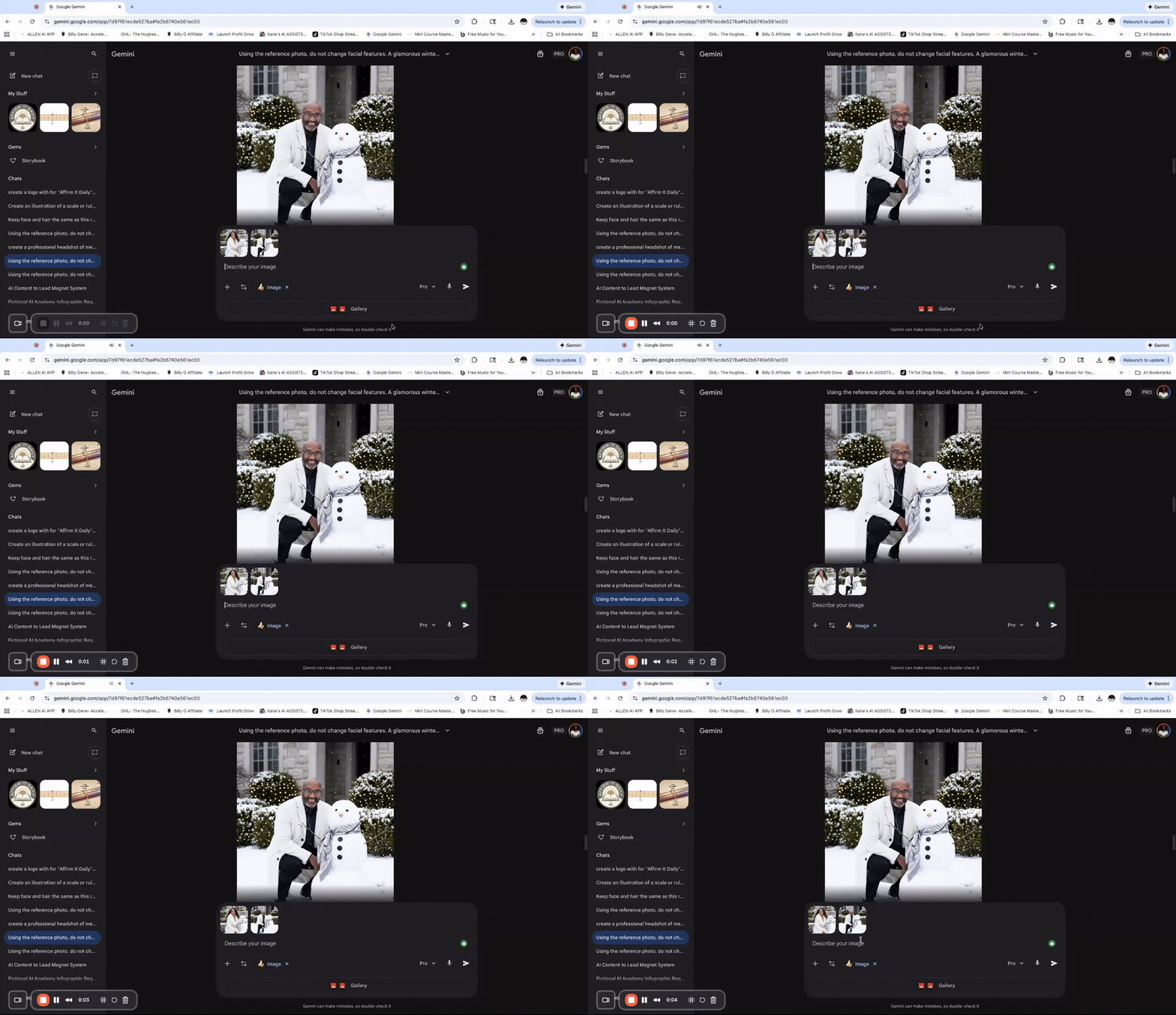
Merging 2 Pictures with Gemini (NanoBanana)
I had shown how to create these pictures with 2 different prompts, but someone asked me to merge the 2, so here is how you can do it in less than 2 minutes with NanoBanana. 🤗

1h •
🤖 The Future of Work with AI: Redefining What It Means to Contribute
When people imagine the future of work, they often picture automation taking over tasks, new job titles emerging, and skills lists changing faster than job descriptions can keep up. But beneath all the technical shifts lies something more personal. The real transformation is not in what we do, but in how we define contribution, creativity, and value itself. The arrival of AI has made work more fluid, more interconnected, and more unpredictable. Many of us are being asked to move from doing work to designing how work happens. That transition can feel both liberating and destabilizing. It challenges our sense of expertise, purpose, and control. What is unfolding is not the end of human work, but the beginning of a new kind of craftsmanship — one built around intelligence as a shared partner rather than a private possession. ---- The Shape of Work is Changing ---- Work used to be defined by repetition and reliability. We learned a skill, refined it, and executed it consistently. Mastery meant stability. Now, mastery looks more like adaptability. The ability to learn quickly, connect ideas, and translate context has become as valuable as technical precision. AI has changed the texture of time and attention. Many of the hours once spent gathering, formatting, or synthesizing information are being reallocated to judgment and decision-making. That shift sounds simple, but it introduces a new kind of strain. It forces us to rethink what a productive day even looks like. Imagine a professional who once spent hours creating detailed reports. With AI summarization and drafting tools, those same outputs now take minutes. At first, that feels like freedom. Then a new question emerges: what do I do with the time I have reclaimed? The answer is not always obvious. This is the new challenge of the future of work. Efficiency is no longer the destination. It is the starting point for deeper human contribution. ---- Redefining Human Contribution ---- In an AI-augmented environment, our contribution becomes less about production and more about perspective. The tasks that remain uniquely human involve context, interpretation, empathy, and choice. These are not easily measured, yet they are the essence of judgment and leadership.

4d •
This Is What Commitment Actually Looks Like
I just want to take a moment to say this... I’m genuinely proud of you. Not because this is easy. Not because you have it all figured out. But because you’re leaning into the work anyway. Adapting is uncomfortable. Learning new tools stretches you. Changing how you think, move, and operate takes effort. And most people avoid that. Most people wait until it feels simple. Until it feels familiar. Until someone else proves it first. You didn’t. You are committed to the tools. You are staying in the room. You choose to get better instead of staying comfortable. That tells me everything I need to know. When things change and you don’t opt out… When you feel resistance and lean in anyway… That’s what separates the few from the many. This is how real growth happens. Not overnight. Not perfectly. But consistently. Keep going. You’re exactly where you should be.

19m •
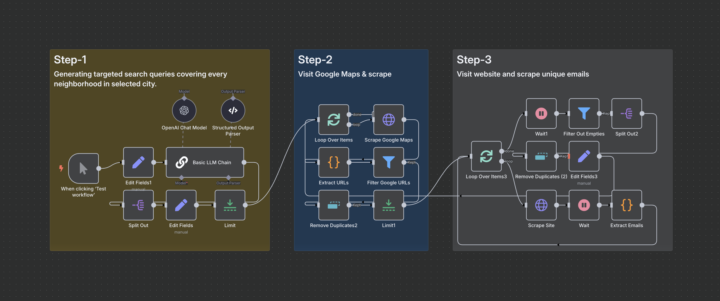
Others scrape 1 zip code. I scrape entire cities from Google Maps automatically — no API keys, no limits.
Most “lead tools” tap out after 1 suburb or a handful of results. And if you try to scale? You either hit Google’s API limits… or your wallet takes the L. $5 here, $12 there — just to scrape data that’s already public. So I stopped relying on APIs. Stopped buying databases. Stopped praying someone else did the scraping right. And I built this instead 👇 ✅ Enter a business type (like "plumber" or "dentist") ✅ Enter a city (like "Los Angeles") ✅ The system auto-generates 30+ hyper-local Google Maps search terms: • plumber+in+hollywood • plumber+in+echo+park • plumber+in+downtown • plumber+near+koreatown • ...it goes deep. Like, “every-corner-of-the-city” deep. Then it gets to work: — Scrapes websites from Google Maps — Filters out junk & Google-owned links — Deduplicates and cleans the list — Extracts valid emails from the homepages using Regex — Delivers a clean sheet of contacts and sites No scraping headaches. No wasted API credits. No manual copy-paste ever again. Perfect if you sell: → Web design → SEO → Paid ads → Local services → B2B outreach to SMBs Basically, if your ideal client is on Google Maps... this system turns their map pin into a real lead. I’ve used it to pull 1,000+ niche businesses per city. No limits. No bloat.
0
0
1-30 of 10,199

skool.com/the-ai-advantage
Founded by Tony Robbins & Dean Graziosi - AI Advantage is your go-to hub to simplify AI, gain "AI Confidence" and unlock real & repeatable results.
Leaderboard (30-day)
1

+913
2

+775
3

+693
4

+336
5

+249
Powered by