
Write something
Pinned

2d •
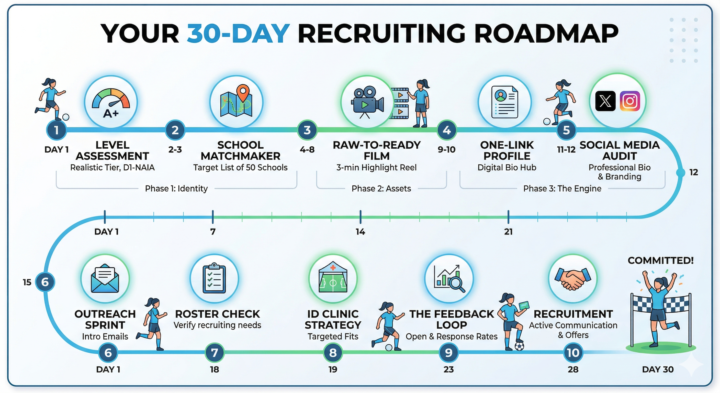
🚨 THE 10-STEP BLUEPRINT: How to Get Recruited in 30 Days 🚨
I talk to parents every day who are exhausted. They’re camp-hopping, sending "cold" emails that never get opened, and guessing at what level their daughter should actually be playing. The recruiting process isn't a mystery—it's a math problem. I’ve spent the last few months distilling my 18 years of D1 experience into a 30-Day Recruiting Roadmap. This is the exact "North Star" we use in our private program to move players from "invisible" to "committed." Here is the 10-step process you MUST follow: Phase 1: The Identity (The Foundation) - Step 1: The Level Assessment – Stop guessing. Find your "Strike Zone" (D1, D2, D3, or NAIA) using our proprietary algorithm. - Step 2: The School Matchmaker – Filter 1,000+ schools by your Level + GPA + Lifestyle to find your "Top 50" list. Phase 2: The Assets (The Proof) - Step 3: The "Raw-to-Ready" Film – Build a highlight reel that coaches actually watch (no drone shots, just impact). - Step 4: The One-Link Profile – Create a digital "Home Base" so coaches can see your film, stats, and grades in one click. - Step 5: The Social Media Audit – Turn your X/Twitter and IG into a professional recruiting brand. Phase 3: The Engine (The Execution) - Step 6: The Outreach Sprint – Send professional, high-conversion emails using proven templates. - Step 7: The Roster Check – Cross-reference our commitment database so you don't waste time on schools that are already full. - Step 8: ID Clinic Strategy – Only attend the camps that actually want your "Tier" of player. - Step 9: The Feedback Loop – Track your responses and adjust your list. - Step 10: The Commitment – Manage coach calls, campus invites, and signing your NLI. ⚠️ HOW TO EXECUTE THIS ROADMAP The steps above are your map. To actually execute them, you need the tools. Our Full Recruiting Engine provides you with the Level Assessment algorithm, the 1,000+ school database, the email templates, the commitment tracker, and the private "Locker Room" community for video reviews.
Pinned
Mar 3 •
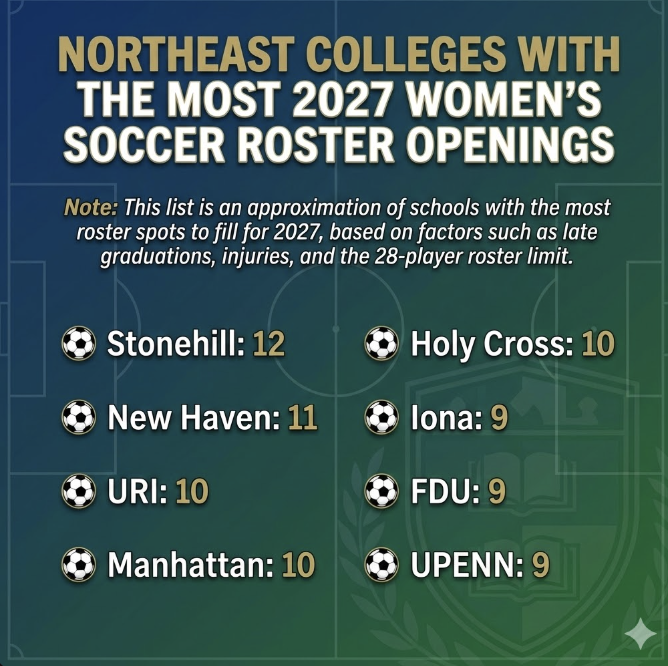
Female Class of 2027 - Roster Openings! 🚨
We've identified the Northeast colleges with the most projected roster openings for your class! With new roster caps looming, knowing where the vacancies are is a huge advantage. Coaches at these programs need to recruit. Check the graphic for the list. Is your target school on here? 👇 Note: Data is approximate and subject to change. #collegesoccer #recruiting #classof2027
Pinned
Feb 27 •
🌟 Success Story: Emily Vella’s Commitment to Sacred Heart University
Big congratulations to Emily Vella (Class of 2027) on her recent commitment to Sacred Heart University! ⚽️ I’ve had the pleasure of working with Emily and her father, @Frank Vella , over the last 12 months. We recently sat down to talk about their recruiting journey and what changed once they had a structured plan in place. Frank put it best when discussing the "Effectiveness of Outside Assistance." As parents, we invest so much in travel, gear, and club fees—but having a roadmap is what actually brings it all together. The Key Takeaways: - Reduced Stress: Moving from "guessing" to having a concrete plan. - A Sounding Board: Having a professional to bounce ideas off of before making big decisions. - Protecting Your Investment: Ensuring the time and money spent on travel soccer actually leads to a college opportunity. "The amount of money that we spend on soccer as parents... we go across country and we do all this. [Once we started working together], did you feel a little less stressed? Absolutely." Emily’s journey is a great example of what happens when talent meets a clear strategy. 📩 Want to build your own recruiting roadmap? If you’re feeling the stress of the "unknown" in your search, let’s talk. I help families cut through the noise and focus on a plan that actually works. DM me or reach out to see how we can streamline your journey Best Steve [email protected] #CollegeRecruiting #CommitmentAlert #SacredHeartSoccer #StudentAthlete #SoccerFamily
4
0

4d •
Parents of 2028s, 2029s, and 2030s,
I spend a lot of my day on the phone with parents of High School Juniors (Class of 2027). If I could record those calls and play them for you, you’d start working on recruiting this afternoon. By Junior year, most families are in what I call the "Recruiting Emergency Room." They’re panicked, they’re behind, and they suddenly realize they’ve spent two years burning daylight on the wrong schools and expensive camps that were never going to recruit them anyway. You have the one thing those parents would pay anything for: Time. If you are a Freshman, a Sophomore, or an 8th grader, you aren't in a crisis yet—which is exactly why this is the time to build your machine. You can either spend the next 30 days getting organized, or you can spend your Junior year praying for a miracle. The "Green Light" You Need to Know About In the college soccer world, June 15th after Sophomore year is D-Day. It’s the very first day D1 coaches are legally allowed to pick up the phone and call or text a recruit directly. Imagine 1,000 coaches all hitting "Send" at 12:01 AM. If your "Marketing Machine" isn't built, your video isn't ready, and your CSN Recruiting Readiness Score isn't established before that date, you’re invisible. We start now so that when your June 15th hits, your phone is the one ringing. The 30-Day "No-Panic" Roadmap I’ve put together a 30-Day Recruiting Foundation Plan specifically for the '28, '29, and '30 classes. No stress, no 1,000 questions—just four weeks of moving the needle. - Week 1: The Reality Check (The CSN Score). We stop guessing. We run our algorithm on your league, accolades, and academics to give you a CSN Recruiting Readiness Score. You’ll know exactly where you stand in the market today. - Week 2: The Strike Zone (The Target List). We find the schools where coaches will actually open your emails. We don't only pick "dream schools"; we pick attainable targets. - Week 3: The Hook (The 60-Second Video). Coaches have no time. We audit your film to make sure your best traits are in the first three clips.
5d •
We’ve known how to stop ACL tears for 20 years, so why is the rate for girls still 8x higher than boys?
The NYT dropped a massive deep dive on the 'ACL Epidemic.' Here are the 3 things every parent in this group needs to know about , fatigue, hormones, and the 'FIFA 11+' program..." Summarized "Why Are So Many Teen Girls Still Tearing Their A.C.L.s?" by Craig Welch (published Feb 26, 2026), is a deep dive into what is being called a "public health crisis" in youth sports.| The "Why" Behind the Crisis: Key Findings 1. The "Still" Problem Researchers have known about this disparity since the 1990s, yet the injury rates for girls have not improved in over 20 years. In fact, in sports like soccer, girls are 2 to 8 times more likely to tear an ACL than boys.| 2. The Devastating "Double" - The Year-Long Gap: For a high school athlete, an ACL tear isn't just a physical injury; it's a social and emotional "erasure" from their community for 9–12 months. - The Re-Injury Trap: Girls have up to a 1 in 3 chance of tearing an ACL a second time within a year of returning to their sport. 3. It’s Not Just Anatomy (The Social Gap) The article moves past the old "wide hips" theory and looks at how we raise athletes: - The Strength Deficit: Boys are often encouraged to lift weights and build muscle early on. Girls are frequently trained "as if they are boys" but without the foundational strength training that protects the joints. - Movement Literacy: Modern kids are more sedentary than previous generations. They lack the "movement literacy" (jumping, landing, and falling correctly) that used to be developed through free play. 4. The Biomechanical Differences - Quad Dominance: Females tend to be "quad dominant," meaning their hamstrings aren't strong enough to counterbalance the pull on the knee during a hard plant. - Valgus Collapse: Girls are more likely to land with their knees caving inward—a high-risk position for a non-contact tear. 5. The Hormonal Factor The article highlights emerging research on the menstrual cycle. Fluctuations in estrogen and progesterone (particularly in the pre-ovulatory phase) can increase ligament laxity and decrease neuromuscular reaction time.
1-30 of 586
powered by

skool.com/steve-coxon-soccer-network-4997
Navigate the college soccer recruiting journey: Build a clear plan, generate coach interest in 6 months, and avoid costly mistakes.
Suggested communities
Powered by