
Write something
Pinned

Apr 1 •
🚨 THE 10-STEP BLUEPRINT: How to Get Recruited in 30 Days 🚨
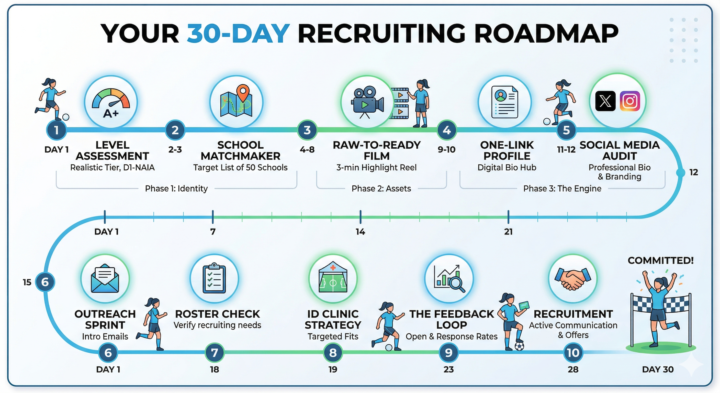
I talk to parents every day who are exhausted. They’re camp-hopping, sending "cold" emails that never get opened, and guessing at what level their daughter should actually be playing. The recruiting process isn't a mystery—it's a math problem. I’ve spent the last few months distilling my 18 years of D1 experience into a 30-Day Recruiting Roadmap. This is the exact "North Star" we use in our private program to move players from "invisible" to "committed." Here is the 10-step process you MUST follow: Phase 1: The Identity (The Foundation) - Step 1: The Level Assessment – Stop guessing. Find your "Strike Zone" (D1, D2, D3, or NAIA) using our proprietary algorithm. - Step 2: The School Matchmaker – Filter 1,000+ schools by your Level + GPA + Lifestyle to find your "Top 50" list. Phase 2: The Assets (The Proof) - Step 3: The "Raw-to-Ready" Film – Build a highlight reel that coaches actually watch (no drone shots, just impact). - Step 4: The One-Link Profile – Create a digital "Home Base" so coaches can see your film, stats, and grades in one click. - Step 5: The Social Media Audit – Turn your X/Twitter and IG into a professional recruiting brand. Phase 3: The Engine (The Execution) - Step 6: The Outreach Sprint – Send professional, high-conversion emails using proven templates. - Step 7: The Roster Check – Cross-reference our commitment database so you don't waste time on schools that are already full. - Step 8: ID Clinic Strategy – Only attend the camps that actually want your "Tier" of player. - Step 9: The Feedback Loop – Track your responses and adjust your list. - Step 10: The Commitment – Manage coach calls, campus invites, and signing your NLI. ⚠️ HOW TO EXECUTE THIS ROADMAP The steps above are your map. To actually execute them, you need the tools. Our Full Recruiting Engine provides you with the Level Assessment algorithm, the 1,000+ school database, the email templates, the commitment tracker, and the private "Locker Room" community for video reviews.
Pinned
Mar 3 •
Female Class of 2027 - Roster Openings! 🚨
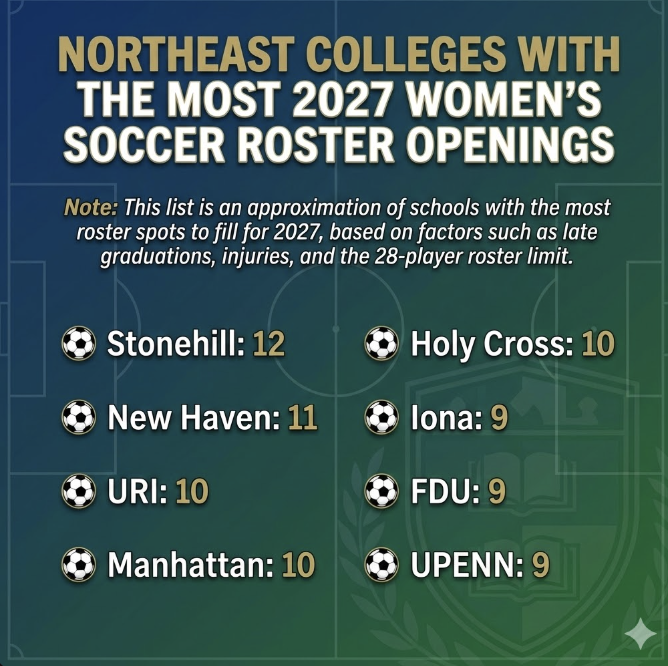
We've identified the Northeast colleges with the most projected roster openings for your class! With new roster caps looming, knowing where the vacancies are is a huge advantage. Coaches at these programs need to recruit. Check the graphic for the list. Is your target school on here? 👇 Note: Data is approximate and subject to change. #collegesoccer #recruiting #classof2027
Pinned
Feb 27 •
🌟 Success Story: Emily Vella’s Commitment to Sacred Heart University
Big congratulations to Emily Vella (Class of 2027) on her recent commitment to Sacred Heart University! ⚽️ I’ve had the pleasure of working with Emily and her father, @Frank Vella , over the last 12 months. We recently sat down to talk about their recruiting journey and what changed once they had a structured plan in place. Frank put it best when discussing the "Effectiveness of Outside Assistance." As parents, we invest so much in travel, gear, and club fees—but having a roadmap is what actually brings it all together. The Key Takeaways: - Reduced Stress: Moving from "guessing" to having a concrete plan. - A Sounding Board: Having a professional to bounce ideas off of before making big decisions. - Protecting Your Investment: Ensuring the time and money spent on travel soccer actually leads to a college opportunity. "The amount of money that we spend on soccer as parents... we go across country and we do all this. [Once we started working together], did you feel a little less stressed? Absolutely." Emily’s journey is a great example of what happens when talent meets a clear strategy. 📩 Want to build your own recruiting roadmap? If you’re feeling the stress of the "unknown" in your search, let’s talk. I help families cut through the noise and focus on a plan that actually works. DM me or reach out to see how we can streamline your journey Best Steve [email protected] #CollegeRecruiting #CommitmentAlert #SacredHeartSoccer #StudentAthlete #SoccerFamily
5
0

3d •
Tips for the 5-6 Day Soccer Schedule
Many of you, especially in the northeast, are well into your fall high school season and dealing with a 5-6-day soccer schedule. Match this with ambitious high school coaches who are doing their best to manage the workload but might not always know how (or that it is critical), and it is important for you to know how to help yourself. You are likely well aware of this now, as parts of your body have started talking to you, so here are a few tips for the 6-Day Soccer Schedule: - You must strength train to keep ahead of injury and keep performance high, but you don't need exhausting 60-minute lifts right now. Stick to 20-minute sessions twice a week focusing on single-leg strength and core stability to prevent overuse injuries. Go light, focus on range of motion, and make sure you pay attention to your form. I also like focusing on what your body is telling you. IE Hamstrings are tight? Some weighted Romanian Deadlifts are excellent. - Don't skip the cool-down: Try not to just hop in the car right after the final whistle. A quick dynamic stretch and foam roll session goes a long way in keeping your legs fresh. These cool-downs are always at the end of a collegiate match. Considering your ambitions for the next level, start these habits now. - Balance the load: After a heavy match day, strictly focus on active recovery. Taking it away from soccer is a great idea: light cycling, mobility work, or yoga (I love Gaiam on YouTube) instead of piling on more heavy training or soccer-repetitive movement. - Fuel up aggressively: Carbohydrates are the primary and most efficient fuel source for soccer players. Eat a carb-heavy meal hours before playing, and hydrate constantly to keep cramps away. I like to say, "Drink beyond water. Things you need to digest like electrolyte drinks, Gatorade, or 1/2 orange juice, half water, and a pinch of salt." As long as they are healthy choices, these will serve you better for what you need to fuel a successful season.
0
0

Jul 11 •
The reality of ID Camps and Clinics (Stop wasting your time!)
Look, we need to clear something up about summer camps and clinics. Too many of you are falling into a trap that wastes your time and your money. Here is the reality of how college recruiting actually works: - Camps are not for discovery. Coaches are not sitting in chairs hoping a hidden gem falls into their laps. They use camps to evaluate players they have already identified on film or live. - The "List" dictates everything. A coach walks into a camp with a list of 5 to 10 players they specifically need to watch. If you aren’t on that list before you attend then you are pretty much wasting your time trying to get "looked at." It just does not work that way. If you want to actually get a return on your investment, here is how you handle it: 1. Secure the call first. Do not attend a camp without reaching out to the schools attending first. Send a short message asking if you can jump on a brief call before you register. You have to get on their radar and onto their list before you get to the gate. 2. Use the updated resources. We just updated our master list of camps and clinics in the Classroom. We add new ones to this list every single week. https://www.skool.com/college-soccer-recruiting-hub-7734/classroom/f10bdf39?md=c7137199c2714fdcaa1d2269ba6243b0 Review the list in the Classroom, pick your targets, and start doing the outreach now. Stop relying on hope as a strategy and do the work upfront. Cheers. Steve
0
0
1-30 of 617
powered by

skool.com/steve-coxon-soccer-network-4997
Navigate the college soccer recruiting journey: Build a clear plan, generate coach interest in 6 months, and avoid costly mistakes.
Suggested communities
Powered by