
Write something

Jul 30 •
Why you're not getting new stages...
While @Richard Hickman (my hubby) and I were in Austin TX this last weekend we were in the room with over 750 speakers. As we were eating our texmex enchilada's at lunch, I got a text from an old contact of mine, saying that one of our mutual friends needed a strong female speaker for an October conference. Apparently I came recommended by Dan Clarke (hi Dan!) which is a huge endorsement. So what does this have to do with you? 2 Things: 1. No one can recommend you if they don't know SPECIFICALLY what you do. 2. It will be way easier to recommend you once they have SEEN YOU IN ACTION. So what should you do if you want to get booked on new stages? 1. Be able to clearly answer the question "I help (specific kind of person) who struggles with (specific problem). In fact, answer it in the comments. If you struggle to answer this, all the better. That just means you need to get better at it. 2. Stop waiting for stages to knock on your door. You'll have much more success if you just start your own stage. This could be in your home, your local library, or at an event center if you wanted to. What is it that you need to do before you go to bed to get clearer on this?

Jul 21 •
Bite off more than you can chew (and then learn to chew it)
I heard this once and it hit me like the ground did the first time I got bucked off a horse. If you start something new, and feel like you "can't do it" - keep doing it If you feel like you are "in over your head" - learn to swim If you feel like "this is too much" - do the next thing. You've heard this before "if you always do what you've always done, you'll always get what you've always gotten" Do you remember when you started riding your bike for the first time? When you sat on that seat, you didn't know how to ride a bike. The first time you fell off, you still didn't know how to ride a bike, but falling off was so painful/embarrassing, you learned something new about how to not crash. Speaking is the same way. You WILL stink at it at first (just watch my old videos) But stinking at it is how you get better. By the way, this message was for you...(you know who you are) ❤️

Aug '24 •
What step are you struggling with most?
Some of you have some steps done, some are missing some steps, and some are in the wrong order. What step is your biggest hurdle right now?

Feb 25 •
What is leg locking?
As part of a series on body language for speakers, I’ve posted this reel on Instagram to explain leg locking: https://www.instagram.com/reel/DVEeDiGAZdL/?igsh=bWs3YXk0cGs4Y3l3 You’ll see this mostly at home but watch for it at events. Lake locking essentially signals deep connection in relationship. Usually it is a welcome gesture. But watch for when it is not. Watch the response of the person that is being “locked.“ Hope this helps. What body language training do you want to see more of?
Feb 8 •
Get off the stage
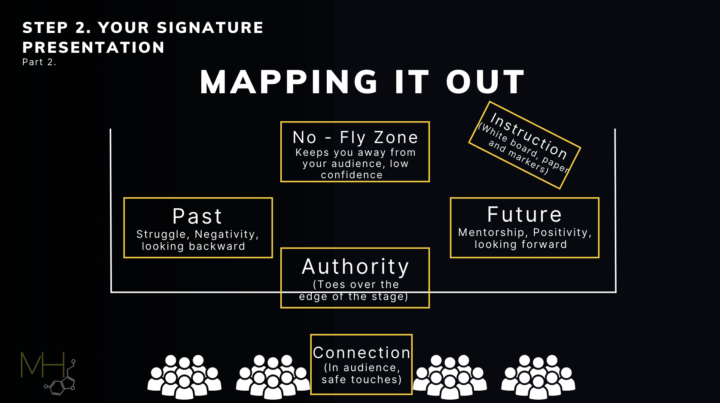
no – really Step off the stage. Too many speakers stay stuck on the stage - rigid, frozen, unmoving. Or some will wander aimlessly without destination or reason, leaving us wondering "where are you going" not only with their body, but with their words. Everything in your presentation should be both 1. On Purpose 2. Supportive of your message There are different positions in stage geography, and the audience is part of that. For example, did you know that different areas of the stage send a different message? Here are just a few 1. The back of the stage - Your No Fly Zone. Avoid this area unless you are trying to appear small or minimize your message 2. The Left of the stage - The Past. Your audience reads from left to right, so if you want to emphasize some historical part of your speech or the parts of your keynote before you learned the moral you'r keynote teaches. 3. The Right of the stage - The Future. This is where you help the audience see their future. What life will be like if they implement the framework your keynote teaches. 4. Rear Right - The Instruction zone. This is where your whiteboard is if you have one. This is where you engage the left brain to lay out your framework and instructions so your audience can take action. 5. Front and Center - The Authority Zone. This is where you stand when you have your mic drop moments. The one-liners that become bumper stickers and t-shirts. Use sparingly 6. And Finally In the audience - The Connection Zone. Too few speakers get off stage and mingle with the audience, and that's why you'll stick out (in a good way) when you do. Remember, you never speak to an audience, just to one person while everyone else listens.
1-30 of 95

skool.com/speakermastery
Grow your business through the power of the stage! Become a sought-after speaker, appear on Podcasts, and monetize your message.
Leaderboard (30-day)
1

🔥
+4
2

+4
3

+3
4
+2
5

+1
Powered by