
Write something

Jun 17 •
The Promise So Small You Can't Fail It
Here's something I wish more people understood about why they "can't stick to anything." It's not discipline. It's trust. Every day we get bombarded by emotions — stress, cravings, the 9pm "I deserve this," the Monday guilt. Whether you succeed or not has almost nothing to do with willpower and everything to do with the strategy you've built for those moments. And underneath the strategy is something quieter: how much you trust yourself. Self-trust is a muscle. Every time you say you'll do something small and then do it, you earn a little back. Do it again, earn a little more. It compounds, exactly like training does, until one day the thing you had to force becomes the thing you just are. But it works the other way too — every broken promise to yourself withdraws from that account. So stop trying to overhaul your life by Friday. Pick one promise so small you can't fail it, and keep it. You're not just building a habit. You're rebuilding the belief that you're someone who keeps her word to herself. What's one tiny promise you could keep every day this week? Name it below — saying it out loud is the first rep.
Jun 16 •
The 11 PM pantry trip isn't weakness
The 11 PM kitchen trip isn't weakness. It's a signal you've been taught to ignore. You know the one. You weren't even hungry at dinner, but now it's late, the house is finally quiet, and you're standing in front of the open pantry with a handful of something you didn't decide to eat. By the time you notice, half of it's gone. For years you've been told that's a discipline problem. It isn't. It's your nervous system asking for something, and food is just the closest thing on the shelf. The whole game is learning to read the actual request before you answer it with snacks. Two tools I keep coming back to. T hey take about ten seconds each, and they work because they move you out of reacting and into seeing it (See It, if you've been with me a while). HALT — what is my body actually asking for? Before you eat, run the four: H — Hungry. Real hunger builds slowly and you'll eat most things. Emotional hunger hits fast and demands something specific (the chips, the chocolate, not the leftover chicken). That specificity is your tell. A — Angry. Stress and frustration push us toward food to take the edge off, and here's the catch: when you eat to soothe, you barely taste it. The food never delivers what you wanted, so you keep reaching. L — Lonely. This one's big for our age group. The kids are grown, the day's demands are done, and food becomes the stand-in for connection. A text to a friend often settles it faster than the pantry does. T — Tired. The heavy hitter, and the most clinical. When you're sleep-deprived, ghrelin (your hunger hormone) climbs and leptin (your fullness hormone) drops. Y our brain is biochemically tilted toward eating, and toward the fast carbs specifically. You are not weak at 10 PM. You are under-slept and out of fuel from a long day. Different problem, different fix. STOP — when the urge is already moving: S — Stop. Freeze the autopilot. Just for a second. T — Take a breath. A few slow ones. This isn't woo, it down-regulates the stress response that's driving the reach.
Jun 15 •
The 6 a.m. Version of You vs. the 6 p.m. Version
There are two of you, and they barely know each other. There's the 6 a.m. version. She's clear. She set the intention. Today's the day she hits her protein, gets the workout in, doesn't graze after dinner. She means it. And then there's the 6 p.m. version. Standing in the kitchen, tired in a way that's hard to explain, reaching for the thing she swore off twelve hours ago. And she watches herself do it, almost from the outside, thinking what is wrong with me. I was so sure this morning. Nothing is wrong with you. You're not two different women with two different amounts of discipline. You're one woman whose body ran out of a resource over the course of the day, exactly the way it's built to. Here's the part your doctor won't sit you down and explain. Willpower and decision-making aren't infinite. Every choice you make all day, what to feed the kids, the work email you didn't want to send, the hard conversation, the hundred small ones you don't even notice, pulls from the same tank. By evening that tank is low. This has a name. Researchers call it decision fatigue, and the science behind it is real, not a self-help slogan. Now layer our stage of life on top. When estrogen shifts, blood sugar gets less stable and sleep gets lighter, so the afternoon crash is steeper and the recovery is slower. The 6 p.m. version of you isn't weaker than the morning version. She's running on a near-empty tank that drains faster than it did in your thirties, and then we blame her character for it. So the fix was never "want it more at night." You cannot out-willpower an empty tank. The fix is to stop asking your most depleted self to make your most important decisions. Front-load the day. Hit your protein at breakfast while the tank is full, so your evening body isn't screaming for fast fuel. Decide tonight's dinner this morning, when the 6 a.m. version is in charge, so the 6 p.m. version doesn't have to decide anything at all. Take the hard thing off her plate before she ever gets there.
Jun 8 •
We Are Done Saying Never Miss a Monday
I had a slow start this morning, and it got me thinking about a phrase I have said for years as a trainer. Never miss a Monday. I am not sure it is the right outlook anymore. Here is why. "Never miss a Monday" makes one day the hero and turns the other six into filler. It also sets up a trap. Miss the Monday and the whole week feels blown before it started. For women in our stage of life, that all-or-nothing wiring is exactly what keeps us stuck. There is something more honest underneath it. The women who actually change their bodies after 45 are not the ones who never miss. They are the ones who never miss twice. Miss a Monday, fine. Show up Tuesday. The streak was never the point. The return is the point. So I am retiring "never miss a Monday" in here. Our version is: never miss the comeback. What is one phrase from the fitness world that you have outgrown? The one that used to motivate you and now just makes you feel behind. Let's name them and leave them in the old chapter.
1
0

Jun 6 •
Fired at 40. Billion-dollar company at 54
Quiet Saturday, and I want to share two things that have stayed with me. I keep coming back to something the founder of Orangetheory, Ellen Latham, said about consistency versus intensity. I've always believed, deeply, in consistency over intensity — slow and steady, every day. But the reframe that got me is this: it's the intensity of your consistency that keeps the consistency alive. Not how hard any single day is — but how seriously you protect the streak itself. I've been turning that over all week. And one more. Ellen was fired from her dream job at 40. A single mom, starting over from a spare room in her house. She didn't found Orangetheory until she was 54 — and built it into a billion-dollar company with studios all over the world. I want my women — 45, 55, 65 — to actually sit with that. The story you've been told is that your window is closing. It isn't. Some of the most powerful chapters get written exactly now, by women who decided they were just getting started. So tell me: what's the thing you've been quietly telling yourself you're "too late" for? Drop it below. I have a feeling this thread is going to be something.
0
0
1-24 of 24
skool.com/shesnotdoneunfiltered
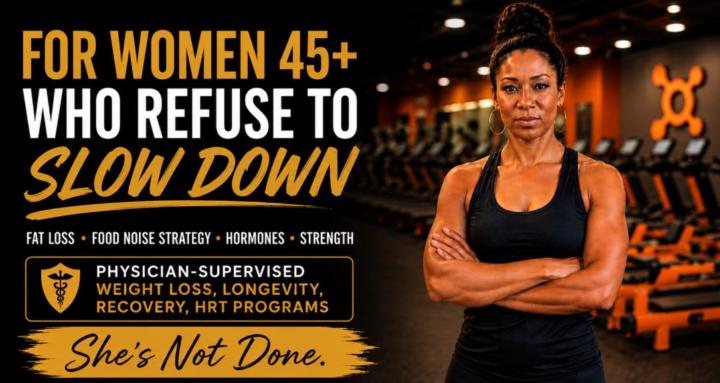
The clinical conversation your doctor won't have and Google can't find. For the woman who isn't slowing down
Powered by