User
Write something
Weekly Qi (Qigong) is happening in 40 hours
A Student of Your Breath | 8 Qualities of the Breath
The Qualities of the breath. The breath is something that is intrinsically linked to our practice and something that is often overlooked in other physical practices. You can look up and google many different kinds of breath work and even become a certified master of breathing;). So how does qi gong view breathing? Well first, let’s not over worry about breathing wrong or incorrectly. If you are currently alive then your breath is doing a great job of keeping you functioning and thinking, especially since the brain uses way more oxygen than almost any other part of the body, so thank your breath for all those good ideas:). Rather than think that we need to control our breath, instead look to become a student of your breath. Listen and observe for how it is already working alongside your movement and posture doing a great job without you ever having had to do a thing. To quote Sun Tzu, “The breath sets the strategy”, and how we connect to our breath is directly related to our concept of ‘song’. By taking the mental posture of a student, we can then relax into the deeper systems that bring stabilization and ease into our state. It is also good to know that the air we breath and exchange with the environment is an aspect of environmental Qi, which is something different from the qi we are observing within our system. The beauty of the breath is that it is something we can use to ‘shine a flashlight’ or “create resonance” within our entire body, but the respiratory process is contained within some very specific spaces and uses logical mechanics. Overtime, there is an integration of sensory inputs that will help support and benefit the system. It is as simple as beginning to learn more about the breath and how to interact and perceive it. Below are a list of qualities we can learn to observe and look for in our breath. These are intentions that we can carry with us to gently influence the nature and quality of our breath over time. Remember, intention is like a rock you cast into a pool. We are looking and listening for the splash and ripples and feeling for the change in current. They are also guides for further study as we can begin to learn what other aspects of our practice need to be present and cultivated to draw out these qualities more easily.
A Student of Your Breath | 8 Qualities of the Breath
Tai Chi Chuan & Aerobic exercise
Are Tai Chi and Qi Gong aerobic? Below is a short article discussing several studies done on the effect of tai chi on energy expenditure and blood pressure. The article was written by a “Tai Chi uncle” of mine Dr. Harvey Kurland who is a Kinesiology professor at UC Riverside. Tai Chi uncle means he trained under the same teacher that my teacher did, in fact he is very good friends with my teacher and trained with Tchoung Ta Tchen for many years. He has done several studies on tai ji over the years and since his methods are very similar to our own we can learn a lot from the findings. The interesting take away from this for me is the energy expenditure related to the different forms and experiences and the range of METS found. This does show that the practice can meet you where you are at, almost self adjusting as you get better and learn more. Do you need to know about all these studies to get the benefits out of tai chi? Absolutely not, but at a time when there is more data easily available, studies such as this as can help us confirm our instincts and give us more confidence and energy to relax into the learning and training process. "T'ai Chi Ch'uan Lowers Blood Pressure" ©Harvey Kurland MSc, CSCS, MFS, 2013 Many students comment how the t'ai-chi they practice in our classes has helped them to keep their blood pressure under control. But, Dr. D. Young from Johns Hopkins University was surprised to find that t'ai-chi significantly reduced blood pressure. In a 12 week study, she found systolic blood pressure fell 8.4 mm Hg in the aerobic exercise group and 7mm Hg in the t'ai-chi group. The benefits were seen after only 6 week (AHA press release, Washington Post, 4/14/98, p. Z28). I don't find these results surprising, based on what students have said and the research we reviewed in past issues. Several studies showed that t'ai-chi ch'uan is an aerobic exercise and has reduced blood pressure. For example Dr. K. Channer found that t'ai-chi reduced blood pressure in cardiac patients (Postgrad Med J 1996 Ju;(848):349-351) and Kurland (UW 1975) found it lowered blood pressure acutely after one session in normal, non-hypertensive, students.
似停非停 "Appears to stop, but does not stop"
This is another of my favorite sayings from the arts. It is meant to evoke an internal awareness as well as an external expression. From the outside at times it might seem like the tai ji or qi gong practitioner has come to a complete rest, and there are times when you should, and it is in those moments you continue to observe and listen for the subtler rhythms of the body and motion taking whatever time is needed to occupy your space. This is the permission to find your own rhythm with a movement once you feel the body, mind, and breath harmonize. This is the space between the breaths where there is no need to rush into the next moment. It is the ending and beginning of movements. It is your practice from one day to the next:)
Posture
There is much that we can discuss and study when it comes to posture, but first we want to understand that posture is as much reaction as it is intention. It is something we have present when we stand, sit, and walk which is one of the reasons we discuss the Three Treasures of walking, standing and sitting so much in qi gong and tai ji. Posture is also intrinsically connected to our breath and sense of our space(internal and external). For these reasons we want to develop a more accepting, logical and practical understanding of posture as we study these arts. Certain aspects of our posture we can affect right away, like our focus, tongue to pallet, and grounding the feet. Others will take time, like core stability, leg strength, and greater awareness of center(of mass). Qi gong training improves all of these qualities naturally so postural improvements are part of the "rising tide" as well as one of the ships being risen. So what are some important, real time cues you can make to improve posture across all areas. Yi Dao Xian | Awareness finds the horizon - Lift gently from the crown of the head and suspend the head top. Eyes rest at level that should be able to rest in your space as if reading a book as well as glancing out to find the horizon as if on a plain, ship or peak. Head on a swivel. Like walking backwards, a lot of new information can come from the panorama. Tongue to pallet -internal postural awareness connected to breath, neck and jaw health. This is an ongoing aspect of our practice. Greater awareness to this area will bring benefits in both the short and long term. In taoist physical theory, tongue gently, yet firmly suctioned to the pallet was the neutral resting place of the tongue at all times. Don't over worry about the challenge this may or may not present in your practice. The body is deeply aware of how to manage these inputs. Simply allow that intention to become part of our practice in its own way. And as always, Relax, Be Present, Listen, Follow & Flow.
Coffee & Qi 咖啡话
Join me tomorrow morning for our first Coffee & Qi from 11:30-12:30pm PST. We can enjoy a simple chat about the practices we now share. If you have any questions or topics drop them in the comments or just ask away tomorrow. In China, it is quite common for teachers and students to sit over tea before or after class and discuss the practice. Over the years, all my teachers, whether they were from China or someplace else had their own way of going about this. Here in Visalia we have a local coffee shop that I have always loved. When I moved away to China I would get beans from them any chance I could get. After I moved back I liked taking students there and introducing them to this local gem. Our small town had grown so much in the time I was gone, but Mavericks Coffee still was relatively undiscovered. Of course, our chats would usually center around qi gong, tai ji, marital arts and general practice topics and that is why we now have Coffee & Qi! No beverage needed:).
1-13 of 13
Rooted Alchemy
skool.com/rootedalchemy
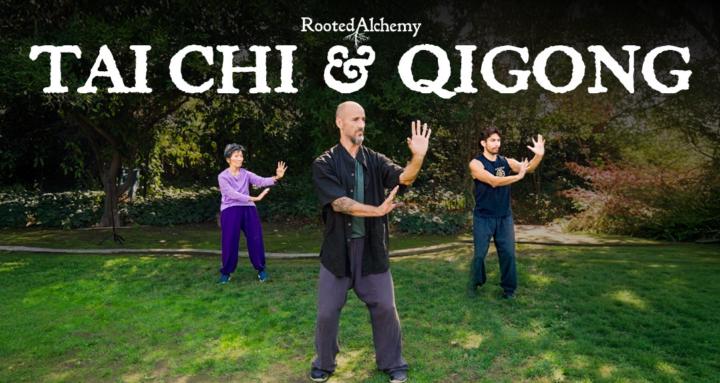
Rooted Alchemy makes Tai Ji and Qi Gong accessible, artistic, and enjoyable—helping people transform their inner world through ancient practice.
Leaderboard (30-day)
Powered by