
Write something

🔥
Jan 27 •
The Exact Menu Engineering Framework That Can Boost Your Profits 15–30%
One of the fastest ways to increase your restaurant's bottom line without spending a dime on marketing or new staff? Menu Engineering. Most owners just list dishes and hope for the best. But top performers treat their menu like a profit machine—categorizing items into Stars, Plowhorses, Puzzles, and Dogs to make smarter decisions on pricing, placement, and promotion. Here's a quick breakdown ): 1. Stars (High Profit + High Sales): Your winners—promote heavily! 2. Plowhorses (Low Profit + High Sales): Reliable sellers—consider small price tweaks or cost reductions. 3. Puzzles (High Profit + Low Sales): Hidden gems—highlight with descriptions, photos, or specials. 4. Dogs (Low Profit + Low Sales): Phase out or revamp. Pro Tip: Combine this with a "Grand Slam Offer" style bundle (e.g., high-margin Puzzle + popular Plowhorse) to drive upsells and make customers feel like they're getting a deal. Who's tried menu engineering before? Drop your biggest win (or question) in the comments: Let's turn those menus into money machines. 🚀 #RestaurantProfits #MenuEngineering #Restaurantownercommunity

🔥
Mar 18 •
Are You Losing 30% of Your Tables
You have the best food in town. Your staff is trained. Your lights are on. But to Google, you might be invisible. When someone searches "Best Steakhouse near me" at 6:00 PM, Google’s AI is playing matchmaker. If your profile hasn’t been updated in 3 weeks, Google assumes you’re "stale" or—worse—closed. This is the Ghost Effect: Having a great restaurant but a "dead" digital profile. The 3-Minute "Mogul" Fix You don't need a $2,000 SEO agency. You just need to feed the algorithm what it craves: Recency and Keywords. 1. The "Live" Update: Post a photo of today’s prep (even just a crate of fresh veg) directly to your Google Business Profile. It tells the AI: "We are open and active right now." 2. The Keyword Reply: When you reply to a review, don't just say "Thanks!" Say: "Thanks for visiting the best Burger Spot in Cape Town! Glad you loved the Truffle Fries." 3. The "Near Me" Magnet: Mention your neighborhood name in your posts. The Challenge: Go to Google and search for your own restaurant right now. - Is the last "Update" from 2024? - Do you have unreplied reviews from last month?
2
0

🔥
Mar 18 •
Stop Paying the "Boring Menu Tax"
Ever wonder why some restaurants can charge $25 for a burger while the guy down the street struggles to get $12? It’s not just the meat. It’s the Copywriting. Most menus are just a "List of Ingredients." - Example: "Beef patty, cheddar, lettuce, tomato, onion, brioche bun." That’s a grocery list. Not a craving. When you write a menu like that, you are paying a "Boring Tax" because guests will only pay for the utility of the food, not the experience. The Mogul Flip (The 30% Revenue Hack) Research shows that descriptive menu labels can increase sales by up to 27%. Here is how to use AI to stop the leak: 1. Use Sensory Adjectives: Don't say "Crispy." Say "Golden-fried with a satisfying crunch." 2.Highlight the Origin: Don't say "Steak." Say "Hand-selected, 28-day aged Karoo beef." 3. Sell the Emotion: Don't say "Chocolate Cake." Say "The decadent, melt-in-your-mouth finale your Tuesday deserves." Let’s stop leaving money on the table.
2
0

🔥
Mar 13 •
Marketing with AI
The biggest lie in the industry right now? "You need to spend 2 hours a day on Instagram to stay relevant." Absolute nonsense. It is a factor to your success, but not the Gold standard today. If you are spending your afternoon filming Reels instead of watching your labor margins or perfecting your menu, you are losing. In 2026, Marketing is a Math Problem, and AI is the calculator. Here is how the top 1% of owners are using AI to dominate their local market while spending less than 30 minutes a week on "marketing": 1. The "AIO" Pivot (AI Optimization) People aren't just searching Google anymore. They are asking ChatGPT, Siri, and Alexa, Gemini, Grok, Claude: "Where is the best quiet spot for a business lunch near me?" If your menu data isn't structured for AI to read it, you don't exist. # 2. The "30-Day Batch" Using the tools, you can take ONE 60-second video of your kitchen and turn it into 30 days of high-converting posts, captions, and emails. - The Old Way: Hiring a photographer for $500. - The Mogul Way: One phone, one AI prompt, $0. 3. Review-Mining for Gold AI doesn't just reply to reviews; it analyzes them. We use AI to scan 100+ reviews to find exactly what people love (The "Secret Sauce") and what they hate. Then, we feed that back into our ads. - If people love your patio, AI tells us to only run ads featuring the patio. No more guessing. So before Ai replaces us, use it. Be 10 X more efficient, spend less money and save a lot of time in the process.
2
0

🔥
Jan 7 •
The "secret wallet" hack
Most restaurant owners waste money on "glossy" flyers that people throw straight into the trash. To win, you have to bypass the "marketing brain" and hit the "curiosity brain." The Execution 1. Buy 100 cheap, colorful envelopes (think bright yellow or red—not white, which looks like a bill). 2. Hand-write on the front: "Found this outside—is it yours?" or simply "For the neighbors at [House Number]." 3. Inside, place a "Golden Ticket" or a high-quality "Member Card" (not a paper coupon). 4. The Message: > "We were doing a neighborhood walkthrough and realized we haven't seen you in a while. This card is worth one free [Your Signature Appetizer or Drink] for you and a guest. Just show this to your server. No strings attached—we just want to meet the neighbors." 5. The "Drop": Have a staff member (or yourself) walk a 5-block radius around the restaurant and leave these in mailboxes or tucked into front doors. Why This Is "Cool" (The Psychology) - The "Found Object" Effect: When someone sees a handwritten envelope that looks personal, their brain treats it like a letter from a friend, not an ad. The "open rate" is 100%. - The Reciprocity Trigger: Because it looks like you "found" something or went out of your way to deliver a personal note, the customer feels a subconscious psychological need to "repay" the favor by visiting. - The "Neighborhood Hero" Vibe: It positions you as a local human being, not a corporate entity. The Math (Why it's High Value) - Cost: $20 for envelopes + 2 hours of walking. - Result: If 10 people come in, they aren't just getting a free appetizer; they are buying 2 entrees and 4 drinks. - ROI: One "Secret Wallet" run can easily generate $500 - $800 in immediate revenue and create 5-10 lifelong regulars.

1-13 of 13
powered by
skool.com/restaurant-owner-community-6305
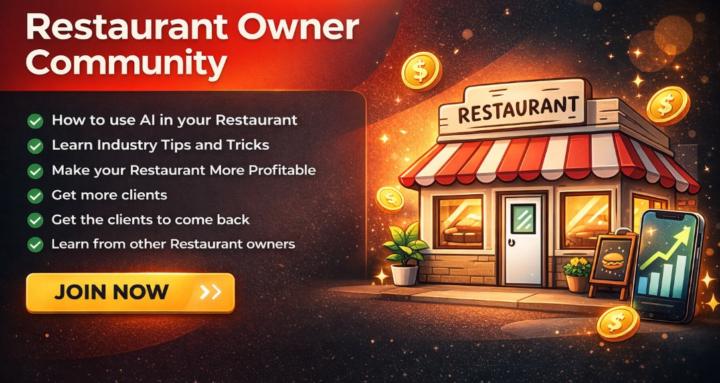
The Restaurant community is where smart Restaurant Owners learn how to use AI to save time, cut costs, and bring in more customers every week.
Suggested communities
Powered by