

Feb 14 •
The Magic in Your Fingertips: A Hidden Human Superpower
A few summers ago, I was walking barefoot along a quiet beach. The sand was warm, silky, alive. At one point I paused. Something made me stop before I stepped forward. I brushed the sand gently with my toes… and there it was a smooth stone just beneath the surface. I hadn’t touched it. And yet… somehow I had. Recently, a study reported in The Daily Galaxy described something beautifully similar. Researchers from Queen Mary University of London and University College London found that humans can detect a buried object in sand before physically touching it with a success rate of over 70%. On average, participants sensed an object from about 6.9 centimetres away. Not psychic. Not a “seventh sense.” Just your exquisitely sensitive tactile system at work. What’s really happening? As your finger moves through sand, it displaces tiny grains. If something solid is buried beneath, it subtly changes how the sand resists and vibrates. Your mechanoreceptors the tiny sensors in your skin pick up those microscopic changes. Your brain translates them into something that feels like: “There’s something there.” It’s not magic. It’s intelligence woven into your nervous system. Interestingly, when a robotic arm with AI tried the same task, it detected slightly further away but was far less accurate. Humans weren’t just sensing data… we were interpreting it. That’s the miracle. A Magical Mind Reflection How often do you override your subtle senses? The slight shift in atmosphere in a room. The pause in someone’s voice. The quiet resistance in your body before you say yes. Your system is constantly reading the “sand” around you. Perhaps intuition isn’t mystical. Perhaps it’s refined perception. Try This at Home: A Mindful Touch Practice You’ll need: A bowl or tray of dry rice or sand A small object (coin, stone, cube) A calm moment 1. Bury the object without looking (or ask someone else to hide it) 2. Slowly move your fingers through the grains. 3. Notice resistance. Notice vibration. Notice texture shifts.
0
0

Feb 8 •
The Architecture of the Soul: From Blanket Forts to Your Inner Den
There’s something almost magical about dragging a heavy blanket over two kitchen chairs. It’s a childhood ritual that seems to exist everywhere, and it’s never just play. It’s one of our earliest moments of self-made safety. A tiny, cosy world where you get to decide the rules. And here’s the thing: we don’t outgrow that need. As adults, the blankets might go back in the cupboard… but the nervous system still longs for a “secret space” a place to soften, settle, and feel held. In hypnotherapy, we bring that instinct back to life through the creation of an inner den: a visualised sanctuary you can return to whenever you need calm, clarity, or a sense of inner steadiness. The childhood blueprint: “This is mine” When you’re small, the world can feel huge. Everything is louder, taller, faster — and often run by other people’s rules. A den is a child’s quiet little rebellion, in the sweetest way. It’s also a rehearsal for something important: Autonomy: “I made this.” Choice: “This is how it looks.” Boundaries: “These people are allowed in… and these people aren’t.” When children decide where the “door” goes or who can enter, they’re practising the beginnings of selfhood. They’re learning that they can have a private inner life a place where thoughts and feelings can exist without being watched, judged, or managed. The therapeutic transition: the den becomes a sanctuary In hypnotherapy, the inner den is the grown-up version of that same instinct but instead of cushions and chair legs, we use imagination and sensory detail. A child builds a fort to create a barrier from the outside world. A client builds an inner den to create a barrier from emotional noise. And it works beautifully, because the mind responds to imagery as if it’s real enough to matter. Your inner den tends to do three powerful things: 1) Regulated safety When someone imagines a warm, enclosed, cosy space, the nervous system often gets the message: “I’m safe now.” That can help shift the body out of fight-or-flight and into rest-and-repair. Breath deepens, muscles soften, thinking becomes clearer.
1
0

Jan 31 •
Imbolc: Lighting the First Spark of Spring
Hope, Hearth, and Gentle New Beginnings As January softens into February, we reach a quiet but powerful turning point in the year: Imbolc. Celebrated from the evening of January 30th and the 31st into February 1st, Imbolc marks the halfway point between the Winter Solstice and the Spring Equinox. Yey! Though winter may still hold the land in frost, cold a loadsof rain something has shifted. The days are longer. The sap is rising. Beneath the soil, seeds are stirrin....Wooo hoo Imbolc (pronounced im-bulk or em-bowlk) is often described as the Earth’s first thaw, the moment we stop looking back at the deep dark and begin, gently, to look toward the light. What Imbolc Represents At its heart, Imbolc is about hope, purification, and renewal not in a loud or dramatic way, but as a steady, intentional spark. The Goddess Brighid This festival is sacred to Brighid (also known as Brigid or St. Brigid), the Celtic goddess of fire, healing, poetry, and the hearth. She embodies inspiration, warmth, creativity, and protection, the flame that keeps us going through the last stretch of winter. Fire and Water in Balance Imbolc carries a beautiful duality: Fire, in the form of candlelight, the returning sun, and creative spark Water, in melting snow, cleansing rains, and purification The fire is not a roaring bonfire yet. It’s a small, steady flame, a promise rather than a declaration. “In the Belly of the Earth” The word Imbolc comes from an old Gaelic phrase meaning “in the belly,” referring to pregnant ewes and the promise of new life. For our ancestors, this was the first sign that the hardest part of winter was nearly over. The Lighting of the Flame: An Imbolc Blessing As you light a white candle on Imbolc night, you may wish to speak a blessing inspired by traditional Gaelic prayers from the Carmina Gadelica, gently modernised for grounding and clarity: “Kindle the light, the winter is breaking. The seeds in the earth are slowly awaking. Brighid of the hearth, Brighid of the flame,
0
0

Jan 17 •
How Ancient Wisdom Informs Modern Hypnotherapy for Lasting Change
For centuries, ancient texts, like the Gnostic gospels (my summer holiday reading) have spoken of a profound truth: that within each of us lies a direct connection to a higher power, a "divine spark" that holds all the wisdom and healing we could ever need. This isn't just spiritual poetry; it's a profound principle that, when applied in modern therapeutic settings, is yielding incredible results. On my Spiritual Hypnotherapy Diploma, we delve into this very concept, moving beyond traditional approaches to tap into that intrinsic inner wisdom. One of our most powerful techniques is called "Spirit Trek." What is Spirit Trek? Inspired by the pioneering work of Roy Hunter (Star Trek Fan) but deeply enriched by my own unique experiences, beliefs and extensive practice, Spirit Trek is a guided inner journey. It’s not about finding external answers or relying on an outside guru; it's about going inside yourself. During a Spirit Trek session, clients are gently guided into an altered state of consciousness, allowing them to connect directly with their own divine essence. From this place, they journey to an alternate space, a higher dimension, if you will, where the typical limitations of the material world fade away. In this higher dimension, clients have access to: All the information they need: Solutions to problems that seemed insurmountable. Profound healing: Emotional, spiritual, and often even physical shifts. Vast resources: Inner strength, resilience, and creative solutions. The power to make conscious choices: Decisions aligned with their highest good. The Gnostic Connection and why It works. The ancient Gnostic texts, particularly the teachings attributed to Joshua (Jesus), emphasise that true liberation comes from gnosis, not intellectual knowledge, but an experiential knowing of one's divine nature. They teach that the "Kingdom" isn't somewhere out there, but "within you and outside you." To know yourself, they asserted, is to know God.
2
0
Jan 16 •
🔥✨ Cooling the Inner Fire: A Mind Magic Way to Soothe Inflammation from the Inside Out
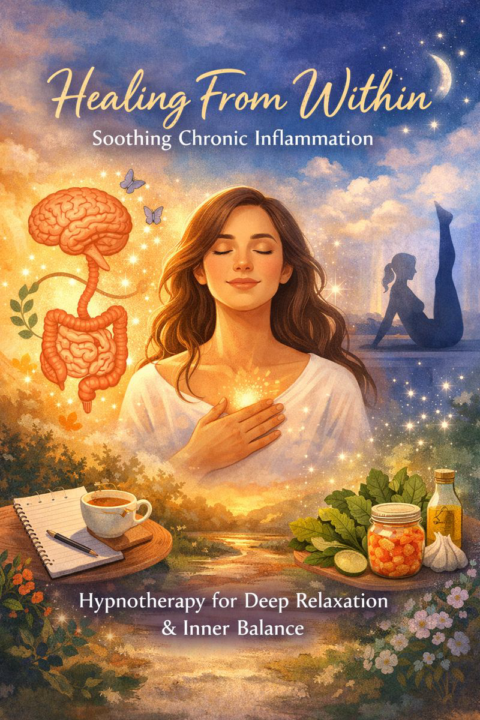
Inflammation is often spoken about as if it is an, something to eliminate, suppress, or defeat. We picture swelling around an injury, redness on the skin, a sudden flare that demands immediate action. Yet for many people, inflammation is not loud or obvious. It is quieter, more constant: a low-grade inner heat that shows up as brain fog, stubborn fatigue, aching joints, digestive discomfort, or a mood that feels stretched thin. When it lingers, it can feel like the body has turned against itself. But a different perspective changes everything. Rather than a sign of failure, chronic inflammation can be understood as a protective signal—an intelligent response that has become stuck. At its core, inflammation is the body’s attempt to keep us safe. It is part of the immune system’s natural design: a rapid-response team that mobilises when the body perceives threat. The problem is not that the body protects us; the problem is when the body cannot stand down. When the stress response stays switched on, day after day, month after month, the immune system may remain in a defensive posture, producing inflammatory signals long after the original danger has passed. In this sense, chronic inflammation is less like an invader and more like a fire alarm that keeps ringing. The aim is not to smash the alarm, but to understand why it will not stop. This is where the mind and nervous system become central. The nervous system acts like a thermostat for the body’s inflammatory state. When we are in “fight or flight,” the sympathetic branch of the nervous system is dominant. In that state, the body prioritises survival: alertness, speed, vigilance. It diverts energy away from repair and digestion, and it increases the production of chemical messengers that help the immune system stay ready for action. This is useful in short bursts. It becomes costly when it becomes chronic. A body that lives in high alert is not a body that can fully heal. If safety is the missing ingredient, then safety becomes medicine. This does not mean life must be perfect before the body calms down; it means the body needs repeated experiences—small, consistent ones—that signal “the threat is over.” One gentle way to do this is to train attention toward what can be called “glimmers”: tiny moments of ease, beauty, warmth, or connection that tell the nervous system it can soften. A warm cup of tea, sunlight on the floor, the sensation of exhaling slowly, a kind message from a friend—these are not trivial. They are biological cues. They help the body step out of defence and into regulation. Another practical tool is the simple act of writing.
1-15 of 15
powered by
skool.com/joyful-mind-community-4081
The Spiritual, Practical community for Manifestation and Meditation Mastery. Build confidence & purpose. Teacher Training available. Join FREE!
Suggested communities
Powered by