

2d •
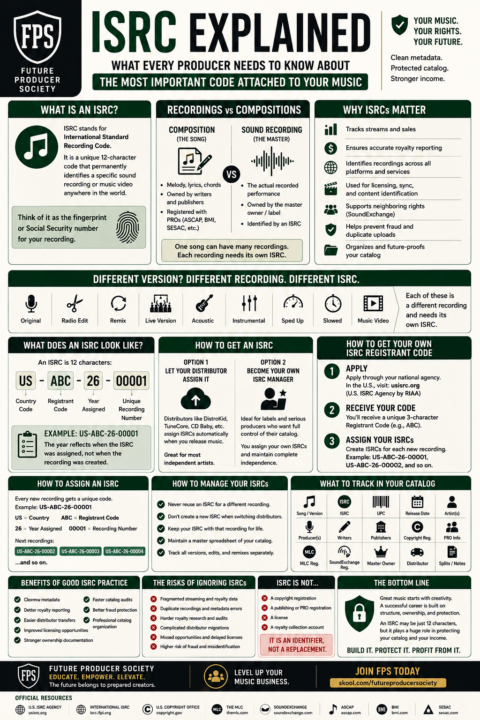
ISRC Explained: What Every Producer Needs to Know About the Most Important Code Attached to Your Music
If you've ever distributed a song through DistroKid, TuneCore, CD Baby, Symphonic, or another distributor, you've probably noticed something called an ISRC. Most producers see it, accept it, and move on. The problem is that very few creators actually understand what an ISRC is, why it matters, or how it affects their ability to collect royalties, organize their catalog, and prove ownership of their recordings. In today's AI-driven music industry, understanding metadata is no longer optional. Your music is competing in an ecosystem where millions of tracks are uploaded every month, and every recording needs a digital identity that follows it wherever it goes. That's exactly what an ISRC does. What Is an ISRC? ISRC stands for International Standard Recording Code. Think of it as the fingerprint or Social Security number for a sound recording. Every commercially released recording receives its own unique ISRC that permanently identifies that recording anywhere it appears in the world. Whether your music is streamed on Spotify, sold on Apple Music, licensed for television, uploaded to YouTube, or distributed to dozens of digital platforms, the ISRC is one of the primary identifiers that tells the industry exactly which recording is being used. One of the biggest misconceptions among independent artists is believing an ISRC identifies the song itself. It doesn't. It identifies the recording. That's an important distinction. Songs and Recordings Are Not the Same Thing Imagine you write a song called Never Looking Back. That song is the composition. Now imagine you create: - The original studio version - An acoustic version - A live version - A remix - An instrumental - A radio edit - A sped-up version - A slowed version They're all based on the same composition. But they are different recordings. Each recording should have its own ISRC because each one represents a unique master recording. This is why you'll often hear music professionals refer to "the composition side" and "the master side."
5d •
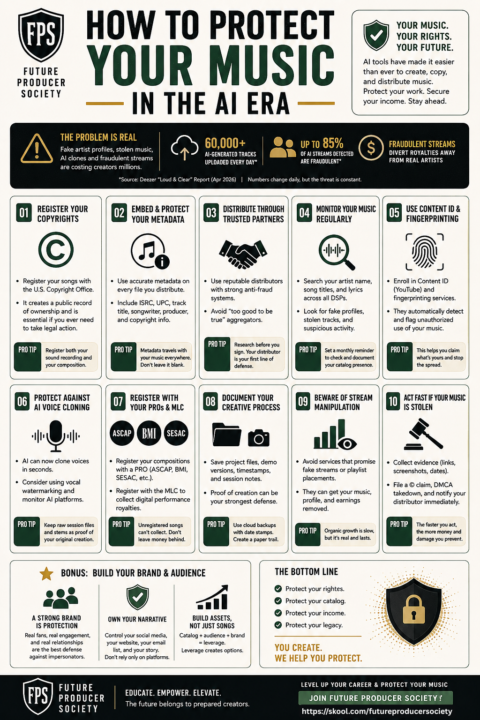
How to Protect Your Music in the AI Era
AI is creating incredible opportunities for producers—but it's also creating new ways for your music, identity, and income to be exploited. Every week we're seeing: - Fake artist profiles - AI voice cloning - Stolen uploads - Metadata abuse - Stream manipulation - Copyright confusion The good news? Most of these problems are preventable if you build your music business the right way from the beginning. That's why I put together this infographic. Inside you'll learn 10 practical steps every producer should be taking right now to protect their catalog, rights, royalties, and long-term career. Remember: Your catalog isn't just music. It's an asset. Protect it like one. 👇 After reading it, let me know: Which of these 10 steps have you already implemented, and which one surprised you the most?

24d •
Sometimes Growth Looks Like Stepping Back.
I’ve taken a step back from going live lately, not because I’m quitting, but because I wanted to spend some time sharpening the foundation. Going live consistently taught me a lot — discipline, finishing beats, thinking on the fly, trusting my ears, and learning to create without overthinking everything. Now I’m in a season where I want to understand the music deeper, so I’ve been spending more time studying theory and really learning the “why” behind what I’m hearing. I think sometimes growth isn’t always about doing more publicly. Sometimes it’s about stepping back, learning, and coming back stronger. Curious… has anybody else ever taken a step back creatively just to level up in a different way?

May 16 •
130s
I want to bring back big booty miami bass...this is the vibe I'm going for. Also the fact that it cuts off at the end on purpose LOL..

1-20 of 20

skool.com/futureproducersociety
A community for producers mastering the music business, AI tools, royalties, and modern strategies to stay ahead in today’s evolving industry.
Leaderboard (30-day)
1
+8
2

+4
3

+2
4

+1
5

+1
Powered by