
Write something

3d •
Can't Kneel? Here's How to Get Up from The Floor Easily
Getting up from the floor can feel harder for some people, but there are techniques that don’t require kneeling. In this video I show a simple way to stand up more comfortably and with less effort. Try it and tell me in the comments: was this easier than your usual way?

5d •
Struggling to get up from a chair?
Standing up from a chair becomes harder for many people over time, but small adjustments can make a big difference. As a physical therapist working in a nursing home, I see daily the struggle that standing up from a chair can be and how certain things make a difference. Try these 3 tips: 1. Scoot forward in the chair 2. Bring your feet back behind your knees 3. Lean forward as you stand (nose over toes!) Simple changes like these can make movement feel easier and more efficient because we no longer have our center of mass behind our base of support. In any case, remember that no tip replaces strength! Which tip helped you (or those around you) the most?

16d •
🚨 One Simple Test That Won't Cost You An Arm And A Leg
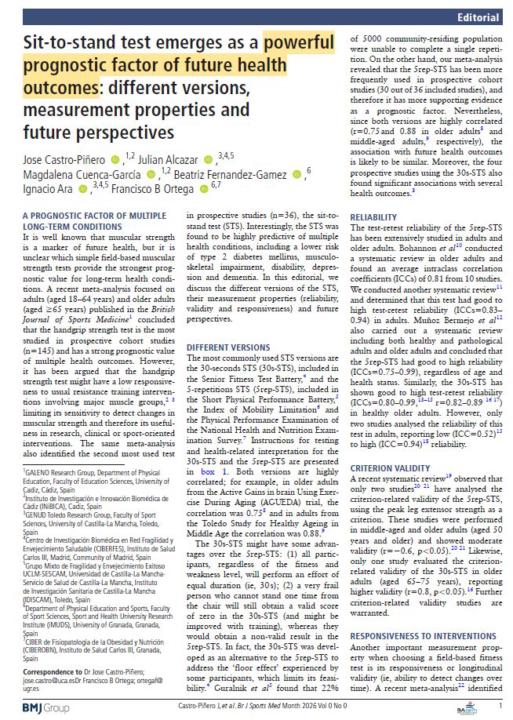
Most people think you need costly scans and advanced lab tests to understand your long-term health, but one of the most useful indicators might be something much simpler (and doesn't cost a dime): The Sit-to-Stand Test! If you haven't checked the Functional Tests in Classroom yet, here’s how it works: sit in a chair and stand up repeatedly for 30 seconds. That’s it. It sounds basic, I know... But according to the British Journal of Sports Medicine, it could be one of the most effective and practical ways to measure how well someone is aging. Your performance on this test is strongly connected to: ✅ Fall risk ✅ Frailty as you age ✅ Cognitive decline ✅ Mobility & independence ✅ Balance & coordination ✅ Lower body strength ✅ Mortality risk Why does it matter so much? Because standing up from a chair requires multiple systems working together at once. It takes strength, coordination, stability, power, endurance, and control. Researchers are also finding this test is useful for tracking progress over time, especially when combined with resistance training. This is the clear example (and reminder!) not to underestimate simple health markers. Sometimes the most powerful assessments aren’t high-tech...They’re practical, repeatable, and (most important!) accessible to everyone. 💬 Have you ever tried the sit-to-stand test? Drop your score in the comments! Reference: Castro-Piñero J, Alcazar J, Cuenca-García M, et al. Sit-to-stand test emerges as a powerful prognostic factor of future health outcomes: different versions, measurement properties and future perspectives. British Journal of Sports Medicine, 2026.
18d •
You Can Exercise Every Day and Still Be Sedentary
🛋️⚠️ The “Active Couch Potato” is real. You can hit the gym 5x a week: do your cardio, lift weights, eat healthy… and STILL be sedentary. It sounds crazy, but it’s true. A lot of people train for 1 hour and then spend the remaining 10–12 hours of the day sitting: 💻 Working 🚗 Driving 📱 Scrolling 📺 Watching Netflix The problem? Sedentary behavior directly affects your metabolism and overall health. Too much sitting has been linked to: ❌ Poorer mitochondrial function ❌ Lower energy expenditure ❌ Worse cardiovascular health ❌ Increased risk of metabolic disease ❌ Higher risk of all-cause mortality Exercise helps counteract this by improving mitochondrial health, muscle function, blood flow, aerobic capacity, and much more and, of course, we can say that 'it's better than nothing', but training alone is NOT enough if the rest of your day is inactive. So yes, keep training hard…but also: ✔️ Walk more ✔️ Take movement breaks ✔️ Stand up often ✔️ Use the stairs ✔️ Stop spending your whole day sitting One workout a day doesn’t undo a sedentary lifestyle, your body needs movement regularly throughout the day so try to fit 'exercise snacks' in!

19d •
We Are Living Against Our Biology
Most people know movement is important but what’s interesting is that our bodies were literally designed for it! For thousands of years, humans survived through physical effort: walking, carrying, climbing, hunting, building... Movement wasn’t 'exercise', it was life. Now we’ve built a world where we can spend almost the entire day sitting: working seated, driving seated, staring at our phones seated, relaxing seated. The problem is not just aesthetics or fitness (this is important because many people still see training as something purely aesthetic) ... Our biology hasn’t caught up with our lifestyle. Back in the 1950s, epidemiologist Jerry Morris studied more than 30,000 London transport workers. He compared bus drivers, who spent most of the day sitting, with conductors, who were constantly moving through the buses. Same company. Similar schedules. Similar demographics. The major difference? Movement! The results were clear: workers with more daily physical activity had significantly lower rates of cardiovascular disease and lower mortality risk. Simple, but powerful. Today we also add ultra-processed food, chronic stress, alcohol, smoking, lack of sleep and lack of social support or meaningful relationships... And then we wonder why energy, health, and quality of life decline over time. Exercise is not punishment and it's not optional optimization either. It’s one of the most fundamental biological signals our body expects to receive. You don’t need perfection but your body needs movement more than your mind thinks it does. What’s currently the biggest challenge for you when it comes to staying active consistently?
Poll
3 members have voted
1-5 of 5
powered by
skool.com/eva-guerrero-8458
For middle-aged adults who want to rebuild mobility, strength and balance so that they never lose their independence and end up in a nursing home.
Suggested communities
Powered by