

🔥
7d •
The Potomac Collision (systemic silence)
One of my roles within Defence is HF/ NTS facilitator (Human Factors / Non-Technical Skills). It means working with aircrew, maintenance, ATC and support agencies to understand the human nature behind serious accidents. I'll share some with you. I hope the tone isn't too dark. Nobody crashes a plane with one mistake. In the Potomac collision, an American Airlines passenger aircraft and a US Army Blackhawk helicopter crashed into each other, resulting in 67 fatalities. The airliner was on final approach to land at Reagan International Airport, a stone's throw from the White House. The helicopter was on a military training flight. The NTSB didn't find a cause. They found a chain. A faulty altimeter. Separate radio frequencies. A controller managing two jobs at once. A missed instruction. A course correction that didn't happen. A helicopter route that left 75 feet between military and civilian aircraft on final approach. Seventy-five feet. In the busiest airspace in the world. Here's what makes this so hard to catch in real time. Each of those factors, assessed on its own, looks manageable. They sit comfortably below the line. None of them a showstopper. Together, they bulk up as aggregate risk: the point where individually acceptable conditions stack into collectively catastrophic ones. The risk isn't in the single piece. It's in the accumulation. And the accumulation happens quietly. Nobody sounds the alarm because at each step, nothing looks alarming. The system appears to be coping. Work is getting done. The checks are passing. "We've always done it this way." "It'll be right." "No one said anything last time." That's not reassurance. That's a whole lot of aggregate risk building. The question isn't whether your workplace has these stacking conditions. I can assure you, it does. Every workplace does. The question is whether anyone is trained to see the pattern forming. To look across the whole picture, not just their piece of it. Human Factors gives you that view. Throwing a HOP lens over the top gives you that view. They’re not just courses you attend. They’re a way of looking at the world that makes you dangerous to complacency.

🔥
Jan 31 •
Normalisation of Deviance
Some of you may consider this a bit heavy for a Saturday night. If it is, I apologise. I've been meaning to write about this all week, but my schedule never allowed it. This week marked the 40th anniversary of the Space Shuttle Challenger disaster. 28 Jan 1986. I'm afraid I remember it really well. I was 13, absolutely infatuated with anything to do with aviation and space, and my Mum burst into my room in the morning, woke me up and tells me that the Space Shuttle had exploded. I was absolutely shocked, and could only think of the teacher who was famously on board as a passenger, Christa McAuliffe. What would her students be going through right now? It was my first exposure to utter disbelief and sorrow. Years later, as an Air Force aircraft technician, our group studied the human factors behind this disaster. We quickly realised the investigation had made an uncommon theory quite suddenly very famous amongst investigators. “Normalisation of Deviance” Described by Columbia professor, Diane Vaughan, “Social normalisation of deviance means that people in a group get so used to doing something wrong that they don't see it as wrong anymore, even if it breaks their own safety rules Let me explain it another way. Imagine there is a road on your way to work that you always go a little bit faster than the speed limit. You never get caught, so every day you continue to exceed the speed limit on this bit of road, sometimes going dangerously fast. This is deviant behaviour. Your safety is at risk, but your everyday risk assessments allow you to think it’s ok. Until one day, the conditions aren’t ideal, you skid off the road and cause a terrible accident. That's Normalisation of Deviance. The engineers who built the solid rocket boosters for the Space Shuttle also knew there was a problem with their design. A primary O-ring sealing rocket fuel in one of the massive solid rocket boosters has had previous faults. The engineers all know about the fault. Due to contractual pressures, they continue to assess the risk of failure as low. On the day of Challenger launch, the conditions aren’t ideal. Unseasonal cold, icy weather hardens the o-ring, making it brittle. 73 seconds after launch, it fails, causes a leak in the SRB and explodes, destroying the entire Space Shuttle, killing 7 astronauts. That's Normalisation of Deviance.

🔥
Jan 10 •
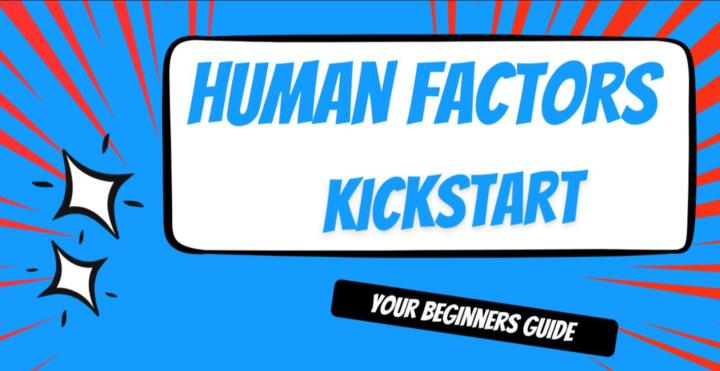
Human Factors Kickstart Course Offer
I’ve got a special offer for all of you lifelong learners. How does FREE access to the Human Factors Kickstart course that is in my classroom sound? In order to make the best quality course, I need some users to test it for me, so I can improve it off your feedback. @David Ferris has had a look and provided some valuable information, which has been so useful. Thanks heaps mate. I truly appreciate it. So far, I have built two modules. 1. Introduction to Human Factors 2. How our Human Information Processing System works If you’re interested in learning and helping shape the rest of the course, reply with a YES and I’ll provide the access for you. Another benefit you can all get is the absolutely awesome Skool affiliate commission💰💰that Foundation Members get when they share the course with friends and colleagues. You’ll get 30% when they purchase, so the more people you tell, you get a little WIN! 💵 This is the same course that has made aviation the safest industry in town. Critical roles like Aircrew, Maintenance and Air Traffic Control have received Human Factors training as a staple foundation for years and years. It has recently been making its way into Healthcare with frontline feedback showing it has saves thousands of lives. Construction, mining and other High Reliability Organisations are using it more and more as well. I’ve seen Private Hospitals turn this training down based on its expense (it’s actually always been a fairly low cost course) while other Public hospitals have embraced it and measurably reduced accident injury rates. So reply with that YES and Ill open up the course for you…
2
0
🔥
Oct '25 •
Kickstart Course is proceeding well
G’day everyone! This week I’ve managed to get one and a half modules for the HF Kickstart course online. How do you feel about taking a look for me?


Oct '25 •
Accident Investigation
Have you ever wondered why preliminary accident investigations are concluded relatively quickly, whereas the final report often requires months or even years to complete? When an accident occurs, the first priority is to determine what happened. This part is relatively straightforward — with today’s technology, such as the Cockpit Voice Recorder (CVR) and Flight Data Recorder (FDR), along with other available evidence, investigators can usually establish the sequence of events quite quickly. However, uncovering why the accident happened is a far more complex and time-consuming process. This stage often involves a deep examination of human factors — psychological, physiological and organisational influences that may have contributed to the event. I’ll leave the discussion here for others to share their insights and elaborate on the specific factors that can play a role.
1-9 of 9
skool.com/crewfusionacademy
Understand human behaviour
Build leadership value in your team
Build better workplaces with:
Human Factors
Human Skills
Safety Differently
Leadership
Leaderboard (30-day)
1

🔥
+36
2

🔥
+22
3

+16
4
+2
Powered by