
Write something

Apr 7 •
Your code ships. Your ideas don't. Here's why.
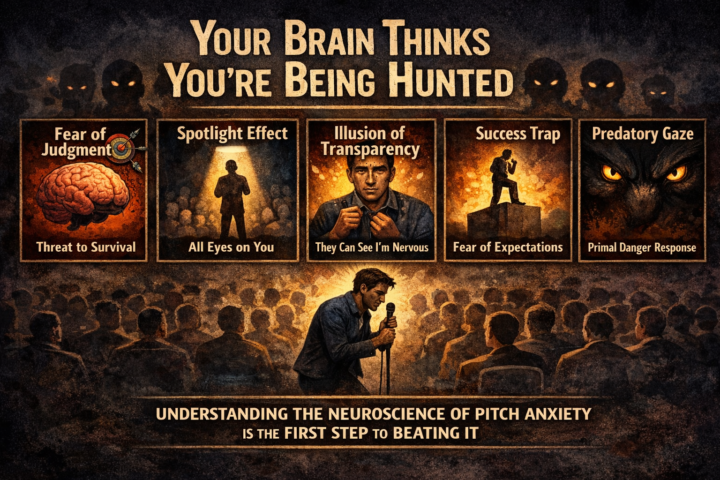
75% of professionals experience public speaking anxiety. In technical roles, that number is even higher — one study found over 56% of future technical professionals show moderate to high speech anxiety. You can be the smartest person in the room and still lose the room. Here's what your brain is actually doing — and why it's not a weakness. 1. Fear of negative evaluation The fear of being judged harshly by peers — especially in rooms full of people who know their stuff — is the primary driver. The more expert the audience, the higher the perceived stakes. 2. The Spotlight Effect You stumble over one word and assume everyone noticed. They didn't. Research shows audiences are focused on the message — or their own thoughts — not your filler words and hesitations. 3. The Illusion of Transparency You feel panicked inside, so you assume it's obvious. It isn't. Studies show internal physiological states are largely invisible to observers. Knowing this alone has been shown to measurably improve performance. 4. The Curse of Knowledge You think the audience knows you skipped a slide or lost your thread. They don't. They have no access to your internal plan — only what you actually said. 5. The Brain Freeze Cortisol — the stress hormone — can physically disconnect your prefrontal lobe from the rest of your brain under pressure. This is why even the most prepared engineer can go completely blank mid-presentation. It's biology, not incompetence. 6. The Evolutionary Threat Response Your brain hasn't caught up with the conference room. Multiple pairs of eyes fixed on you trigger the same primal threat response as being watched by predators. The fight-or-flight system fires whether the audience is investors or a room of your own colleagues. Here's the real cost: research is clear that public speaking proficiency often matters more than technical skill for career advancement. The engineer who can't present their ideas doesn't advance. The one who can, leads. The gap between technical excellence and communication confidence is where careers stall — and where they accelerate.
0
0
Apr 5 •
Three Communication Trends That Flipped This Week (And What They Mean for Tech Leaders)
I track what's working in leadership communication content across YouTube, HBR, Stanford, and top channels. This week's trends were... surprising. 1. "Speaking Less" Just Beat "Speak Up" 🤐 Stanford research just went viral: strategic silence increases perceived influence more than speaking frequently. The old advice was "contribute more in meetings." The new reality? Timing > volume. Tech leaders who speak less but nail the moment are getting promoted faster than the verbose ones. Why it matters for us: If you're naturally introverted or come from an IC background, this is your superpower. The game changed. 2. Executive Presence Can Actually Backfire 🎭 HBR just published "When Executive Presence Backfires" — and it's getting massive traction. The behaviors that got you promoted (bold, confident, decisive) can isolate you at senior levels. The "command the room" energy that worked as a manager reads as unapproachable when you're leading leaders. The twist: Vulnerability and composure > confidence and charisma at the top. 3. 82% of High-Achievers Have Imposter Syndrome... And It Gets WORSE at Leadership Levels 📊 New research shows imposter syndrome doesn't fade with seniority — it intensifies. The more capable you become, the more you feel like a fraud. Why? Because the stakes are higher, the room is more senior, and you're dealing with ambiguity instead of technical problems you can solve. The opportunity: Competence-based charisma beats validation-seeking confidence. You don't need to "fake it till you make it." You need frameworks that let your actual expertise show. ─── 💬 Question for the group: Which one resonates most with your current challenge? A) Learning when to stay quiet (strategic silence) B) Softening your presence without losing authority C) Dealing with imposter syndrome at a new level Drop a letter in the comments. Curious where everyone's at right now. ─── P.S. If you want the detailed breakdown of what's working in leadership communication right now (titles, formats, content gaps), I can share the full research notes. Just shout.
0
0
Feb 28 •
How a 5-minute pitch changed the direction of my career
When I was building a tech startup, we got invited to pitch to a group of investors. Five minutes. That's all we had. We'd spent weeks on the deck. Every slide was perfect. Every number was sourced. It was comprehensive, detailed, and... completely wrong. One of the investors stopped me two minutes in and said: "I don't care about your TAM slide. Tell me why YOU are the person to build this." I put the clicker down and just talked. About the problem. Why we'd spent two years on it. What I'd seen in the Navy that made me think differently about it. That unscripted three minutes got us further than any polished deck ever did. The lesson I've never forgotten: People don't invest in slides. They invest in people. They invest in conviction. They invest in someone who clearly gives a damn. Whether you're pitching to investors, presenting to your board, or trying to get your team excited about a project — the moment you stop presenting and start talking is the moment you win. What's the most important thing you've ever had to pitch or present? How did it go? 👇
0
0
Feb 28 •
🔥 Hot take: Slides are a crutch. Agree or disagree?
I'll go first: I think 90% of slides make presentations worse, not better. Here's why: - They give the speaker something to hide behind - They split the audience's attention (reading vs listening) - They encourage lazy preparation ("I'll just put my notes on the slides") - They create a false sense of structure The best presentations I've ever seen — and the best ones I've ever given — were either slide-free or used minimal visuals (a single image, a single number, a single word). The counterargument: Complex data, technical topics, and large audiences sometimes genuinely need visual support. Fair. But here's my test: If you deleted every slide, could you still give the talk? If not, you don't know your material well enough. What do you think? Am I being extreme, or do you agree? 👇
0
0
Feb 28 •
Quick Tip: The 3-second rule that changes every talk
Most people start a presentation the same way: "Hi, I'm Andy, and today I'm going to talk about..." Boring. Forgettable. Everyone's already reaching for their phone. Try this instead: The 3-Second Rule. When you get to the front of the room, don't speak immediately. Stand still. Make eye contact with someone. Hold it for 3 seconds. Then start. Not with your name. Not with an agenda. Start with something that makes people lean in: - A question: "When was the last time a presentation actually changed how you think?" - A statement: "Everything you've been told about public speaking is wrong." - A story: "Last Tuesday, I watched a CEO lose a £2 million deal in 90 seconds." - Those 3 seconds of silence before you speak do something powerful: they tell the room you're in control. You're not rushing. You're not nervous. You're choosing when to begin. Try it in your next meeting. Stand up, pause, make eye contact, then speak. Let me know what happens.
1
0
1-5 of 5
powered by

skool.com/command-the-room-5647
Communication skills for tech professionals and leaders. Stop being overlooked. Start being heard.
Suggested communities
Powered by