
Pinned

Mar 15 •
Welcome to Clief Notes. Here's where to start.
1. Watch the intro video and introduce yourself in the intro post here 2. Start with The Foundation (free course). Concepts, folder architecture, prompting framework. Everything else builds on this. 3. Check in at the bottom of each lesson. Polls, discussion posts, other members working through the same stuff. Use them. 4. When you're ready to build real things, move to Implementation Playbooks (Level 2). When you're ready to build your own tools, Building Your Stack (Level 3). 5. Post your work. Ask questions. Help others when you can. What are you here to build?
Poll
6685 members have voted
Pinned
2d •
Where've we been? Plus a quick ask
Hey all. You've probably noticed it's been quiet in here the last couple weeks, wanted to explain. We've been building something for the community, and travelling at the same time to meet with investors and a few clients. We've also been busy getting the Lyceum ready. So less posting than usual, but for a good reason!! We're announcing the thing this week, and there'll be more info on the Lyceum coming out this week too. I think a lot of you are going to be happy. We've been grinding nonstop to get this ready. Before we do, we want to hear from you. If you're Premium or VIP, what's missing for you right now and what would you want us to add? If you're not Premium or VIP yet, what would actually make you want to upgrade? Form's here, takes about two minutes: https://forms.gle/MM8PLn2f6An1dfEUA It's open until Sunday June 21. Looking forward to reading everyones answers! Back soon with the news :)
Pinned

👑
⭐
1d •
Did Google Steal my research?
Personally. No I don't think they did, I think the researchers are discovering what I did already ! And I'm happy they are. I would love if you all could comment, share or tag Google in this though as I would love to work with them ! Video below. https://cloud.google.com/blog/products/data-analytics/how-the-open-knowledge-format-can-improve-data-sharing

2d •
Obsidian - Leverage of one Brain
The biggest trap for modern entrepreneurs right now is "platform lock-in." We stack our businesses with flashy tools, only to realize our most valuable asset—our data, our frameworks, our unique voice—is trapped behind a dozen different corporate paywalls and subscription models. Lately, Kevin and I have been leaning hard into building a unified digital brain using a completely different approach: Obsidian. For those who haven't tracked with it yet, Obsidian isn't another software trap. It is literally just a local lens that sits on top of a standard folder of plain-text Markdown (.md) files right on your hard drive. If the company vanishes tomorrow, your data doesn't change at all. We’ve been building with it. How We Are Leveraging It Right Now: One Source of Truth: Pulling our standard operating procedures, content frameworks, and vision into a single repository. It ensures absolute voice consistency across everything we touch. Modular Freedom: Because it’s just raw text files, we can swap out our workflows, tools, or automation scripts on the fly without any import/export friction. Future-Proofing for AI: This is the real chess move. Clean, linked Markdown is the absolute gold standard for feeding data into autonomous sub-agents and custom AI skills later. We are organizing the dataset now so our future tech stack can navigate it seamlessly. The Honest Reality (The Security / Setup Balance): Because it’s local-first, the core data is incredibly secure. No big tech company is scraping it to train public models. But it does mean you own your infrastructure: The Risk: Relying on basic cloud syncing (like iCloud or Google Drive) drops you back into their ecosystem. The Fix: Using local, peer-to-peer syncing or private Git repositories keeps your data entirely yours. Stick to trusted, audited plugins to keep the environment locked down. How Are You Keeping Control of Your Data? Are you already using Obsidian, Notion, or just raw Markdown folders? How are you structuring your knowledge base so it's actually ready for future AI agents without sacrificing your privacy?

40m •
The Email That Vanished
A friend who does IT for a living — and helps small businesses on the side — brought me a client's problem: their email had quietly stopped reaching Gmail. Every diagnostic tool said the setup was perfect. It wasn't. I wrote up the full fix and gave away all of it — every record, every gotcha. Because the *what* was never the hard part. The hard part was the *how* Quiet AI organized the solve: it read four layers of live infrastructure at once, spotted the one that was lying, and had the answer in minutes — on a problem that had been stuck for weeks. That's the part you can't lift from a checklist. It does nothing magical. It makes the right move obvious, fast, and quiet — then the email goes through and nobody sees the machinery. Invisible competence, job done. Full detective story (sanitized) 👇 https://medium.com/@gabeyoga/the-email-that-vanished-3a78e1a70df6?sk=50bba8bd11104c317a390d6ce8f13fcb My friend was rather blown away by how I was using "AI."
1-30 of 1,810
skool.com/cliefnotes
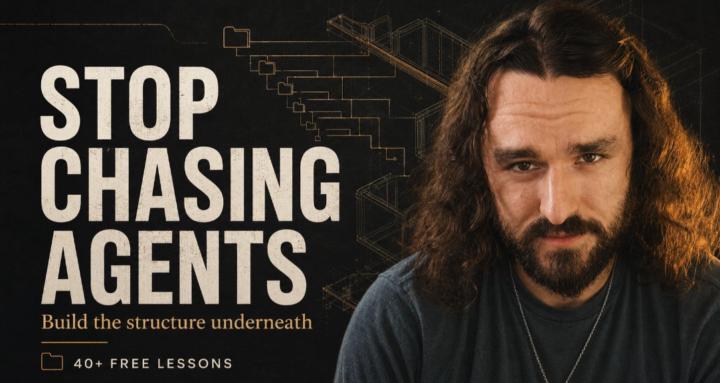
What we give away free beats most paid courses. Build durable AI systems with a Marine vet and Edinburgh researcher. 40+ lessons, growing.
Leaderboard (30-day)
1

🔥
+1885
2

+1453
3

+1422
4

+641
5

+444
Powered by