Activity
Mon
Wed
Fri
Sun
Oct
Nov
Dec
Jan
Feb
Mar
Apr
May
Jun
Jul
Aug
Sep
What is this?
Less
More
Chase AI Community
78.5k members • Free
Decster - Agents for Skoolers
220 members • Free
The Gut Mechanic
12 members • Free
Constellations
102 members • Free
Clief Notes
48.4k members • Free
337 contributions to Clief Notes

May 3 •
The Folder System Became My Agency
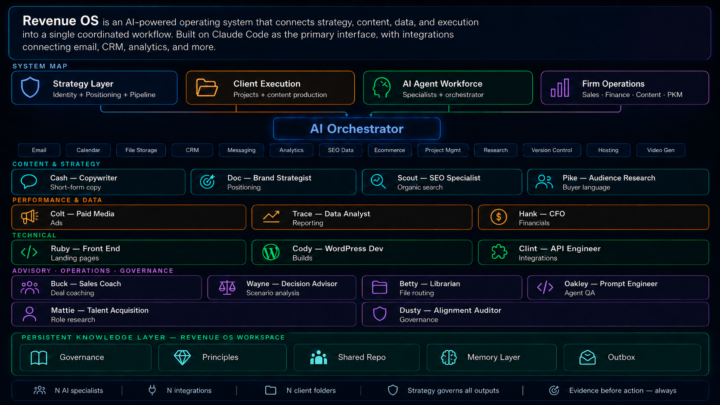
Twenty-four days ago I posted about Jake's folder system video. This is what happened next. Same foundation — markdown files, orchestration prompts, clear roles. I just kept building. Fifteen named specialists. Each one with a soul file, guardrails, and a playbook. Duke orchestrates. Cash writes. Trace pulls the data. Hank runs the financials. Clint handles the MCP integrations. Behind each one is either a human counterpart doing the real work alongside them — or a role I can't afford to hire yet. Katie who's been with me for 18 years, now has her own orchestrator running the same system. Twenty-seven client folders. Twelve live MCP integrations. One shared repo. The folder system isn't replacing my agency. It becoming my agency. Jake gave me the unlock. This is how it's going.
1 like • 2d
@Cees Q it doesn't contradict ICM, at least Jake hasn't said so. We went through this on this post here. https://www.skool.com/cliefnotes/agents-as-folders?p=38957cdd
0 likes • 1d
@Fabien Pochez we all write to the shared repo for client work. Everyone uses claude desktop or chatgpt at times for various tasks but work that needs logged happens in the ICM.

4d •
As A Small Business Owner, It Took 5 Months For ICM To "Click"
After 5 months of being in this community, I finally caught the ICM flu... I didn't catch it the first month--we were just having a good time back then. I didn't catch it the second month, either. Those were the "lego" days, and still long before it would really click. I didn't even catch it when I started a second company 6 weeks ago, that I built after being inspired right here in this community. For 5 months, I was vibe coding. Up late, up early, like a middle schooler with a new video game, like the internet just became a thing for the first time... I thought that was the thick of it. No. Oh no.. No, no, no, no, no, no. There are levels, boys, there are levels... I caught the ICM flu once I made a widget that an actual client used. And then it finally clicked. Software. Agents. Human. You can just build a whole foundation for any company using this method. Which, sure, yes, we know that. But, realizing that once you got it... once you've built that first widget, that first workflow tied to a piece of software you coded and an agent you made, you realize... that's the whole thing. Do it once, do it a thousand times. Recycle, reuse. We're all software developers now, baby! About 2 weeks after it finally clicked, I joined the Lyceum because I understood the value of this finally. It does not matter what you plan to do--these skills transfer to ALL SORTS of things. Software, Agents, Human... just apply it to.... anything! As a side note, I have already received value after the first Lyceum session. I finally can see how I can transform my little house cleaning company into a mega machine and create the dream vision I have for this company. FOR ANYONE THAT SAW MY ANNOUNCEMENT ABOUT STARTING A COMPANY... This is going to sound nuts, I know, but Im shutting down the company I just made despite the fact that it's working. I can now see that the greatest play, and most value I can create, is going to come from the company that I have so much experience in already, and not the one that I have limited experience with. My judgements and tastes are strong where I've spent a ton of time already. Really, I have 3 lanes I've spent the majority of my life in, and I've decided I need to see those through at this point because I have way too much specialized knowledge to not do something with it. *And that's the secret sauce.*
5 likes • 3d
Bravo @Ruby Sparks, it sounds like you're making the right move.
Apr 8 •
Eight months of infrastructure. Two weeks to simplify it.
Eight months ago, I started building what I thought orchestration required — N8N, Postgres, LibreChat, consulting and hosting fees. Tens of thousands of dollars. That was the right bet at the time. Nobody I saw was doing this with Claude yet. Three or four months ago, the game changed. And I didn't know it until I stumbled onto Jake's content on YouTube. Two weeks after watching "Stop Building AI Agents. Use This Folder System Instead", I have a working MCP. Client demo-ready. The whole system I was killing myself over? Markdown files and orchestration prompts. That's it. I want to give credit where it's due. Jake put something out that reoriented how I thought about AI. The investment wasn't wasted — it built the foundation. But Jake and this community pointed me toward what was actually possible now. If you're still building the complex version because you think you have to — it's worth a second look.
0 likes • 3d
@Cody Guluk I also found Jake through YouTube back in March. You're right though, we were looking for answers and Jake gave us answers not fluff.
0 likes • 3d
@Doug Bittinger keep learning. A lot of smart people in this community if you reach out.

9d •
Anthropic vs OpenAI for Writing?
I've been in Claude since early this year because, well, Claude was just better. Seems like a bunch of folks are jumping ship (back) to OpenAI with 5.6 and Astra releases. I haven't had the time to do any testing. What's your experience? Anyone compared the writing capabilities between the modern OpenAI models and say Opus 4.8 or Sonnet 5? I've started a 70 article series on Substack and LinkedIn so I'm not switching midstream for that. Just curious Ari convinced me to look at Grok 4.6 so I'm testing that as well but for coding only.
1 like • 9d
Claude has gotten sloppy lately. Not impressed with latest models. Outside of our own custom instructions I’m now running most writing through codex after Claude. Then give Claude back what codex fixed before I proof read and manually edit myself. For emails Gemini really helps correct some things that get too wordy, and grammarly helps in a lot of long for documents. I’ve been impressed by codex results lately. I often have the two have a conversation with each other to work through a problem.
10d •
Your 60% Is Documented. Is It Load-Bearing?
Simon Sinek's Golden Circle asks why you do what you do. You probably already have an answer for your own system. It's in an ICM somewhere. A values doc, a mission file, the folder that says what it's for. A COO I work with asked a different question on a call last month. He wasn't asking why his team ran performance reviews. He was asking what would happen if they stopped. Nobody in the room could answer. Those are two different tests. Sinek's question checks whether you can articulate a belief. The COO's question checks whether that belief is load-bearing. You can pass the first one in a conference room with nobody watching. You can only pass the second one by pointing at what actually breaks. That COO had a month of build-versus-buy behind him. Platforms compared, discovery calls stacked up. Then he asked one question, and the room went quiet. Nobody had ever tested whether their reasons for running reviews would hold up under questioning. Take whatever you've documented about why a process exists and ask what specifically breaks if you stop doing it. Name a consequence you can check: a number that moves, a decision someone makes differently, a person who acts differently on Monday. If you can name it, you have a claim to test. Then look for evidence that the process produces that result. If you can't, you haven't established what the process does in practice. @Jake Van Clief's ratio describes database queries, logic, and AI calls. I apply it as an analogy to people and process. The ratio is his. A client forced the load-bearing test on me, not the other way around. If you want to run it against your own 60%, I'm happy to talk it through. The full article, The Tool Is Ten Percent, is in David's classroom.

1 like • 9d
@Jay Mena good analogy.
3 likes • 9d
@Matthew Smith the question is being asked by a COO, not an operator. It's his call to make, he needs to look at the business and make a judgement call.
1-10 of 337
@curtis-hays-2010
Catalyst helping businesses find the truth beneath their growth problem. Agency founder. Podcast host.
Active 1d ago
Joined Apr 2, 2026
INTP
Michigan
Powered by