
Write something
Feb 5 •
16 Methodological tools for solving every passage
Hi, group! Almost a year ago I started writing a small "booklet" compiling the most effective tools I use and teach my students to use for solving methodologically any passage's difficulty either technical or musical. These are tools that many of us use most of the time but I never saw them all together systematically explained. The pdf was first distributed in spanish with great feedback from all over and I have now translated it into english and share it with you. The text is Creative Commons License. I'm not in the bussiness of monetizing my materials. I prefer to share with everybody, but if you think it is useful and want to contribute to the cause I won't get mad about it. Just let me know. You are free to use this as you see fit, share it with whom ever you think may profit from it and teach from it, if you think it is adaptable to your teaching process. I have posted some videos in my Facebook and Instagram pages (in spanish) about the uses and reasons behind each tool and you are welcome to look for them. I´ll probably also upload them to Youtube in a while with subs. I hope you'll enjoy them. Feedback is very welcomed!!
Dec '25 •
Pepe Romero Masterclass Video
Pepe Romero conducted a Masterclass on Monday evening, at Guitar Salon International in Santa Monica CA. Program: 1. Tiento Antiguo by Joaquin Rodrigo - performed by Arturo Solorzano 2. An Malvina, from “Bardenklange” by Johann Kasper Mertz - performed by Juri Yun 3. Homenaje by Manuel de Falla - performed by Brady Davis 4. En Los Trigales by Joaquin Rodrigo - performed by Pietro Ruscigno 5. Three forest paintings: “Snowdrop“ by Konstantin Vassiliev - performed by Eduard Hrmushyan 6. Lullaby by Clarice Assad - performed by Doris Ćosić This event is sponsored by TeacherNet, Guitar Salon International, the GSI Foundation and is organized in collaboration with the classical guitar department of the USC Thornton School of Music. https://www.youtube.com/live/4zkexUdlu10?si=OUk33z07oXRCe2ff
Sep '25 •
Recovering from other activities before practice
I'd like to start my last practice session of the day right now instead of posting this message, but one thing I've learned this year is that fatigue affects my playing (even if it involves different muscles), and I just finished a moderate session on the weight bench, so I'm giving my body at least 15 minutes to recover first. I'm not sure if this is wisdom or just an aging body talking.

Sep '25 •
The Best Way to Practice "Difficult" Runs?
I am teaching myself Villa-Lobos' Prelude No. 3. I am sure that most of you here have played that. In the first section, there are three "runs". In the Eschig version of the score, they occur at measures 3, 8, and 18. I was watching Julian Bream's masterclass on the VL Preludes, and he said that these "flourishes" should be played at a pretty quick tempo. So, I spent a half hour today practicing the first run, starting at a slow tempo and working my way up. I still do not have it at Bream's tempo, but I would like to work my way up to it. My question to you good folks ... how much time do you usually spend learning a challenging run? Do you practice a single run at a time, or do you change between the different runs? Is 30 minutes too much time to spend in a single day on 12 16th notes? My goal is to try to commit the run to muscle memory so that it is second nature. After a while of practicing, I just closed my eyes and tried "feeling" the run to see if my fingers memorized the pattern.
Sep '25 •
Adding section labels
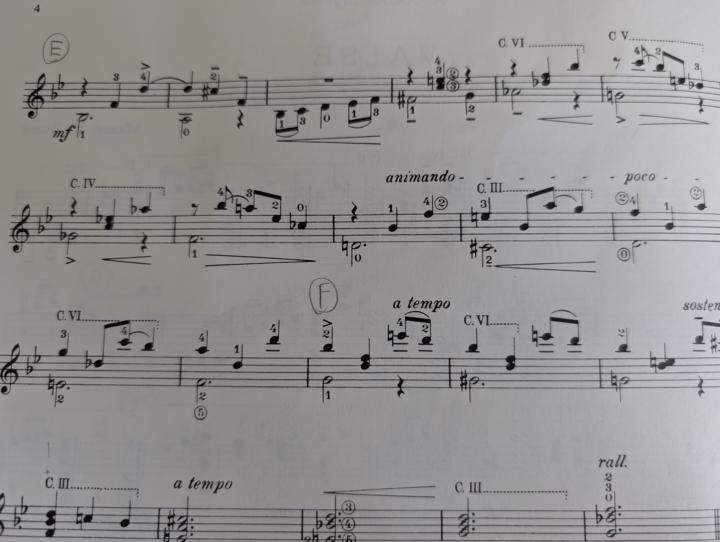
If you've ever played an orchestral instrument, you'll be familiar with section labels (usually uppercase letters) in the scores, marking the beginning of major passages. The conductor will just say "Let's take it from C" or "two bars before F" and everyone knows exactly where they are. I decided to try penciling those into some of my scores to help with practicing. I don't need them for coordination (since I'm solo), but 1. They help me plan my practicing. 2. They make it easier to log what I did in my practice diary. 3. They make the musical structure more visible (those are obvious places to change timbre, stroke, etc). 4. They're already standard notation in sheet music, so they feel familiar. I'll likely move them around a bit by trial and error.
1-10 of 10
powered by
skool.com/classical-guitar-community-6420
A community to help Classical Guitarists of all abilities grow and connect.
Suggested communities
Powered by