
Write something

18m •
Audit Day!
Don't forget to take care of your AI operating system... Mine's auditing meow. -> https://github.com/oathdriven/rymac-4r-icm-audit Always got your back, RyMac


7h •
Utilize Open Models ? Ran out of tokens mid-audit…
Sunday audit day rolled around, so I fired up Claude Code to run the 4R audit across my workspace. Everything was cruising along, but if you've run a real audit across a deep folder tree, you know it checks everything—every rule, every "done" line, and every edge case. Mid-run, I hit the usage wall. Audit half-finished, terminal frozen, and I didn't want to wait around for the reset, so I coughed up the extra $3 for more usage just to keep the momentum going. That got me thinking: burning premium tokens just to have Claude read through dozens of raw files and terminal outputs is like hiring a master electrician just to sweep up wire scraps. So I started playing around with running open models through Ollama in Claude Code to act as the "scout," and it completely changed the workflow. The Setup: The Artifact Handoff Instead of letting Claude burn tokens reading the entire workspace, I split the job: 1. The Heavy Lifters (Kimi / DeepSeek) - kimi-k3:cloud: Great for long-horizon agent loops. It crawls the directories, tests edge cases, and logs open findings without dropping the ball mid-pass. - deepseek-v4.1-flash:cloud: With a massive 1M context window and high speed, it chews through massive workspaces in seconds. - The open model runs the discovery phase and dumps the prioritized punch list into a clean audit-report.md file. - The Finisher (Claude) - Exit the session, open a fresh terminal, and bring Claude in only to read audit-report.md. - No raw log bloat: Claude never touches the hundreds of files traversed or raw logs. It only sees a tight 2–3 KB report. - Zero wasted turns: Claude spends its context strictly on making surgical edits, fixing the broken rules, and running the verification test. Fast, cheap, and no hit on your limits. Anyone else playing with hybrid setups or open models for their ICM maintenance? How are you guys saving tokens during heavy workspace runs?

3h •
Framework Skills Automating Processes
I made some skills to integrate a project to an existing workspace. Also, from an already done project and structure it following the framework, already with skills with instructions. No guessing. I noticed there’s a lot manual work.. it was slowing me down. So, I wanted to automate the process. I have the frameworks and skills. Now, I tell the agent to do it. Created it so I can stay out of the loop as much as possible when needed. Unfortunately, there are bottlenecks to the framework which I solved or tried to solve, especially when scaling. I rather tell my agent set it up. Do this. Do that. I got enough quota for agentic workflows anyways. What have you done to solve these issues, problems, bottlenecks? Did you notice any? Even the original paper mentions the bottlenecks to the methodology. I take the best from it and started implementing what works for me and is more agentic and dynamic.
22h •
"Is My Site Live?" (Dad Update)
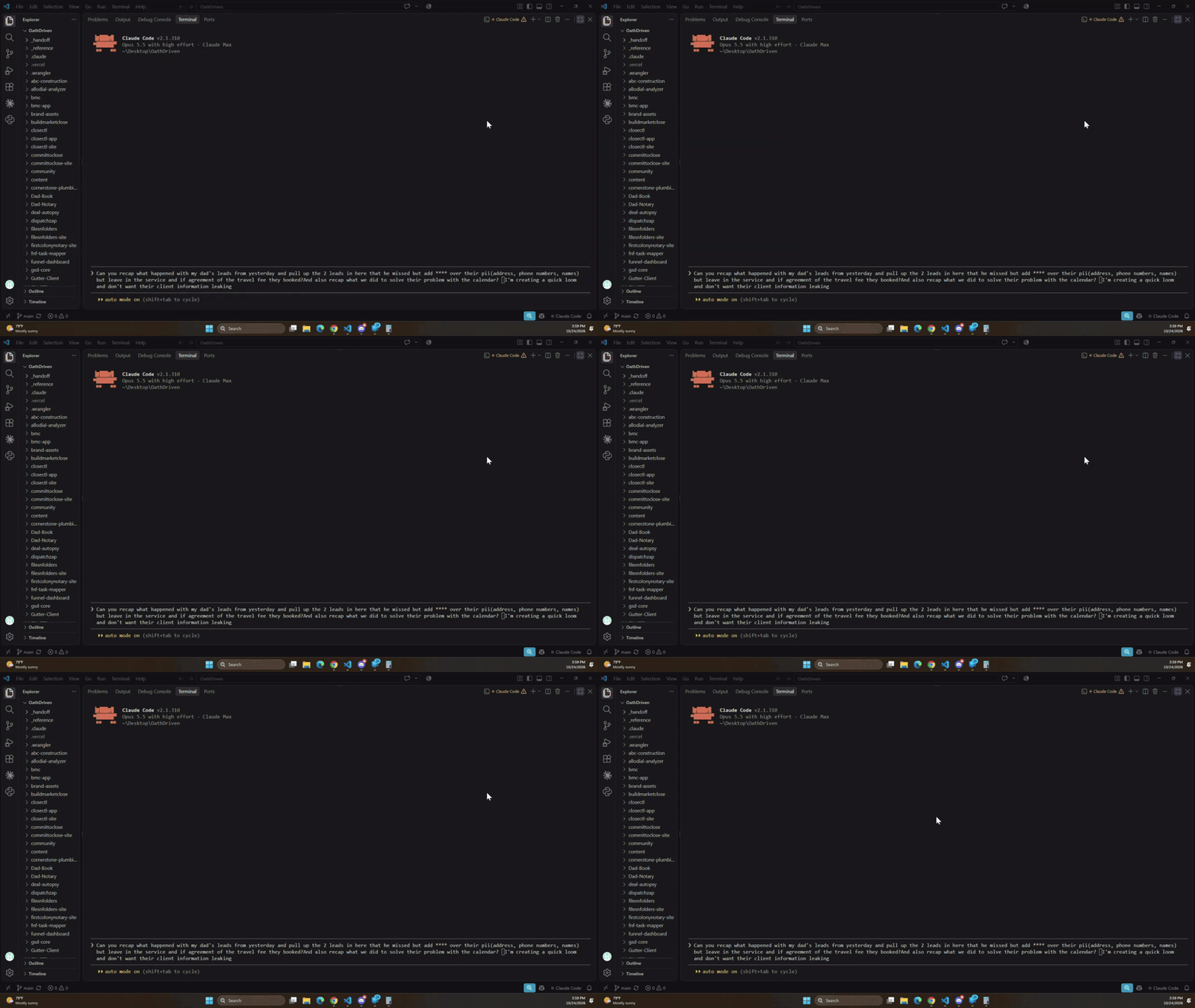
I was on a call with @Carlos Acuna working through some stuff with him and my dad called and opened with: "Is my site live?" I was confused because his site went live right at 2 months ago and I had explained that "I built it to convert and it will get found in the search engines and should be converting around 60 days from now..." The confusion came in because they have been knit-picking at version 2 on a vercel link... So I aggravatedly said, "yes, it's creeping up the search engines, why?" "Well, we had an e-mail from a booking we missed at noon", he goes on to explain. So, I asked Fred to look into it...and sure a shit: October, 18th and October 22nd - 2 self bookings for his mobile notary business. They came from Google. Back in August, I turned on my camera, and I built my Dad's site and helped him launch his business from scratch. Here is the post where I said I was going to launch it: -> https://www.skool.com/buildmarketclose/my-dad-called-me-today-slightly-frantic?p=37dd353d Part of that gameplan was him networking around the area (which came from Fred's research), so he wasn't relying on search traffic. I built a site with blog post, the same way I launched the car shop's site, and I told him it would be about 60 days give or take before you start getting found on Google. It took exactly 60 days from August 19th launch to October 18th self booking. I freakin' nailed it, I've been doing it long enough ... I can usually call my shots. By the way, everyone that is in premium and VIP has access to that business launch in the classroom here if you haven't went through that course yet. SO... He messed up his first 2 real bookings 🤣😭... BUT... It just goes to show you that I used free resources and a well built site designed to convert bookings and be read by search engines in just a few hours of "work"...
Jul 14 •
Introduce Yourself Below (Please & Thank You)
Yo! Drop your intro below. Where you're from and what whiz-bang(s) you have...or want to build, or don't have. Everyone is in different stages of life, business, etc. I'd like to get to know you. You will come to find out that I really enjoy hearing what you're up too. I'm always fascinated with the things humans can do and I want to know more about you Last question: Can you can triple stamp a double stamp?
1-30 of 219

skool.com/buildmarketclose
Learn to build , market , and close with a Marine Veteran turned serial entrepreneur that's been featured on EOFire using AI with Files & Folders.
Leaderboard (30-day)
1

+53
2

+50
3

+48
4

+39
5

+34
Powered by