
Write something

11d •
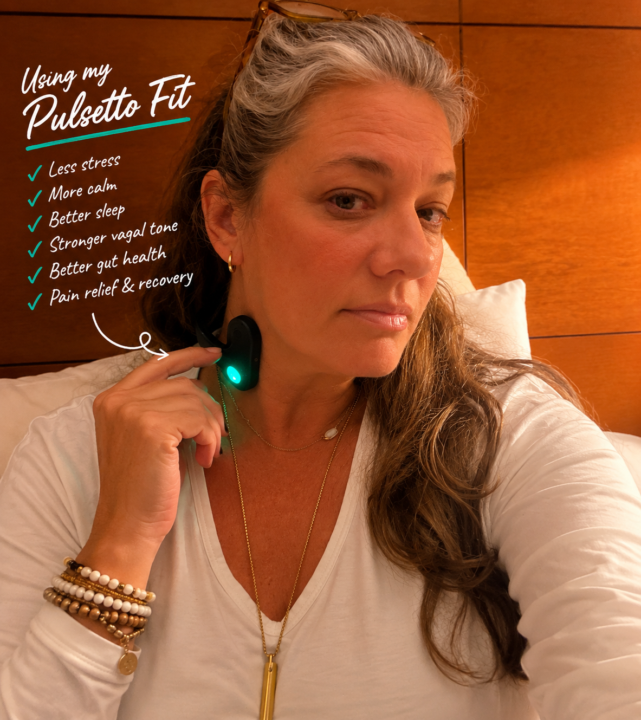
Why My Pulsetto Vagus Nerve Stimulator Is One of My Favorite Health Tools
How I use it for stress, anxiety, burnout, recovery, gut health, and nervous system regulation. If you’ve been around Bedrock Nutrition for any length of time, you’ve probably heard me say that symptoms are often the body’s way of communicating—not the problem itself. Anxiety. Digestive issues. Poor sleep. Chronic pain. Fatigue. Burnout. Many times, these aren’t isolated problems. They’re signs that the nervous system is struggling to adapt. That’s why one of my favorite tools over the past year has been my Pulsetto vagus nerve stimulator. I use it regularly myself, recommend it to many clients, and consider it one of the most practical ways to support the body’s built-in healing system. First: What Is the Vagus Nerve? The vagus nerve is the longest cranial nerve in the body. It connects the brain to many of your most important organs, including: - Heart - Lungs - Digestive tract - Liver - Pancreas - Spleen Think of it as the body’s primary communication highway. It helps regulate: - Stress response - Heart rate - Digestion - Inflammation - Mood - Sleep - Recovery When vagal tone is strong, the body is better able to move into a parasympathetic state—often called “rest, digest, heal, and recover.” When vagal tone is poor, people often feel stuck in survival mode. The Problem: Most People Are Living in Fight-or-Flight The modern world keeps the nervous system constantly stimulated. Emails. News. Social media. Financial pressure. Family stress. Lack of sleep. Inflammation. Poor nutrition. The body interprets all of these as stressors. Over time, people begin experiencing symptoms such as: - Anxiety - Panic feelings - Racing thoughts - Digestive problems - IBS - Poor sleep - Fatigue - Increased pain - Hormonal imbalances - Brain fog - Burnout
23d •
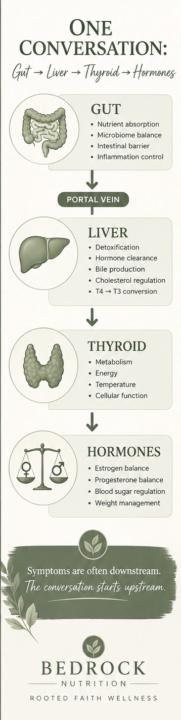
The Conversation Between Your Gut, Liver, Thyroid, and Hormones
One of the most important concepts to understand about health is that the body does not function in departments. Unfortunately, our healthcare system often does. You have a gastroenterologist for the gut. A hepatologist for the liver. An endocrinologist for hormones and thyroid. A cardiologist for the heart. A neurologist for the brain. But your body never received that memo. Every organ system is connected. Every system influences every other system. One of the clearest examples of this relationship is the connection between the gut and the liver. The Highway Most People Never Hear About Your digestive tract and liver are physically connected by a direct blood vessel called the portal vein. Everything absorbed through your intestines travels directly to the liver before it reaches the rest of your body. Think of the liver as a processing plant receiving shipments all day long. If the gut is healthy, those shipments contain: • Amino acids • Vitamins• Minerals • Healthy fats • Fuel for metabolism If the gut is inflamed, permeable, or dysbiotic, those shipments can also contain: • Bacterial endotoxins• Inflammatory compounds • Excess estrogen metabolites • Undigested food particles • Metabolic waste products The liver must process everything it receives. Every single day. Why Nutrient Absorption Matters Many people focus on what they eat. Far fewer focus on what they absorb. You can eat selenium, zinc, magnesium, iron, B vitamins, protein, and healthy fats all day long. If digestion and absorption are compromised, your cells may never receive adequate amounts. These nutrients are required for: • Thyroid hormone production• Thyroid hormone conversion• Hormone metabolism• Detoxification pathways• Energy production• Immune regulation The body cannot build health from nutrients it cannot absorb. The Thyroid Connection Many people know the thyroid produces hormones. Fewer understand that thyroid hormone must be converted into its active form. T4 is largely a storage hormone.
24d •
Introducing "Understanding Methylation:" New Course and Workbook in the Classroom
🚨 NEW COURSE RELEASE 🚨 🧬 THE METHYLATION COURSE & WORKBOOK IS NOW LIVE! If you've ever heard terms like: MTHFR COMT VDR Methylation B12 Pathways SAMe Epigenetics ...and thought: "What in the world does any of that actually mean?" This course is for you. Inside you'll learn: ✅ Why your genes are NOT your destiny ✅ How genetics create tendencies, not diagnoses ✅ Why nutrition can change genetic expression ✅ The truth about MTHFR ✅ Why B12 problems are often missed ✅ How Vitamin D impacts immunity, mood, and inflammation ✅ Why protein, collagen, and muscle are critical for recovery ✅ The Bedrock Health Pyramid approach to genetics Most people start at the top. They want the perfect supplement. The perfect gene hack. The perfect protocol. We start at the foundation: Sleep. Sunlight. Hydration. Movement. Nutrition. Gut Health. Nervous System Regulation. Because that's where health is built. This may be the most important genetics education we've ever released inside Bedrock Nation. Drop a 🧬 below after you've started the workbook and tell us your biggest takeaway. Skool Course Link: https://www.skool.com/bedrock-nation-8489/classroom/07ed205c?md=6628fa7eb9384b3995c2166418294aac
3
0

Apr 26 •
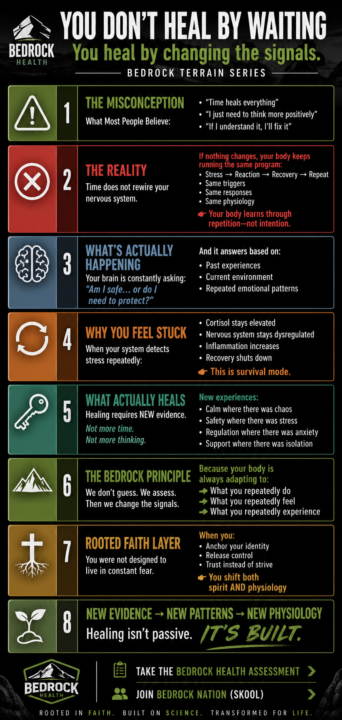
You Don’t Heal by Waiting — You Heal by Changing the Signals
You do not heal simply by waiting. You heal when your body experiences something different enough to stop expecting danger. 🧠 Your Body Is Not Broken — It’s Patterned Your brain and nervous system are constantly asking one question: 👉 Am I safe… or do I need to protect? And it answers that question based on: • Past experiences • Repeated environments • Emotional patterns• Stress physiology Not just what you think…But what your body has learned to expect. ⚠️ Why So Many People Stay Stuck If nothing changes, the system doesn’t change. If you stay in: • The same stress loops • The same relationships • The same emotional reactions • The same metabolic state Then your body keeps running the same program. 👉 Elevated cortisol 👉 Dysregulated nervous system 👉 Chronic inflammation 👉 Survival mode physiology Time alone does not fix that. ❌ What Doesn’t Create Real Change • Waiting• “Thinking positive”• Talking about it without changing inputs• Replaying the same patterns and expecting different outcomes Insight is helpful… But insight without new experience does not rewire the body. 🔑 What Actually Heals the Nervous System Healing happens when the body receives new evidence: • A calm response where there used to be reactivity • A safe conversation where there used to be shutdown • A supportive relationship where there used to be stress • A regulated moment where there used to be anxiety These moments matter because they shift: 👉 Nervous system signaling 👉 Hormonal output 👉 Brain pattern recognition 👉 Cellular environment This is terrain work. 🌿 The Bedrock Principle We don’t guess. We assess. And then we change the signals. Because your body is always adapting… The question is: 👉 What are you repeatedly teaching it? ✝️ The Rooted Faith Layer Healing is not just biological… It’s spiritual alignment too. Because many people are living in a constant state of: • Fear • Striving • Uncertainty • Identity confusion But Scripture reminds us: God did not design your body to live in constant fear.
May 10 •
Mother’s Day Specials from our Partners!
Sharing some of my favorite things and mothers day specials: 1. 🌸 EVERLYWELL🌸 One of the greatest gifts you can give the women you love is clarity, insight, and proactive health support. 💚 Everlywell is offering special Mother’s Day savings through Monday 5/11: ✨ 30% OFF all at-home testing kits Use code: EMPOWER ✨ $100 OFF the Everlywell 360 Comprehensive Annual Health Test Now just $299 (regularly $399) Use code: EMPOWER360 From hormones and thyroid health… to inflammation, vitamins, metabolism, gut health, and food sensitivities — testing can help uncover the WHY behind symptoms instead of guessing. Because real wellness starts with understanding your terrain. 🌿 https://refer.everlywell.com/s/Leanna110 2. 🧠💜 BRAIN TAP 💜🧠 Moms carry so much mentally, emotionally, and physically — which is why nervous system support matters more than ever. 🌿 This Mother’s Day, BrainTap is offering some incredible specials to support stress resilience, relaxation, sleep, focus, and overall brain wellness. ✨ Mother’s Day Specials (May 6–9): Extended to 5/10. 🎧 Power Bundle Deal Save $200 on the BrainTap Headset + Annual Subscription Bundle 🎧 Headset Special Save $200 instantly on the BrainTap headset 📱 App-Only Annual Subscription Save 50% with annual pricing BrainTap is one of our favorite tools for nervous system regulation, stress reduction, better sleep, mental clarity, and creating restorative “rest and repair” signals for the body. Because healing isn’t just physical — the brain and nervous system are part of the terrain too. 💚 https://braintap.com/?afmc=2208LECA 3. 🌿⚡ PULSETTO ⚡🌿 Stress, overwhelm, poor sleep, and nervous system burnout have become so common that many people think they’re “normal.” They’re not. Your body is asking for support. 💚 This week, Pulsetto Vagel Nerve Stimulator is offering up to $300 OFF during their early Mother’s Day + Memorial Day sale. Pulsetto is one of our favorite nervous system tools for:

1-30 of 40
powered by
skool.com/bedrock-nation-8489
Free wellness community for faith based living, functional health and real connection - off social media, rooted in purpose - learn, grow and heal.
Suggested communities
Powered by