
Write something

11d •
Shifting from Page-Based Thinking to Graph-Based Architecture (The Service Business Spec)
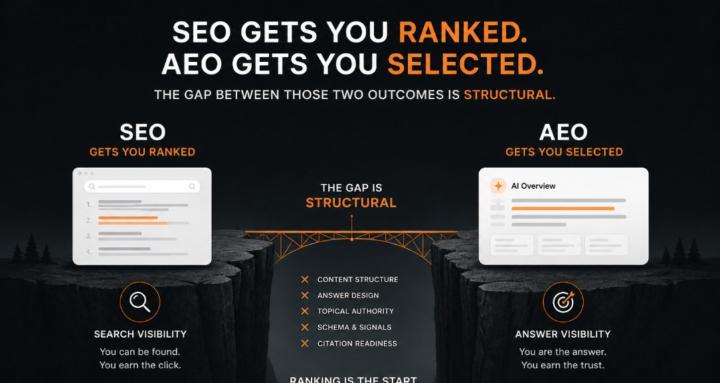
Hey everyone — happy Tuesday. We talk a lot in the lab about how the gap between getting ranked and getting selected by AI systems is entirely structural. Today, I want to drop the exact content engineering blueprint for building an enterprise-grade semantic system. If you run an agency, consult, or build visibility stacks for local service businesses (or brick-and-mortar operations), you can deploy this framework directly into your CMS templates to automate machine-readability. The Core Concept: The Web Is a Map, Not a Folder Traditional SEO treats a website like a folder of separate pages. AI systems—Google AI Overviews, ChatGPT Search, and Perplexity—treat it like a localized Knowledge Graph. If your schema properties are just thrown on a page via basic standalone plugins, you're delivering fragmented data soup. If you want high citation confidence, you need a rigid hierarchy of Hubs, Nodes, and Edges. I've put together a quick technical teardown matrix showing exactly how this lines up across your content layers: SEO = Classic SERP Lean HTML5 code, strict URL directory design, keyword-to-intent matching. AEO = Answer Extraction Engines Schema-validated FAQ blocks + direct summary text (150-200 characters) immediately following your question headers. GEO = Generative Engine Citations Hard entity corroboration. Mapping primary nodes to Wikidata via sameAs arrays and anchoring pages to verified expert entities. How to Build it Safely in Your CMS Templates Instead of editing things manually page-by-page, map these 3 components directly into your global page layouts (whether you use Webflow, WordPress, or custom headless builds like Sanity): 1. The Claim Component: A dedicated landing section that mathematically clarifies Who is performing the service, What the service parameters are, Where it physically takes place, and the Proof behind it. 1. The E-E-A-T Author Object: Never leave service content anonymous. Dynamically link every single landing page to an author entity profile that parses a clean Person node (jobTitle, knowsAbout, alumniOf).
0
0
22d •
GA4 Now Tracks AI Traffic Natively. Here's Your 10-Minute Setup (And Your Baseline Assignment)
Big one. As of mid-May, GA4 has a native "AI Assistant" channel. Traffic from ChatGPT, Gemini, and Claude gets classified automatically and sits right next to Organic Search in your default reports. Why this matters for what we do here: every baseline test we've been running — asking engines what they believe about your business — now has a traffic counterpart. You can see whether AI engines are actually sending people, not just whether they mention you. Find it (2 minutes): Reports → Acquisition → Traffic Acquisition → set primary dimension to "Session default channel group" → look for AI Assistant. Rollout is gradual, so if it's not there yet, check back in a few days. Understand what it counts (and what it misses): GA4 classifies by referrer header. When someone clicks a link inside ChatGPT's web interface, the referrer comes through and you get an AI Assistant session. When someone clicks from a native mobile app that strips the referrer — you get a Direct session, same as always. So your AI Assistant number is the minimum. Real AI traffic is higher. Also: not retroactive. Your historical AI visits are still buried in Referral and Direct, and they're staying there. Comparisons across May 13 are broken by design. Set it up properly (8 minutes): Annotate May 13 in your GA4 property so future-you knows why the channel appears from nowhere. If you already built a custom AI channel group with regex (some of you did), don't delete it. Update its condition to also match "Default channel group exactly matches AI Assistant." You'll catch sources Google's list misses, and you keep your historical view. Create a comparison: AI Assistant vs Organic Search, last 30 days. Look at engagement and conversions, not just sessions. Early reports across the industry suggest AI referral traffic is small but converts differently. Verify on your own data, not industry chatter. Your assignment: Screenshot your AI Assistant channel — sessions, engaged sessions, conversions, even if it's zero — and post it in the comments with your site type. Zero is data. We're building a baseline across this community: who's getting AI traffic, what kind of sites, from which assistants. In three months we compare. That's how we generate the evidence everyone on LinkedIn keeps saying doesn't exist.
0
0
22d •
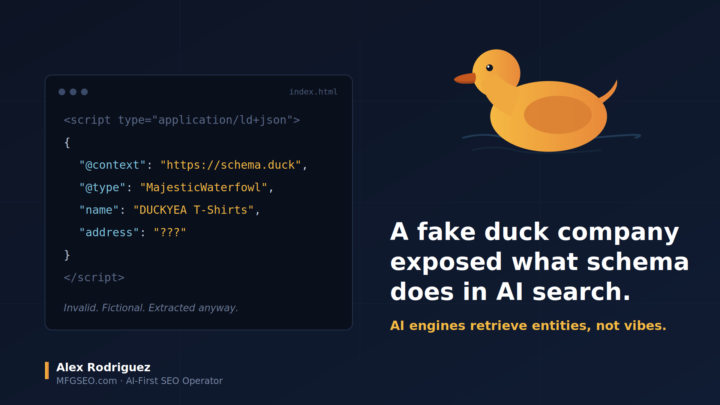
The Duck Test: What Schema Actually Does in AI Search (With Receipts)
A fake t-shirt company called DUCKYEA settled the biggest argument in AI SEO. Sort of. Quick setup. An SEO put a company address in JSON-LD only. The markup was deliberately broken — fake @context, made-up @type, nonsense properties. The address appeared nowhere in the visible text. Then he asked ChatGPT and Perplexity where the company was based. They both returned the address. Half the industry took the wrong lesson. So let's take the right one, because this changes how you should spend your schema hours. What the duck actually proved LLMs read your JSON-LD as plain text. Not as a graph. Not as structured data. They tokenize your entire HTML — script tags included — and "@type": "Organization" becomes character soup just like everything else on the page. That's why invalid, fictional schema got extracted exactly the same as valid schema would. The structure did nothing. The text presence did everything. So when someone sells you "schema optimization for ChatGPT rankings" — that mechanism doesn't exist. There are zero peer-reviewed studies showing structured data directly improves citation rates in ChatGPT or Perplexity. Zero. But here's the other half nobody pairs with it The platforms went on record. Both of them. Fabrice Canel — the guy who runs Bing's crawling infrastructure — confirmed on stage at SMX Munich that schema helps Microsoft's LLMs understand your content. That covers Bing Copilot. Google's structured data engineer Ryan Levering, same month: "A lot of our systems run much better with structured data." His reason? It's computationally cheaper than extracting facts from your prose. Then in April at Search Central Live Toronto, he said something even more specific: schema is used as context served to models when doing query fan-outs. Translation: when Google's AI surfaces break your query into sub-queries, your structured data rides along as context. So both camps are right. About different layers. Layer 1: The retrieval layer. AI Overviews and Copilot sit on top of search indexes and knowledge graphs that have parsed schema for a decade. Your JSON-LD feeds entity reconciliation there. Confirmed by the engineers who build it.
0
0
1-3 of 3
skool.com/alex-rodriguez-seo
A practical AI visibility lab for business owners, marketers, and operators who want to get found, trusted, cited, and selected.
Leaderboard (30-day)
1

+1
Powered by