
16d • Entity Lab
Shifting from Page-Based Thinking to Graph-Based Architecture (The Service Business Spec)
Hey everyone — happy Tuesday.
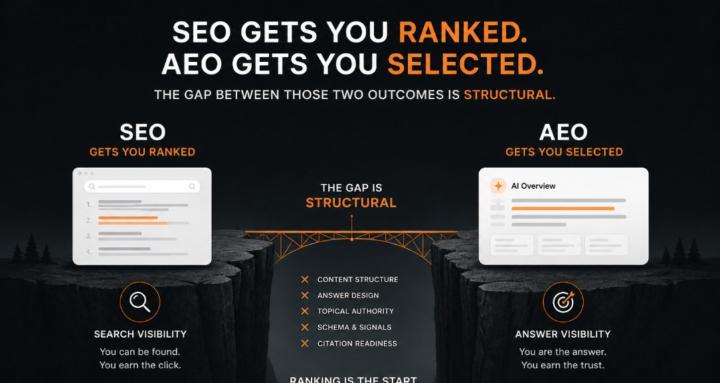
We talk a lot in the lab about how the gap between getting ranked and getting selected by AI systems is entirely structural.
Today, I want to drop the exact content engineering blueprint for building an enterprise-grade semantic system. If you run an agency, consult, or build visibility stacks for local service businesses (or brick-and-mortar operations), you can deploy this framework directly into your CMS templates to automate machine-readability.
The Core Concept: The Web Is a Map, Not a Folder
Traditional SEO treats a website like a folder of separate pages. AI systems—Google AI Overviews, ChatGPT Search, and Perplexity—treat it like a localized Knowledge Graph.
If your schema properties are just thrown on a page via basic standalone plugins, you're delivering fragmented data soup. If you want high citation confidence, you need a rigid hierarchy of Hubs, Nodes, and Edges.
I've put together a quick technical teardown matrix showing exactly how this lines up across your content layers:
SEO = Classic SERP
Lean HTML5 code, strict URL directory design, keyword-to-intent matching.
AEO = Answer Extraction Engines
Schema-validated FAQ blocks + direct summary text (150-200 characters) immediately following your question headers.
GEO = Generative Engine Citations
Hard entity corroboration. Mapping primary nodes to Wikidata via sameAs arrays and anchoring pages to verified expert entities.
How to Build it Safely in Your CMS Templates
Instead of editing things manually page-by-page, map these 3 components directly into your global page layouts (whether you use Webflow, WordPress, or custom headless builds like Sanity):
- The Claim Component: A dedicated landing section that mathematically clarifies Who is performing the service, What the service parameters are, Where it physically takes place, and the Proof behind it.
- The E-E-A-T Author Object: Never leave service content anonymous. Dynamically link every single landing page to an author entity profile that parses a clean Person node (jobTitle, knowsAbout, alumniOf).
- The Graph Nesting Script: Use distinct hash URIs (like /#organization and /#service) to cleanly nest your JSON-LD. This creates a unified matrix that lets search engines follow clean database paths instead of computationally expensive prose extraction.
⠀
Your Assignment for the Week:
- Grab a client domain or your own project site and run it through the Schema.org Validator.
2. Check your entity graph: Is your core corporate node seamlessly bound to your location profile and service pages, or are they returning as completely detached items?
3. Drop a screenshot of your node count or ask any architectural blockers below.
If anyone wants to look at a live code example of how this auto-compiles dynamic fields out of a relational CMS, let me know in the comments and I’ll film a quick Loom walkthrough for the classroom.
Let's build. — Alex
0
0 comments
Shifting from Page-Based Thinking to Graph-Based Architecture (The Service Business Spec)
skool.com/alex-rodriguez-seo
A practical AI visibility lab for business owners, marketers, and operators who want to get found, trusted, cited, and selected.
Leaderboard (30-day)
1

+1
Powered by