Activity
Mon
Wed
Fri
Sun
Aug
Sep
Oct
Nov
Dec
Jan
Feb
Mar
Apr
May
Jun
Jul
What is this?
Less
More
Memberships
Retro Riches Archive
98 members • Free
Clients for Coaches
28 members • $27
Smart AI Operators
3k members • Free
AI That Works For Businesses
286 members • $5/m
Skool Extensions 🧩
638 members • Free
BloomingVoices Streaming TV
124 members • Free
LUXX Creator Academy
212 members • Free
Panda for Skool CRM +
424 members • $36/month
Start a Business with No Money
486 members • Free
6 contributions to Skool Monetization Strategies

🔥
Feb 22 •
New Tool Alert! 📱 Skool QRCode Generator
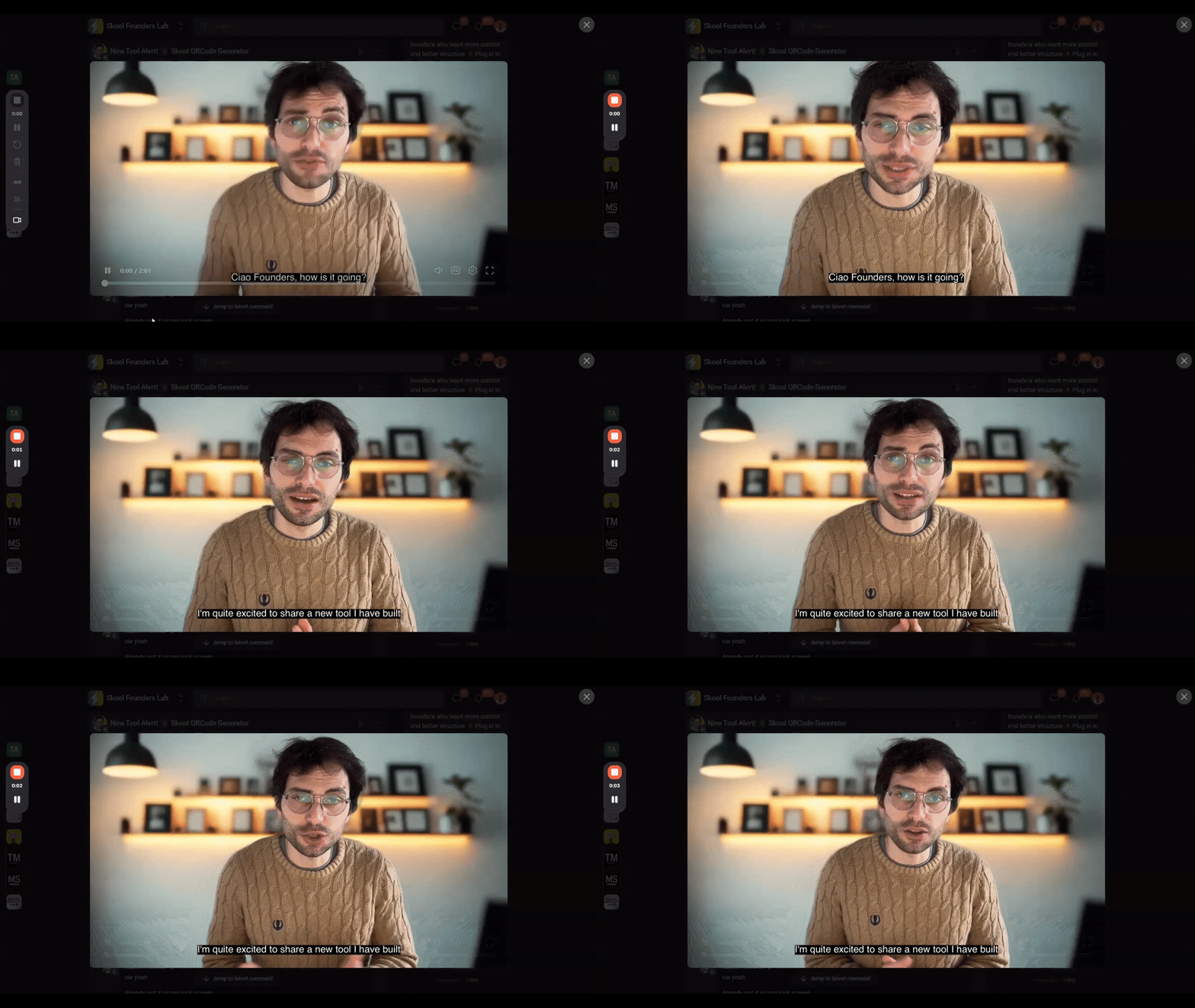
Hey everyone, My good friend Claudio Campobassi from Skool Founders Lab just built a free tool that solves a real-world problem for community owners. The Skool QR Code Generator turns your community URL into a QR code or custom smartphone wallpaper. If you're ever at a networking event, speaking on stage, or just meeting a potential member in person, you can share your community instantly. No fumbling with links. No spelling out URLs. You can even set it as your lock screen so sharing requires zero unlocking. For those of you actively growing your communities, this is a simple way to bridge your online community with any offline conversations you're having. Free to use: https://claudiocampobassi.com/skoolqrcode If you try it, drop your wallpaper design in the comments — curious to see what people create! Connect with Des: LinkedIn • Facebook • Instagram • Instagram 2 • Substack • Pinterest • Des Dreckett YouTube • Skool Monetization YouTube • The Authority Engine Community • The Authority Engine YouTube

🔥
1 like • Feb 23
Very nice! Thank you @Des Dreckett and Claudio for making this.
🔥
Jan 26 •
The Truth About Skool's "Free Members" Discovery System (And Why You're Probably Not Getting Any)
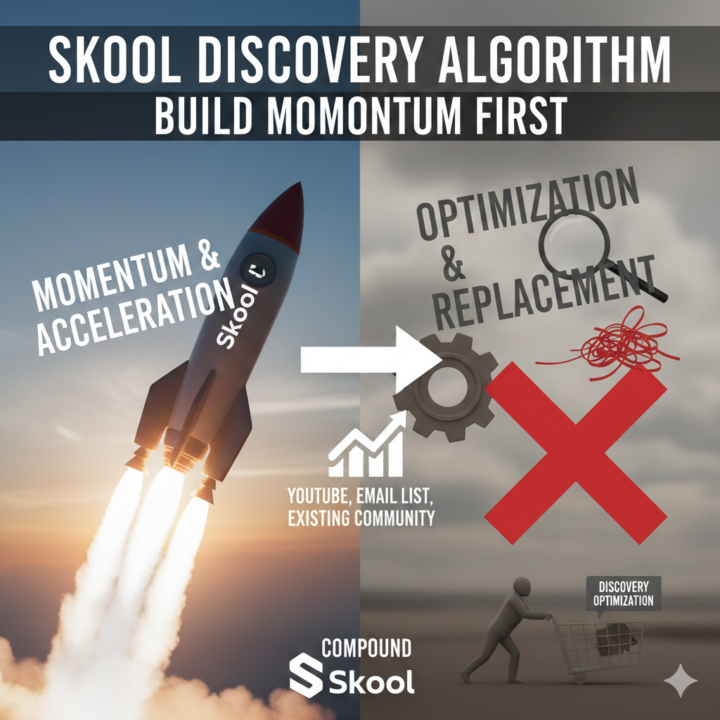
The Viral Promise That's Half True Someone in your feed posted about their Skool community growing "on autopilot." 100+ members every month. No ads. No website. No funnel. No massive audience. Just Skool's Discovery page is sending them qualified leads while they sleep. Ready to start your Skool community? The post shows screenshots. The numbers look real. Other community owners flood the comments asking "how did you do this?" and "what's your secret?" Here's what that post doesn't tell you: those 100+ monthly members from Discovery didn't start on day one. They started after the community already had momentum - usually 200-500 members built from external traffic first. I know because I run two Skool communities. One has 400+ members (Content Revenue Lab). The other has 44 paying members (Skool Monetization Lab). And despite doing everything the "Discovery optimization" posts recommend, my cold Discovery traffic is essentially zero. Professional headshot? Check. Clear community name? Check. Detailed About page? Check. Daily engagement? Check. Top of the Skoolers leaderboard among 200,000+ members? Check. Still nothing from Discovery. So I dug into the data to understand what's actually happening. What I found explains why some communities get flooded with Discovery traffic while others get ignored and why the conventional "just optimize your profile" advice misses the entire point. How Skool's Discovery Algorithm Actually Prioritizes Communities Skool's Discovery page works like an internal search engine. Users find communities through keyword searches, category browsing, and curated sections like "Trending" and "Top Communities." But before your community even appears in Discovery results, you need to clear some thresholds. Most communities under 50 members don't surface at all, regardless of optimization quality. The algorithm ranks visible communities based on three primary signals. First: Member growth velocity. This is the dominant factor. Communities gaining 10-20 new members per week get prioritized over communities gaining 1-2 members per week, even if the smaller community has better engagement. The algorithm interprets rapid growth as a quality signal and amplifies it further through Discovery placement.
🔥
2 likes • Jan 26
A literal dissertation on Skool growth concepts and methods. Whew!
🔥
Jan 19 •
Free vs Paid Skool Communities: Which One Grows Your Business Faster?
The short answer: Both. But they serve completely different purposes in your business model. If you're only running one, you're leaving money and growth on the table. Here's exactly how they differ: Here's the video - https://youtu.be/A1mbAb_kODs?si=R1qgQIXqs-t11l1o The Strategic Difference Free communities build trust and generate leads. Paid communities filter for serious members and generate revenue from day one. You don't choose one or the other—you run both strategically to maximize growth and revenue. Step 1: Understanding Your Dashboard Log into Skool and view your communities dashboard. If you manage multiple communities, you'll see them listed with either "FREE" under the member count or your monthly price like "$49/month". The pricing is completely flexible—anywhere from $5 to $297+ per month depending on your value proposition. Step 2: The Interface Is Identical Here's what confuses most people: both free and paid communities look exactly the same once you're inside. Same features, same functionality, same engagement tools. The only difference is how people join. Step 3: Free Community Join Experience Click on your free community, then click the "View" icon (👁️). Visitors see a "Join Group" button with no payment required. Before they can join, they answer your qualifying questions—things like "Are you over 40?" or "What's your primary goal?" Once answered, they get instant access. This is your trust-building engine. You're capturing leads and establishing authority without friction. Step 4: Paid Community Join Experience Click on your paid community, then the "View" icon (👁️). Now visitors see either "Start Free Trial" (if you've enabled one) or your monthly price. They still answer qualifying questions, but payment is required for access. This is your revenue engine. You're filtering for committed members willing to invest in premium value. What to Do With This Information: Build a funnel, not a single community. Start with free to deliver substantial value and build credibility. Identify your most engaged members. Then invite them to upgrade for premium resources, direct coaching access, and implementation support.
🔥
1 like • Jan 19
@Des Dreckett makes perfect sense. And the way you have laid this out is right on target. Since I'm already in both groups, I have been able to watch the development, but still didn't quite grasp the beauty and elegance of the growth funnel concept. Brilliant job mate!
🔥
Jan 17 •
How Kim Built a $10K+/Month Revenue Engine From a Hobby Community
Kim Thompson Pinder migrated a 25K Facebook group to Skool. Now she's #8 in ALL English-speaking hobby communities with 1,200+ members. Here's a link to her community - Circular Machine Knitting Addi But here's what everyone's missing: The ranking isn't the story. The monetization model is. She converted 4% of her founding members to paid. If even half her 1,200 members are paying $20- 30/month, that's $12K-18K MRR. From a hobby community. And she doesn't answer every question. Her members call themselves "family" and do it for her. That's not community building. That's revenue engineering. The 4% Benchmark (And Why It Matters) Kim got 4% of her founding members to convert to paid. That's not impressive by SaaS standards, but for a hobby community migrating from Facebook? That's actually really good. Here's why this number matters to you: It's a validated baseline. If you've got 100 members and you're trying to figure out what "good" looks like, now you know. Get 4 people to pay you $29/month and you're tracking with a Top 10 community. That's $116/month. Not life-changing, but it's proof the model works. Now scale that. 500 members at 4% = 20 paying members = $580/month. 1,000 members = $1,160/month. You can see where this goes. The real question: Are you even trying to convert 4%? Or are you stuck at 0% because you haven't asked anyone to pay yet? The Member-Led Sales Model Kim has 1,200 members. She can't possibly answer every question, respond to every post, or hold everyone's hand. So she doesn't. Her members do it. Seven of them have fire icons (Skool's "most engaged" badge). Those seven people are essentially unpaid staff. They answer questions, welcome new members, keep discussions going. Here's the revenue angle most people miss: When members answer questions instead of you, you get your time back. That time can go into creating paid products, running Roadblock Calls, building referral systems, or literally anything that generates revenue.
🔥
1 like • Jan 18
Such an awesome interview! And my hat is off to Kim. She is no doubt a driven woman with a great story.

Jan 14 •
From $1 to $65 Billion
If you know anything about Canva, you'll know they started their monetization strategy with $1 sales of stock photos. Now, they're worth more than $65 Billion. But they still sell icons, images and illustrations etc for just $1. And the least you can sell something for on Skool is $1. Co-incidence? Yeah, it's probably a co-incidence lol So if you haven't earnt your first dollar on Skool yet don't get stuck trying to create a product that will be worth thousands of dollars. Just create something simple like a checklist, an image or template that will help your community members and price it at $1. Aim to solve one problem with one solution in one sitting. Honestly, making that first sale and seeing that first dollar land in your bank account can be truly transformative. Don't under-estimate it! And don't delay it! You've got this :-) What could you sell for $1?

🔥
1 like • Jan 14
Ding-Ding!
1-6 of 6

🔥
@steve-robertson-3575
Sales and marketing expert who loves helping people develop solutions using AI and electronic media
Active 7h ago
Joined Jan 13, 2026
South Carolina