Activity
Mon
Wed
Fri
Sun
Jul
Aug
Sep
Oct
Nov
Dec
Jan
Feb
Mar
Apr
May
What is this?
Less
More
Owned by Sharon
Genuine beginner over 50? Onliners helps real people start making real money - in less than 8 minutes. Join us!
Memberships
Clief Notes
35.3k members • Free
Panda for Skool: The CRM +
363 members • Free
UGC World
13.3k members • Free
🔥Substack Starter Space🔥
103 members • Free
SUBSTACK💜The You World Order
557 members • Free
Seasonal Sisters
12 members • Free
Skool Made Simple
68 members • Free
Laughter Clinic
48 members • Free
Your First $5k Club w/ARLAN
29.5k members • Free
17 contributions to Skool Monetization Strategies

🔥
Mar 5 •
Closing This Community :(
Hi all, it's with great regret that I am closing this Skool. This was a test of a test of a test, and it has now fulfilled its purpose. Just thought I would let you know before the doors finally close.

🔥
1 like • Mar 5
I don't know whether I should be sad @Des Dreckett or if this is just a test of a test of the test?? ;-)
🔥
1 like • Mar 5
@Des Dreckett 🤣
🔥
Feb 6 •
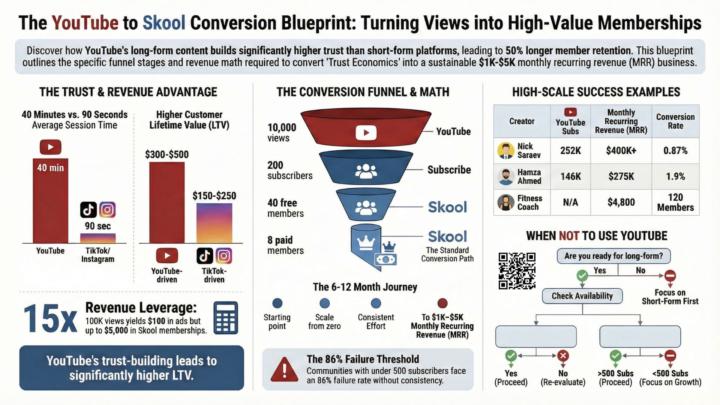
Why YouTube Drives More Skool Members Than Any Other Platform
If you're trying to grow your Skool community, you've probably heard the advice: "Just post on social media." But here's what nobody tells you - YouTube converts to Skool memberships at 3-5x higher rates than Instagram, TikTok, or LinkedIn. Most community owners waste months posting short-form content that gets views but zero paying members. Meanwhile, creators using YouTube are building communities of 50-100 paying members in 3-6 months, generating $1,500-5,000 monthly recurring revenue. This post breaks down exactly why the YouTube to Skool funnel works so well, backed by real conversion data and case studies. By the end, you'll know whether YouTube is worth your time investment and how to make it work for your specific situation. In this post, you'll learn: • Why YouTube viewers convert to paid members 50% better than other platforms • The actual conversion benchmarks (views → subscribers → Skool members) • Real creator examples generating $20K-200K/month using this funnel • When YouTube is a terrible strategy (and what to do instead) YouTube Builds Trust That Short-Form Content Can't Match Here's the fundamental difference: YouTube viewers spend an average of 40 minutes per session watching content. Compare that to Instagram where people scroll for 90 seconds and move on. When someone watches you explain a concept for 15 minutes, they're not just consuming content—they're building a parasocial relationship with you. They hear your voice, see your face, understand your thinking process. This creates perceived expertise that short-form platforms simply can't deliver. The data backs this up. Studies show video content increases perceived expertise by 40-50%, leading to higher conversion intent. More importantly, Skool members from YouTube retain 50% longer than those from TikTok or Instagram, with average lifetime values of $300-500 versus $150-250 from other platforms. Why? Because by the time someone joins your Skool from YouTube, they've already "auditioned" you through multiple videos. They're pre-qualified, not impulse sign-ups from a viral reel.
🔥
1 like • Feb 9
@Des Dreckett how much of your YT external traffic comes from Skool?
🔥
1 like • Feb 10
@Des Dreckett My traffic from external to YT is more than one-third from Skool - I had been focusing on the Yt TO Skool traffic and hadn't even thought about the reverse!
🔥
Feb 3 •
Why Skool's New Spam Filter Could Save You 10+ Hours Every Week
If you're running a free Skool community, you know the pain: fake profiles, scam DMs, and drop-shipping bots flooding your membership requests. You're spending hours every week manually screening members instead of building revenue. Here is the video replay - https://youtu.be/kyFy567zACk?si=lNk1sDEFJLX6V5AR Skool just fixed this. Their new Auto-Mod spam detection system doesn't just flag suspicious accounts—it routes them to a spam folder automatically, sends you zero notifications, and works 24/7 without you lifting a finger. Here's why this matters for monetization: time is money. Every hour you spend blocking spammers is an hour you're not running Roadblock Calls, creating paid products, or engaging with real members who might upgrade to premium tiers. What Auto-Mod Actually Does Skool's spam risk score now appears on: - Membership requests (with one-click block) - DM conversations (massive red warning before you engage) - Posts and comments (auto-flags suspicious content) The system analyzes multiple signals—account age, contribution history, posting patterns—to identify high-risk users. When it detects spam, it doesn't just warn you. It disappears the content entirely. For community owners with 1,000+ free members, this is game-changing. You can finally enable auto-approve on membership requests and let Skool handle the filtering. The Traffic Source Feature Everyone's Waiting For Skool also teased their traffic source tracking tool (launching early February 2026). You'll finally see exactly where members come from: Instagram, YouTube, Facebook ads, Google search—broken down by percentage. @Sharon Jones from Onliners nailed why this matters: "You want to know where is the best place to spend most of my time and where am I going to make the most money from spending that time."
🔥
1 like • Feb 3
The silent DM spam routing is Ninja level genius @Des Dreckett - spammers literally won't know what hit them!
🔥
Feb 2 •
"I Don't Want a Big Community" - Simon's $10K/Month Strategy
Just watched my interview with Simon from The Raw Leader, and his approach completely flips the typical Skool playbook. The Unexpected Truth While most community owners are chasing 1,000 members, Simon's deliberately keeping his small. His focus? High-ticket clients who actually transform, not vanity metrics. What He's Doing Differently Simon uses his Skool community as a lead generator for his real business—high-ticket coaching. He's not trying to monetize the community itself. He's using it to attract the RIGHT people who'll pay $3K-$10K for done-with-you support. The Part That Surprised Me His community isn't his product. It's his funnel. That's a completely different monetization model than what most people teach, and it's working. Why This Conversation Matters There's no "one right way" to monetize a community. Simon's model works because it aligns with his business structure—coaching-first, community as the vehicle. Your model might be different. Maybe you DO want to monetize the community directly. Maybe you want membership tiers. Maybe you want digital products. The lesson isn't "copy Simon." It's "know what YOU'RE actually building." Watch the full interview: https://youtu.be/PhvqvKRjL4U Check out Simon's community: https://www.skool.com/therawleader/about?ref=c75adaa832e449d8b1ef463c22b1d8a9 What's YOUR monetization model? Community revenue, high-ticket backend, or something else entirely? Want more monetization strategies? 🆓 Free Community: Join 400+ community owners in Content Revenue Lab 💰 Paid Community: Turn 25-50 members into $1K-$5K/month → Skool Monetization Lab Connect with Des: LinkedIn • Facebook • Instagram • Instagram 2 • Substack • Pinterest • Des Dreckett YouTube • Skool Monetization YouTube
🔥
0 likes • Feb 3
Community as funnel is such a powerful strategy @Des Dreckett
🔥
Feb 2 •
The Traffic Platform You're Ignoring (That Gets 578M Searches Monthly)
Everyone's grinding Instagram, chasing YouTube, dancing on TikTok... Meanwhile, Tim Adams pulled 70,000 monthly views in 60 days on a brand new account with 36 followers. Not YouTube. Pinterest. Full podcast breakdown here Why Pinterest Works for Community Owners Pinterest isn't social media—it's a visual search engine. People aren't doom-scrolling. They're searching for solutions. And unlike Instagram or TikTok, your content lives forever. Tim literally has pins from 10 years ago still driving traffic today. The setup is dead simple: Create a 9x16 image, add title and description, drop your link (Skool about page, lead magnet, YouTube), and Pinterest adds a "Visit Site" button. That's it. Tim's Playbook (Works with Zero Followers) Here's what actually matters: Start with keyword research, not content creation. Use Pinterest Trends (it's free and built-in) to find what people actually search for. Don't waste time creating what you think they want. Your pins need clear calls-to-action on the visual itself. Test both static images and short videos (5-20 seconds). See what converts better, then do more of that. Daily consistency beats everything else. Post 1 new pin per day to your link. Repin 5-10 others' content to show activity. Takes maybe 10 minutes total. Pinterest rewards consistency, not follower count. The School Growth Strategy Tim grew Pinterest School from 150 to 1,300+ members in 90 days. His secret wasn't complicated—he combined Pinterest traffic with affiliate activation. He teaches members to become Pinterest School affiliates, then pin those affiliate links across Pinterest. The traffic comes in already sold because it's a referral. His about page conversion rate sits at 42%. Some days it hits 60%. One member sent him 42 referrals in 48 hours using this exact system. What to Pin Right Now Pin your about page directly. Create "How to [solve problem]" pins that link to your community. Turn your best YouTube clips into short Pinterest videos that drive back to the full video.
🔥
0 likes • Feb 2
I just don't get Pinterest @Des Dreckett :\
1-10 of 17
🔥
@sharon-jones-5093
Helping people over 50 make their first dollar on Skool, escape wage-slavery & find a community of creative, fun and supportive online entrepreneurs.
Active 10h ago
Joined Jan 13, 2026
Wollongong