Activity
Mon
Wed
Fri
Sun
Jun
Jul
Aug
Sep
Oct
Nov
Dec
Jan
Feb
Mar
Apr
What is this?
Less
More
Memberships
Breakthrough Publishing
3k members • Free
AI Automation Society
348.7k members • Free
Women Build AI
3.4k members • Free
The AI Advantage
120.6k members • Free
46 contributions to The AI Advantage

⭐
Nov '25 •
🥦 CONGRATS TO 14,173,890 MEALS 🍎
We just had the privilege of letting our partners over at Feeding America know that we will have another 2,000,000 meals ready to send their way in November. We just donated 1,400,000 meals in October and they just informed us that in the last few years we are now at 14,173,890 MILLION MEALS DONATED! It wouldn't be possible without all of you! 😃

1 like • Nov '25
Wow - just amazing! Thank you Tony and Dean.

🔥
Nov '25 •
Just Start Even if You Have NO Idea What You’re Doing
This post is dedicated to all of the people who are learning about AI tools and feeling overwhelmed. The takeaway I want to leave you with is: Start, even if you don’t know what the heck you’re doing yet. That doesn’t matter. Just START. A few years ago, with no background except my professional experience, I built a national internship for sixty college students exploring artificial intelligence, quantum science, synthetic biology, and technical security. I paired students from small universities and community colleges with peers from top research universities, and assigned them project mentors I trusted from different departments in the US government. We had no idea how this experiment would turn out. The goal was simple: prove that brilliance can come from anywhere. I had doubts and major imposter syndrome! What happened next surprised me. My most successful interns had determination, not perfect grades. It wasn’t skill that pushed them to the top. It was courage. They didn’t wait to feel ready. They just started. They learned fast and collaborated with others who had the skills they lacked. Technology doesn’t replace people. It reveals them. It amplifies imagination, courage, and intent. If you want to build something extraordinary, stop waiting. Begin now. Build the thing that scares you. Learn as you go. Perfection and “I’ll do it when….” is a trap. Next steps: Pick one free AI or tech resource and explore it for fifteen minutes today. Ask one better question. Curiosity opens more doors than credentials. Build something small — a prompt, a workflow, a prototype — anything. Share what you learned. Teaching reinforces confidence. Repeat tomorrow. Momentum matters more than mastery. Start small. Begin anyway. THE ONLY THING MORE COSTLY THAN FAILURE IS NEVER STARTING AT ALL.
3 likes • Nov '25
What a great story @Theresa Elliott congrats on such success 🤩. I imagine it takes quite a bit of courage to be in the Navy. Your comment about Technology not replacing people really resonates with me as it's also the message I'm passionate to express is the power of the collaboration Human+AI. Thanks for sharing.
🔥
Nov '25 •
PROTECT YOUR INTELLECTUAL PROPERTY AS YOU START USING AI
I purposely titled this in all caps. It is the virtual version of the foot stomps you would hear if I was standing onstage delivering my TED talk to you. Spend the necessary time to digest and really understand this information. How to Protect Your AI Company, Your Code, and Your Likeness Before You Scale. Learn the risks and the rules. Anyone can now build with AI. But very few understand what they’re giving away in the process if they’re using free accounts. The difference between a billion-dollar company and a compromised experiment isn’t talent or timing. It’s ownership. Ownership of your data, your models, your prompts, and your likeness. Build everything correctly from the start, protect intellectual property, and defend digital identity in an era where the lines between creator, code, and clone are vanishing. BUILD WHAT YOU OWN, AFTER SHIELDING YOUR INTELLECTUAL PROPERTY FIRST When I start a new company, my first principle is simple. Build the thing that FOREVER STAYS MINE. Every decision from entity formation to cloud architecture flows from that. FIRST PRINCIPLES Speed is worthless if it costs your ownership. Incorporate a Delaware C-Corp and assign all intellectual property to it immediately. Make every founder, employee, and contractor sign invention assignment and confidentiality agreements. File trademarks and copyrights early. Secure a domain, repository, and encrypted vault under company control. Use enterprise-grade AI providers with written data-control terms. ******Never rely on no-code builders or free chat accounts for proprietary work****** Design for swapability so your model router, vector store, and orchestration logic can move between providers. Choose systems that make you faster and freer. THE IP RISKS INSIDE CHAT APPS When you use a FREE chat account to test ideas, write prompts, or iterate strategy, you are working inside someone else’s lab. You do not control data retention. You do not know where your inputs are stored.
5 likes • Nov '25
@Theresa Elliott excellent post. Thank you for sharing. @Jennifer M. Irwin I think you will like this post too.

Nov '25 •
Tech Impaired but willing to learn
My son says that I am technologically impaired. I may be, but I'm very excited about learning Ai and perhaps I can teach him a thing or three. Question #1. What do they mean when they say "Tell the AI ALL ABOUT YOURSELF?" Do you simply type it in and the program saves all about you?
0 likes • Nov '25
@Blanche Grube Way to go! Dean's got you all set up to start, I just wanted to leave you a little encouragement that I share with my clients and readers that are all women entrepreneurs and business owners. Gen AI (such as ChatGPT, Claude, Gemini) doesn't require a technical background. It requires good conversation, communication and collaboration skills. This is your natural advantage! Here is what actually matters with AI: 1) Clear Communication - Ability to explain what you need clearly 2) Giving Context - providing helpful background information 3) Iterative Improvement - You review work, give feedback and refine something until it's right 4) Relationship-building - Collaboration skills - that back and forth you do when you work with others 5) Critical Thinking - Making final decisions with your discernment Gen AI is conversational, not technical. You're already an expert at conversation + You likely delegate to team members or temporary contractors + You explain things to clients or customers + You raised and taught your your Son using these skills That's the SAME skill set for partnering successfully with Gen AI! You got this.

Nov '25 •
When Using an AI Partner- Are You Curious to Learn This As Well?
Aloha, to all, 😀. Fantastic Event! 🎉 I would like your insights and feedback: When using AI and the tools as your partner, are you keeping track of each that you use on each of your projects, whatever that project may be, and how many hours and minutes you use for each? If so, what tool are you using to keep track of that, or are you using pen and paper for that? It has occurred to me that maybe this will become an important thing to do, especially, for example, if you use Gemini. It is my understanding that Gemini will put an invisible Watermark on what it is doing for you. So ... it may be important to have a distinct time reference as to what is your work without the AI partner and when you bring in the AI partner for assistance. I don't know if Gemini gives, let's say a 15-minute window of use, before the invisible Watermark is applied. And, does anyone know at what percent you are still able to claim copyright of your work before you lose access to claim copyright because you used an AI partner? If you lose copyright at x percent, does the AI model/company own your work and you have to pay the company to use your own work, or are they now x percent owner in your company or your book or....? If anyone knows about these things, it would be very helpful. Many attorneys don't know the answer to these questions. I thought that because many of you here are more knowledgeable in the application of AI and real-time use, many of you would have a better understanding of real-time and real-world happenings. Thoughts? 😀
1 like • Nov '25
@Jennifer M. Irwin wow thanks for sharing that. So sorry to hear she lost her use of the TM and her business. I don't think we are the only ones not sure about all this, like you mentioned attorneys are still trying to figure it out and the courts too.
2 likes • Nov '25
@Jennifer M. Irwin Yes, I agree, we need to stay up on all of this. I do take it seriously as it's my work to help others with AI. I will keep your questions in mind and if I learn anything new that will be helpful, I'll come back and post it on this thread.
1-10 of 46
@robin-cordova-3366
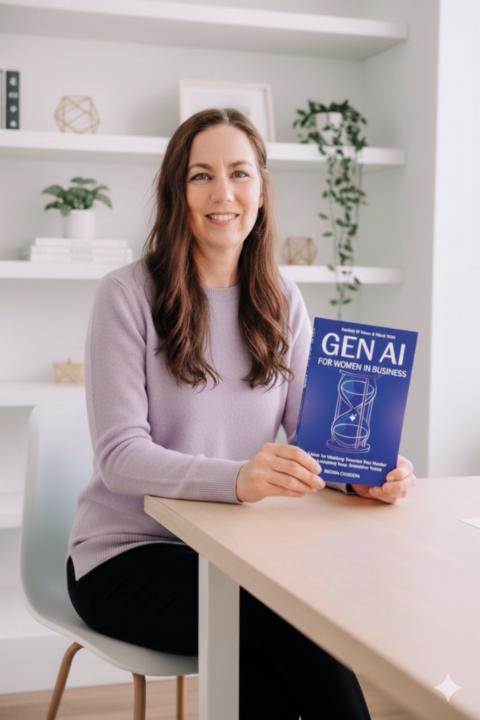
Helping women entrepreneurs with beginner friendly AI. Author of "Reclaim 10 Hours a Week with Gen AI for Women In Business". Fellow learner!
Active 1d ago
Joined Nov 3, 2025
Seattle, WA
Powered by