Activity
Mon
Wed
Fri
Sun
Dec
Jan
Feb
Mar
Apr
May
Jun
Jul
Aug
Sep
Oct
Nov
What is this?
Less
More
Credit Millionaires
421
5.0
$97/m
NC ELITE
229
Free
CRM ACADEMY
2k
$27/m
Credit Master Pro
125
Free
AI Creator Academy
1.6k
Free
AION Growth Lab
635
5.0
$27/m
Skool of Funding
80
5.0
$99/m
Credit Academy 411
117
Free
Prompt Warrior: Master AI
588
5.0
$49/m
3 contributions to Leverage Credit For Cashflow

Sep '25 •
Let's Talk Vantage Scores Vs. FICO Scores...
VantageScore is used by over 3,700 institutions, including banks and FinTech's, for funding applications across various products, from credit cards to mortgages. Although FICO scores have traditionally been the industry standard, VantageScore's use has increased significantly, with 42 billion scores used in 2024 alone. Adoption across lending products VantageScore is used for many different types of applications: - Credit cards: In 2024, VantageScore usage by credit card lenders grew by 142%, a major driver of the model's overall expansion. - Personal loans and auto loans: Many banks and lenders use VantageScore 4.0 for personal and auto loan applications. - Mortgages: In a significant development, the Federal Housing Finance Agency (FHFA) now requires Fannie Mae and Freddie Mac to accept VantageScore 4.0 for mortgages. This change, effective immediately as of July 2025, opens up the mortgage market to millions of borrowers with "thin files" who were previously un-scorable by traditional models. - Rental screening: Telecommunication, utility, and rental screening organizations also use VantageScore, with usage growing by over 2,900% in 2024. Comparison with FICO scores While VantageScore is increasingly prevalent, FICO scores still hold a majority share of the market, particularly for legacy and specialized loan programs. However, there are key distinctions that have helped increase VantageScore's adoption: - Less credit history required: VantageScore can generate a score with as little as one or two months of credit history, compared to FICO's typical six-month requirement. This makes it easier to score consumers who are new to credit. - Alternative data: The VantageScore 4.0 model incorporates alternative data sources, such as rent and utility payments, to provide a more inclusive assessment of creditworthiness. - Increasing competition: The FHFA's mandate for mortgages has eroded FICO's long-standing monopoly in that market and encouraged greater competition in the credit scoring industry.

1 like • Sep '25
@Banetta F McDaniels ty
1 like • Sep '25
@Banetta F McDaniels ty

Jul '25 •
0% Intro Offer Business CC's?
I have business credit cards with the banks listed below. Are there any others I should apply for that have a 0% interest offer? I ONLY want business credit cards. AMEX US BANK TRUIST Chase Navy Bank of America
1 like • Jul '25
@Banetta F McDaniels Ty.

Aug '24 •
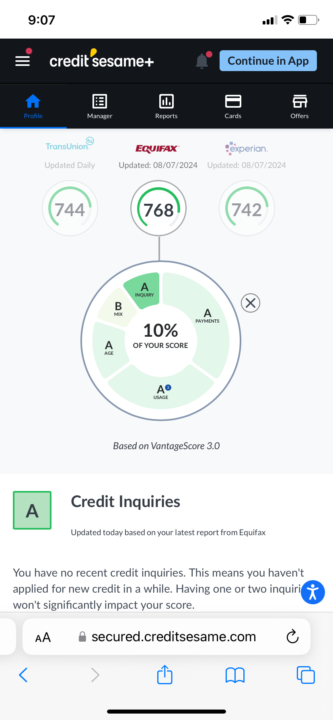
Just Showing My Success So FAR To Tobi Vids
I advanced so much by watching Tobi! I just wanna say thank you and I’ve got so far 69,000 in funding amongst two businesses together No credit Inquiries IYKYK ;) by watching Tobi videos Personal credit now is excellent but started out poor …Now looking to buy multifamily up north and utilize that Zero APR !!!
2 likes • Aug '24
Congratulations.
1-3 of 3

@orlando-armas-9183
Credit Optimization, Financial Profile Alignment, Capital Readiness Coaching. Credit Repair and More
Active 34m ago
Joined Aug 7, 2024
Miami, Fl