Activity
Mon
Wed
Fri
Sun
Aug
Sep
Oct
Nov
Dec
Jan
Feb
Mar
Apr
May
Jun
Jul
What is this?
Less
More
Memberships
Syntropic Sunlands w/ Milan
178 members • Free
8 contributions to Syntropic Sunlands w/ Milan

May 22 •
Spring Pruning
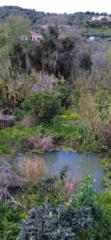
Hey guys wanted to share with you an update of the trial line planted a year and a half ago post pruning. After a month and a half, plants are regrowing very well and here's the mix of factors : -I irrigated 3 times that week (a couple times too pre-pruning) - there's plenty of water in wells so it's using unlimited water at that time. -The heat didn't come yet, the bar of 30 degrees wasn't reached yet, plants are still in a strong vegetative state. Hope you got something useful out of this video !
1 like • May 22
Considering that transpiration collapses after pruning, what is the rational behind over-watering right after the disturbance?
Apr 15 •
Making a case against the use of Eucalyptus in syntropic systems in the Mediterranean climate (and other climates with long drought periods)
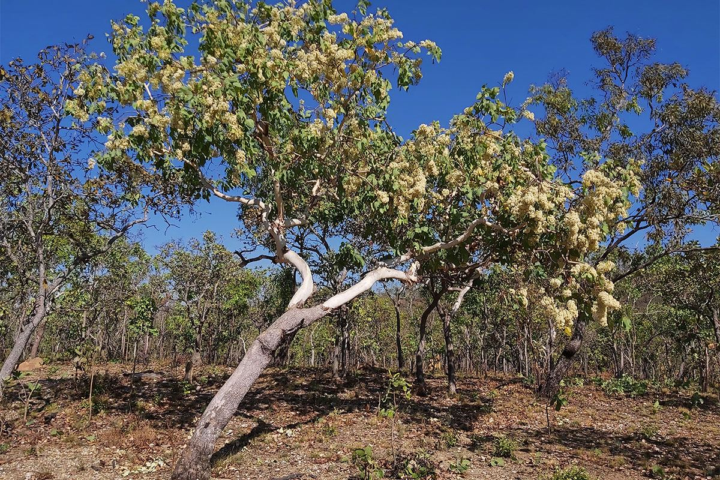
I know that this is an unpopular statement but personally, I prefer basing my decisions and teaching on scientific evidence rather than on "opinions" and anecdotal "findings". Eucalyptus species are increasingly difficult to justify within syntropic farming systems operating under Mediterranean or seasonally dry climates (tropical and temperate climates are really another story), primarily due to their disproportionately high transpiration rates and their capacity to function as facultative phreatophytes. Empirical work published in Tree Physiology demonstrates that eucalyptus stands can maintain significant transpiration by accessing groundwater when it is available at relatively shallow depths (<9 m), effectively coupling canopy water demand directly to aquifer reserves . This behavior becomes particularly problematic in dry periods: rather than downregulating water use in synchrony with ecosystem scarcity—as is desirable in syntropic systems—eucalyptus can continue transpiring at elevated rates by mining groundwater, thereby decoupling plant water use from rainfall inputs. In Mediterranean trials, annual transpiration values on the order of 520–910 mm have been documented, even under constrained irrigation regimes . This level of water flux represents a substantial hydrological drawdown, especially when compared to mixed, stratified agroforestry systems designed to retain moisture and recycle atmospheric humidity locally.From an ecohydrological and successional perspective, this groundwater-dependent strategy directly conflicts with the core principles of syntropic agriculture. Syntropic systems aim to enhance infiltration, build soil organic matter, and stabilize the small water cycle; however, deep-rooted, high-demand species like eucalyptus can act as vertical drains, exporting water from soil profiles and lowering local water tables over time. The literature on eucalyptus plantations using shallow groundwater shows that these species readily exploit subsurface reserves even when saline or marginal , reinforcing their classification as aggressive water extractors rather than cooperative system participants. In practice, this can suppress understory development, reduce microbial and fungal activity in upper soil horizons, and exacerbate drought stress for co-planted species—precisely the opposite of the facilitative interactions sought in syntropic design. Consequently, while eucalyptus may offer rapid biomass accumulation, its hydrological footprint and competitive rooting ecology make it fundamentally misaligned with resilient, water-conserving agroecosystems.
2 likes • Apr 16
@Milan Marquis My points are not about how they are invasive, flammable or allelopathic (which they can be as you say in non-maintained stands). It's about water usage when water is not available. Your points are valid but none of them is unique to eucalyptus. What is (almost) unique to it (like prosopis for example) is that it is accessing aquifers when water is not available. The core issue isn’t whether management changes tree behavior; it clearly does. The problem is that the argument selectively assumes management can override species-level physiological traits, which is not fully supported. 1) “Unmanaged vs managed” does not neutralize species traits Pollarding reduces canopy size, but it does not fundamentally change stomatal regulation strategies, xylem conductivity, rooting behavior and leaf chemistry (including allelochemicals) Species in the genus Eucalyptus are evolutionarily adapted to maintain high transpiration rates under favorable conditions, aggressively exploit deep soil moisture and produce secondary metabolites that can suppress understory growth (yes, in an abundant system that is greatly diminished). These traits persist even under pruning. You can modulate intensity but not eliminate the underlying function. 2) Deep water access does not mean hydrological benefit by default The “bio-pump” argument is often overstated. Hydrologically, deep-rooted trees can redistribute water upward (hydraulic lift) which is indeed beneficial locally; however, they can also increase total system evapotranspiration (ET) which in a Mediterranean context is often the dominant effect in drought periods. In semi-arid systems, increased ET frequently reduces net groundwater recharge; it does not increase. This is well documented in afforestation studies globally and has been the main issue with massive reforestation projects in several locations around the world where the hydrology and water management was not actually taken into account.
Apr 15 •
A Tip to Prevent Weeding - Video Filmed in February
The Fava Bean Trick ! Fava beans are great for smothering weeds, and they sprout easily with the first rains. In this video, I show how I use them - and how much easier they make the work. No need to get on your knees pulling grasses in the first year. You get 2 cuts with them, and each cut took me 20min/100m/1 person. It's really not that much work - about 2 and a half hours for these 3 rows of 240m each. By the time they phase out, it’s already Summer here in the Mediterranean, so there’s basically no need to weed anymore. Then when the rains return, your rows should be established enough that weeding becomes a minimal task. You might need a bit of weeding in year two if your trees haven’t grown enough - but in my experience, one more pass is usually enough - cutting them, not even uprooting them. After that, the trees outcompete the grasses and take over. What other plants do you think could do a similar job? I’m thinking artichokes or cardoons could work really well - but they’d need to be started as seedlings.
2 likes • Apr 15
I'm using comfrey to achieve a similar effect...it's an amazing weed suppressor when the conditions are right for it to grow. However, it works mainly from April to December but it often accumulates so much plant material that weeds can't grow through it. Other strategies include creeping thyme, alfalfa, mesimbrinanthemum and others
Mar 4 •
The Infestation - How to do syntropic ag amendments free
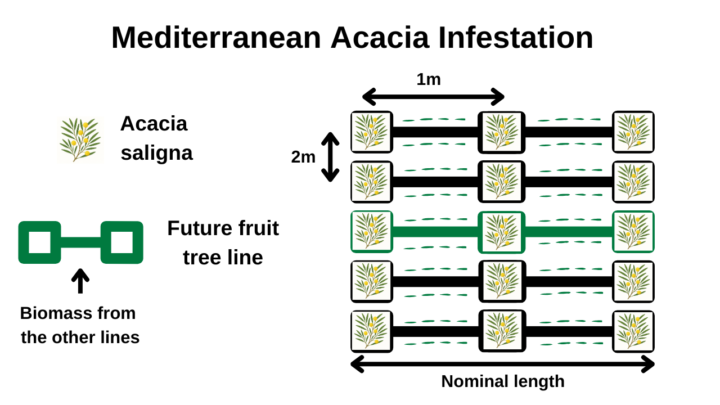
Hey everyone ! For the past two years I’ve been working toward something I’m finally beginning to implement: "the Infestation" a term coined by Scott Hall. Those of you on his platform will likely be familiar with it. Scott actually shared a design with me, and I’m currently in the middle of preparing the soil. - What is an infestation, and what’s the purpose? The concept of an infestation is simple—it’s essentially how nature most efficiently drives succession forward from bare or infertile soil. In natural ecosystems, a tough, fast-growing pioneer species colonizes poor ground because it’s the most adapted to those harsh conditions. It rapidly occupies space, outcompetes other plants, and establishes dominance so effectively that even grasses have little impact on its growth. After a few years, this often results in a dense hedge or stand of that species—you can clearly observe this along many roadsides. In my area, the species that naturally behaves this way is Acacia saligna. It self-seeds readily and is extremely resilient. Successional Accumulation Inspired by this natural process, Scott has been developing the concept of “Successional Accumulation.” The goal is to run syntropic agroforestry systems without external amendments by harnessing the initial growth and biomass production of the infestation phase. The system progresses through: - Infestation phase (pioneer dominance and biomass buildup) - Stabilisation phase - Succession phase - The end goal is the same abundance we seek in syntropic ag - but achieved only through plant power rather than external inputs. I won’t dive too deep into each phase here, but I’m happy to discuss further. Why acacias in the Mediterranean? Scott and I have discussed extensively how to adapt this to Mediterranean climates. We both see Acacia species as particularly promising pioneers (e.g., Acacia saligna, Acacia dealbata, Acacia pycnantha, etc.).
5 likes • Mar 4
Infestation is indeed what nature does and it does it well. However, there is a substantial research bibliography that shows that infestation with several species (at least 6 from different genera) will give you a substantially better result. The reasons are many, some which are the following: Plants from different genera will: -associate with different microorganisms. -give the soil different exudates at different times of the year -occupy a different soil horizon -occupy a different above ground horizon etc.etc. So infestation in a syntropic fashion would be to choose 6 genera of different profiles and infest with them.
Feb 2 •
We're in for one of the wettest winters - What do we do about it ?
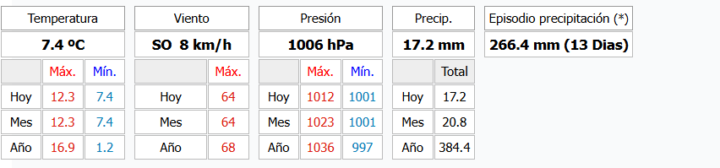
I’ve never seen such a wet January — it’s often the driest winter month here in Andalucía. Here’s a screenshot of the meteorological records for my area for January alone — nearly 400 mm! That’s almost what we usually get in a whole year, since the annual average is around 450–500 mm. If we add the rainfall since Autumn 2025, we’re probably already over 600 mm. It looks like we’re in the middle of a La Niña influence. I’m no meteorologist, but here’s what my gut tells me: - The last two years, aquifers have been able to recharge more than during the previous drought years. - We seem to have perfect conditions for larger-scale plantings, thanks to the rainfall. This is one of the reasons why, after seeing the heavy autumn 2024 rains, and the total rainfall of 2025 we went ahead with a large syntropic planting (~6000 m²). Doing this is especially important when water is limited - mind you, we’re on a hill where wells dry up faster than in the lowlands. So why is this the right time to plant? El Niño and La Niña cycles don’t happen from one year to the next. Each phase usually lasts 2–7 years, because ocean and atmospheric systems take time to shift. This creates clusters of wet or dry years, rather than a perfect alternating pattern. For planting, this is crucial: if we’re at the end of a wet phase, it’s a great opportunity to plant. The soil still has moisture, the aquifers are recharged, and there’s a high chance of more rain during the rest of winter and spring, maybe even into early June if we’re lucky. Let the trees and the soil soak up that rainfall, we'll end up with deeply taprooted trees that will grow more vigorously than in drought years, it's the perfect opportunity - the timing couldn't be better !
0 likes • Feb 5
Here in Crete things are a bit better than the last 5 years (close to the 30 year average bust still below that; last few years we were at 50% of average). However, the big news is that we just had the warmest January in history and February continues the same way. We had zero chill hours so far close to sea level, which means no hazelnuts, nectarines, almonds, peaches, walnuts and even some olive varieties....things are really really bad. We have many days with 20-23 degrees.....it's insane
0 likes • Feb 18
Btw, it's true that during La Niña winters, the polar jet stream is more prone to dipping south over the Atlantic, which can favor more frequent low-pressure systems entering the Mediterranean basin—especially the western and central Mediterranean. This increases the probability of wetter conditions but does not guarantee them. The Mediterranean is having a very wet winter mainly because persistent atmospheric blocking (anti-cyclone) over northern Europe is forcing Atlantic storm tracks southward, repeatedly steering low-pressure systems into the region. At the same time, a warmer Mediterranean Sea and altered jet-stream patterns driven by climate change are intensifying these storms, increasing moisture availability and rainfall when they arrive.
1-8 of 8
@nikolaos-gryspolakis-1227
Syntropic/Mycotropic farmer/designer. Water management engineer. FreeField
Active 7d ago
Joined Jan 30, 2026