
Mar 4 (edited) • Design and Soil Preparation
The Infestation - How to do syntropic ag amendments free
Hey everyone !
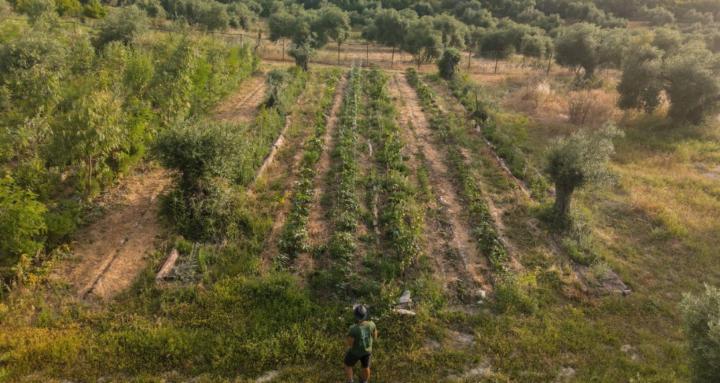
For the past two years I’ve been working toward something I’m finally beginning to implement: "the Infestation" a term coined by Scott Hall. Those of you on his platform will likely be familiar with it. Scott actually shared a design with me, and I’m currently in the middle of preparing the soil.
- What is an infestation, and what’s the purpose?
The concept of an infestation is simple—it’s essentially how nature most efficiently drives succession forward from bare or infertile soil.
In natural ecosystems, a tough, fast-growing pioneer species colonizes poor ground because it’s the most adapted to those harsh conditions. It rapidly occupies space, outcompetes other plants, and establishes dominance so effectively that even grasses have little impact on its growth. After a few years, this often results in a dense hedge or stand of that species—you can clearly observe this along many roadsides. In my area, the species that naturally behaves this way is Acacia saligna. It self-seeds readily and is extremely resilient.
Successional Accumulation
Inspired by this natural process, Scott has been developing the concept of “Successional Accumulation.” The goal is to run syntropic agroforestry systems without external amendments by harnessing the initial growth and biomass production of the infestation phase.
The system progresses through:
- Infestation phase (pioneer dominance and biomass buildup)
- Stabilisation phase
- Succession phase
The end goal is the same abundance we seek in syntropic ag - but achieved only through plant power rather than external inputs. I won’t dive too deep into each phase here, but I’m happy to discuss further.
Why acacias in the Mediterranean?
Scott and I have discussed extensively how to adapt this to Mediterranean climates. We both see Acacia species as particularly promising pioneers (e.g., Acacia saligna, Acacia dealbata, Acacia pycnantha, etc.).
Running amendment-free syntropic systems is especially important in Mediterranean and other brittle climates because:
- Compost and manure can be scarce
- Mulch is often limited
- In dry years, even wheat straw can become expensive and hard to source
That said, in semi-arid climates, irrigation is often still necessary during establishment (typically the first 2–3 years) until the system becomes more self-sufficient.
The current implementation I'm preparing (Scott's design)
The specific design I’m testing is a very dense acacia infestation:
- Trees planted every 1 meter
- Rows spaced every 2 meters
The goal is to accumulate fertility as quickly as possible. Over the next few years (my estimate is around 5 years, possibly more):
- The acacias will be pruned annually or bi-annually depending on regrowth
- The biomass of all the rows will be brough to the center line.
- The stabilisation phase (support species and fruit trees) will be planted into that improved zone
It will require patience, but the potential upside is huge :
- Scalable conversion of large farmland
- Minimal external inputs (mainly irrigation early on)
- Resilience
Importantly, this approach isn’t limited to agroforestry—it could also be adapted for annual vegetable production.
Overall, this feels like a very pioneering approach that could have a major impact on degraded Mediterranean soils, many of which are being abandoned year after year.
Looking forward to discussing this with you all in the comments !
10
25 comments
The Infestation - How to do syntropic ag amendments free
powered by
skool.com/syntropic-agroforestry-w-milan-3000
Mediterranean Syntropic Agroforestry made practical.
Efficient design, minimal water, low inputs — maximum impact.
Suggested communities
Powered by