
Write something
May 27 •
My Biggest syntropic mistakes
My first syntropic rows were too wide and not enough space between the rows, it's much more adaptable to have 4m between the rows, and then if you choose it is still possible to alley crop, run animals or cut hay/bio mass . The width of the rows should be as narrow as it is practical to cultivate, I now choose 60cm width because my broad fork is 55cm wide . Narrow rows save time weeding and can always be widend after a few seasons of mulching. My planting density is about 40cm, which again saves on weeding, economising on planting density is tempting, but in the end slows the system and makes more work, if there's not enough to fill the row, push cuttings in the gaps after a bit of experience you get an idea of what roots easily. There's always comfrey or something similar to fill gaps where plants fail . Making a mother row of plants to propagate from is a good investment, when you become experienced in multipling these, the extra plants can be exchanged for new members of your mother plant community or sold to raise revenue. My first experiments in syntropic planting were more of a hybrid between traditional landscaping and forest gardening, both of which I know well, now I find it pays to be committed to getting the planting correct because the speed of establishment is considerably better/quicker when you get it right .

Apr 17 •
Infestation Block of Acacias
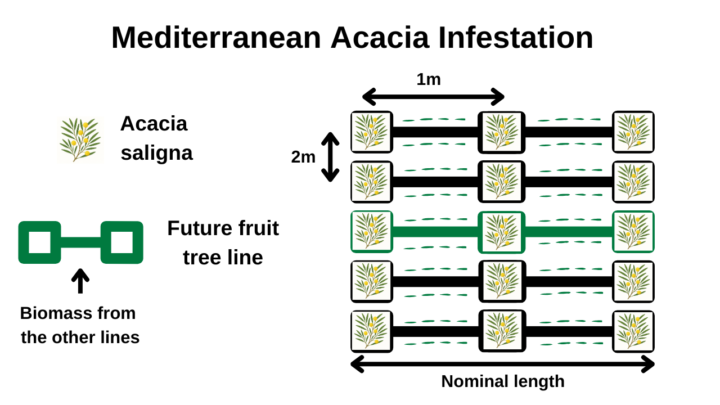
After a year and a half of thinking about it -and after visiting Scott Hall on his farm, as well as the Permadynamics family in New Zealand - I finally took the leap and planted an infestation block of Acacia saligna. In this video, I am breaking down what Infestation actually means, and why it can be such a powerful lever - especially in brittle climates (Arid, Semi-arid or Mediterranean climates) Infestation isn’t a standalone method. It’s the first step in a broader framework called Successional Accumulation, a concept developed and coined by Scott Hall. The process unfolds in these three stages: - Infestation - Stabilisation - Succession We’ll dive deeper into each of these steps here on the platform as we go ! What I’ve found is that this approach is far more practical at scale than trying to plant everything all at once - especially when you’re limited in water, amendments, or access. And Scott covers his experience with it on his platform. It’s a way to work with constraints instead of fighting them, and it can significantly reduce costs while setting up a long-term resilience strategy. I’d really love to hear your thoughts. What species have you seen that could play a similar role in your climate ?
Apr 15 •
A Tip to Prevent Weeding - Video Filmed in February
The Fava Bean Trick ! Fava beans are great for smothering weeds, and they sprout easily with the first rains. In this video, I show how I use them - and how much easier they make the work. No need to get on your knees pulling grasses in the first year. You get 2 cuts with them, and each cut took me 20min/100m/1 person. It's really not that much work - about 2 and a half hours for these 3 rows of 240m each. By the time they phase out, it’s already Summer here in the Mediterranean, so there’s basically no need to weed anymore. Then when the rains return, your rows should be established enough that weeding becomes a minimal task. You might need a bit of weeding in year two if your trees haven’t grown enough - but in my experience, one more pass is usually enough - cutting them, not even uprooting them. After that, the trees outcompete the grasses and take over. What other plants do you think could do a similar job? I’m thinking artichokes or cardoons could work really well - but they’d need to be started as seedlings.
Mar 4 •
The Infestation - How to do syntropic ag amendments free
Hey everyone ! For the past two years I’ve been working toward something I’m finally beginning to implement: "the Infestation" a term coined by Scott Hall. Those of you on his platform will likely be familiar with it. Scott actually shared a design with me, and I’m currently in the middle of preparing the soil. - What is an infestation, and what’s the purpose? The concept of an infestation is simple—it’s essentially how nature most efficiently drives succession forward from bare or infertile soil. In natural ecosystems, a tough, fast-growing pioneer species colonizes poor ground because it’s the most adapted to those harsh conditions. It rapidly occupies space, outcompetes other plants, and establishes dominance so effectively that even grasses have little impact on its growth. After a few years, this often results in a dense hedge or stand of that species—you can clearly observe this along many roadsides. In my area, the species that naturally behaves this way is Acacia saligna. It self-seeds readily and is extremely resilient. Successional Accumulation Inspired by this natural process, Scott has been developing the concept of “Successional Accumulation.” The goal is to run syntropic agroforestry systems without external amendments by harnessing the initial growth and biomass production of the infestation phase. The system progresses through: - Infestation phase (pioneer dominance and biomass buildup) - Stabilisation phase - Succession phase - The end goal is the same abundance we seek in syntropic ag - but achieved only through plant power rather than external inputs. I won’t dive too deep into each phase here, but I’m happy to discuss further. Why acacias in the Mediterranean? Scott and I have discussed extensively how to adapt this to Mediterranean climates. We both see Acacia species as particularly promising pioneers (e.g., Acacia saligna, Acacia dealbata, Acacia pycnantha, etc.).
Feb 9 •
Retrofitting an Olive grove with a 10x10m spacing
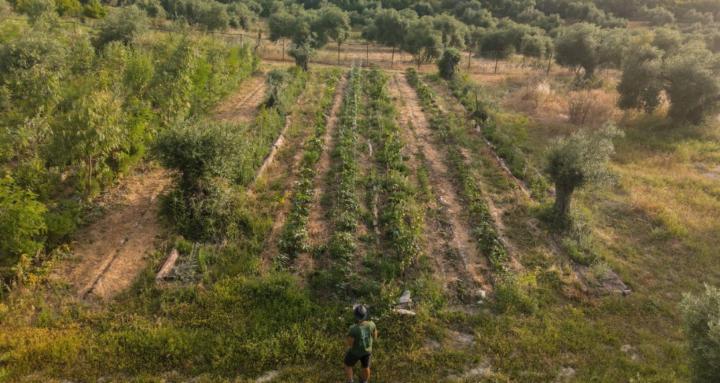
Olive groves are everywhere in the dry Mediterranean zones. And yet many ancestral groves still keep this 10x10m spacing. Now it's going more towards the 6x6m or 7x7m spacing but still it shows that this idea of planting at maturity spacing is highly unefficient. You're not gonna get any return from this planting for decades. We can use these spaces in a much smarter way ! Here's what we've done on a 150m row !

1-9 of 9
powered by
skool.com/syntropic-agroforestry-w-milan-3000
Mediterranean Syntropic Agroforestry made practical.
Efficient design, minimal water, low inputs — maximum impact.
Suggested communities
Powered by