Activity
Mon
Wed
Fri
Sun
Feb
Mar
Apr
May
Jun
Jul
Aug
Sep
Oct
Nov
Dec
Jan
What is this?
Less
More
Memberships
Liberty Politics Discussion
3.3k members • Free
8 contributions to Liberty Politics Discussion

5h •
Injuries Reported After Police Operation in Front of the Iranian Embassy in London
Disturbing images are currently reaching the international public via TousiTV, showing a police operation during what appears to have been a peaceful demonstration in front of the Iranian Embassy in London. At present, the exact circumstances surrounding the events in the United Kingdom remain unclear. According to available reports, there have been allegations of possible misconduct of individuals of London Police against involving individuals identifiable as members of the press in connection with the demonstration outside the Iranian Embassy. Video footage repeatedly shows scenes in which police officers push demonstrators back using physical force, rather than employing de-escalatory measures such as dialogue or verbal communication. Notably, police measures can be observed already at the beginning of the demonstration, the specific reasons for which cannot be clearly determined based on the available material. The recordings also show individuals with visible injuries following contact with the police. Several of these individuals appear emotionally distressed, including crying, after police officers spoke continously to them. The circumstances that led to these reactions cannot be conclusively assessed on the basis of the available footage. In some video sequences, it also appears that a police officer involved repeatedly attempts to prevent camera crews or journalists from filming. From a journalistic perspective, it therefore seems appropriate to document these scenes and, where necessary, make them available for possible later review. Regardless of this, the presumption of innocence naturally applies in this case as well. This article is not intended to create sentiment for or against either side. Nevertheless, the question of how these scenes came about remains a legitimate one. Source:{youtube>yg5AAIhakoU} #London #Demonstration #PoliceConduct #FreedomOfExpression #HumanRights Note: This post is based on currently publicly available video material and eyewitness accounts. Should new information or official statements emerge, the article will be updated or corrected accordingly.
0 likes • 5h
I covered this in a new Article on FischundFleisch: https://www.fischundfleisch.com/ezeyko/verletzte-nach-polizeieinsatz-vor-iranischer-botschaft-in-london-91325
14h •
international Security Conference | islamistic Regime isolated further
German media report that representatives of the Islamic Republic of Iran were uninvited from this year’s Munich Security Conference. While this may appear symbolic, it is nevertheless an indicator of ongoing international isolation and growing diplomatic backlash against the Islamist regime, following its internal repression. At the same time, it remains troubling that representatives of the Islamic Republic are still treated as legitimate diplomatic actors at all. Notably, the uninvitation also highlights a broader inconsistency: the regime was ultimately handled with greater institutional consideration than parts of the Islam-critical Iranian opposition, which says much about the continued naivety of European political frameworks when dealing with authoritarian regimes, human rights violations, and ideological extremism. Note: This development may also be relevant in the context of the secular revolution. The year before, Reza Pahlavi was invited, while he was not invited this year – a decision that already triggered media backlash regarding the conference’s invitation policies. At present, there is no information on whether this will be reconsidered through a formal re-invitation of Reza Pahlavi, which would represent a notable signal of international solidarity with the Iranian people. Sources: https://www.rnd.de/politik/muenchner-sicherheitskonferenz-laedt-iran-nach-gewalt-bei-protesten-wieder-aus-QFLHB4IHDFA5HFDCOB5XRJ2VDA.html?outputType=valid_amp https://www.finanzen.at/nachrichten/aktien/muenchner-sicherheitskonferenz-ladt-iran-wieder-aus-1035719943
0 likes • 14h
I also covered that topic again on Fisch&Fleisch: https://www.fischundfleisch.com/ezeyko/internationale-sicherheitskonferenz-islamistisches-regime-weiter-isoliert-91322
15h •
Independent Journalistic Coverage | German Sources
I cover current political developments on the Iranian secular Revolution as they emerge on Fisch & Fleisch, an independent Austrian journalism blog focused on politics, geopolitics, and security-related topics. If you are interested in German-language sources or articles for analysis, discussion, or citation, feel free to use and share them. I will continue to provide updates, original reporting, and translated materials where relevant. Main page:https://www.fischundfleisch.com/ezeyko/saekulare-revolution-iran-91290 Latest article (Iran situation report, Jan 16, 2026):https://www.fischundfleisch.com/ezeyko/iran-lagebericht-16-jaenner-2026-91319 German translation of Reza Pahlavi’s vision statement on a free Iran: https://www.fischundfleisch.com/ezeyko/iran-saekulare-revolution-91300
0 likes • 15h
if you have or search for additional german sources please feel free to share. best regards!
16h •
Reza Pahlavi | Press Conference 16.Jan.2026
Press Conference of Reza Pahlavi on the actual Situation in Iran: "the so called Islamic Republic is NOT the government of the people of Iran" (R.Pahlavi). #freeIran #rezapahlavi #Iran #HumaRights Source: https://www.youtube.com/live/GIYZhaoiFYU
0
0

1d •
When “Leftist” Means the Wrong Thing: How Global Mislabeling Is Undermining U.S. Support
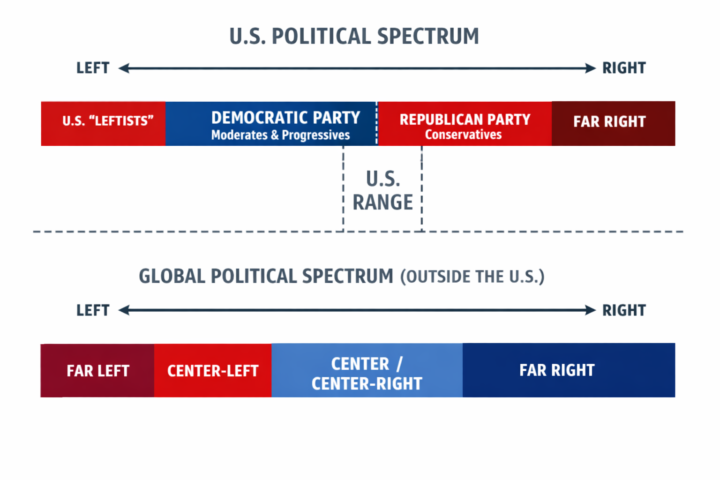
Quick summary: Much of the frustration over U.S. “leftist” support for the Iranian revolution is rooted in a basic mistake: American Democrats are not leftists by global standards. Misusing these labels distorts expectations, weakens solidarity, and obscures why support appears uneven. ————— As global conversations increasingly cross borders through journalism and social media, political language plays a powerful role in shaping understanding—and misunderstanding. One area where this is particularly evident is in how the terms “leftist” and “Democrat” are used by commentators outside the United States when referring to American politics. The issue is not one of intent, but of alignment. The U.S. political spectrum is structured differently from that of many other countries, and political labels that translate easily elsewhere do not always map cleanly onto the American system. When these differences are overlooked, confusion can arise—sometimes with real consequences for international engagement and cooperation. In much of the world, “leftist” is primarily an economic designation. It often refers to political movements or parties that support expansive social welfare systems, strong labor protections, and a more active role for the state in ensuring economic equity. These positions are common and well-established within left-wing politics internationally. In the United States, however, the term carries a narrower and more specific meaning. Most members of the Democratic Party do not identify as leftists in this global sense. Economically, many U.S. Democrats would be considered centrist—or even center-right—by international standards. The American political left, as understood elsewhere, exists within the U.S. but represents a relatively small segment of the broader political landscape. This distinction is important because expectations often flow from terminology. When international observers assume ideological alignment between U.S. Democrats and left-wing parties abroad, they may reasonably expect similar policy positions, rhetoric, or strategic priorities. When those expectations are not met, the gap can be misinterpreted as reluctance, inconsistency, or lack of support.
2 likes • 1d
In my view, it is worth pausing for a moment to reflect on what terms like “left,” “center-left,” “center-right,” or “far-right” actually mean — and whether these labels are still useful at all. I personally describe myself as liberal-conservative. But does that make me “left” or “right”? I would argue: neither. What is often called Classical Liberalism, especially in the tradition of the Austrian School, is not an ideology in the narrow sense. It is rather a framework of ideas that does not neatly belong to the political left or right — and in some respects touches elements of both. At its core, this framework rests on a few fundamental principles: - the primacy of reason over dogma - open discourse within society - factual debate (arguments ad rem, not ad hominem) - the primacy of science and evidence - capitalism as an economic foundation - and, above all, human rights as the guiding maxim of political action In addition, I consider myself a pan-European patriot — a category that is still evolving and not yet clearly defined. Culturally and philosophically, I often feel closer to the American constitutional and liberal tradition than to narrow national identities, even though I was born and live in Austria. Around 2015, I joined a movement of like-minded people who warned about the dangers of radical Islamism and proposed a political concept built on three pillars: secure borders, humanitarian aid at the location where needed, and regulated remigration. For this, the movement was broadly labeled “far-right” or “extremist”, despite operating within legal boundaries and explicitly grounding its positions in human-rights reasoning. The result was a deep lesson for me:labels such as left and right often say more about who is doing the labeling than about the actual content of a position. To some on the far left, I appear as an islamophobe right-wing extremist; to some on the far right, I appear as a naïve liberal left wing idealist. Both views miss the point.
1 like • 1d
@Brittani Coy amen, absolutley. I think you handle it for you also in a very smart way. best regards! Am Yisrael Chai! Azadi!
1-8 of 8
@markus-zeitlhofer-5028
Ein Student zahlreicher Künste, ein Forscher auf mancherlei Wegen
Active 4h ago
Joined Jan 15, 2026
Powered by