Activity
Mon
Wed
Fri
Sun
Feb
Mar
Apr
May
Jun
Jul
Aug
Sep
Oct
Nov
Dec
Jan
What is this?
Less
More
Memberships
Liberty Politics Discussion
3.3k members • Free
8 contributions to Liberty Politics Discussion

4d •
The Importance of Remembering the Fog of War as Events Unfold
As reports begin to surface about the upcoming Iran operation, it is critical for the public to pause, breathe, and remember one enduring truth of conflict: the fog of war is real, unavoidable, and often misleading—especially in the earliest stages. In moments like these, information moves faster than understanding. Social media fills gaps before facts are confirmed, analysts speculate in real time, and emotionally charged narratives take hold long before reality has a chance to emerge. This is precisely when caution matters most. What Is the “Fog of War”? The term fog of war refers to the uncertainty, confusion, and incomplete information that surrounds military operations and conflicts. Coined by military theorist Carl von Clausewitz, it describes the reality that no participant—commanders, governments, journalists, or the public—has a complete or perfectly accurate picture while events are unfolding. Even those directly involved often operate with fragmented intelligence. For outside observers, the fog is exponentially thicker. Take Everything With a Grain of Salt In the opening hours and days of any operation, nearly all information should be treated as provisional, not definitive. Early reports may be: - Incorrect - Incomplete - Out of context - Intentionally misleading - Based on assumptions rather than confirmation This does not mean journalists, analysts, or observers are acting in bad faith—it means they are working inside the fog. Accuracy tends to improve with time, corroboration, and declassification, not immediacy. Factors That Will Increase the Fog in This Conflict Several elements are likely to intensify confusion and misinformation surrounding this operation: 1. Language Barriers Primary-source information may emerge in Persian (Farsi), Arabic, Hebrew, or regional dialects. Nuance can be lost or distorted in translation, especially when rushed for headlines or social media. 2. Interpreters and Secondary Sources Much of what the public receives will be filtered through interpreters, stringers, or intermediaries. Each layer adds the potential for misunderstanding or emphasis shifts.
1 like • 12h
Please read this article and repeat the two points below to yourself over and over again. While there is (probably) about to be the biggest military operation in history, know that the biggest mis/disinformation campaign in history is currently being fought online. 4. Information Operations (InfoOps) All modern conflicts involve strategic messaging. Governments, state actors, and non-state groups actively shape narratives—both domestically and internationally. Some information will be released intentionally; other facts will be withheld or delayed. 5. Classified Intelligence Some of the most consequential details—targets, objectives, intelligence sources, decision-making processes—will remain classified indefinitely. Even years from now, the full picture may never be publicly known.
1d •
January 16, 47 Years Ago Today
Today, January 16th, marks exactly 47 years since the Shah’s exile. 47 years of hell.
2
0
1d •
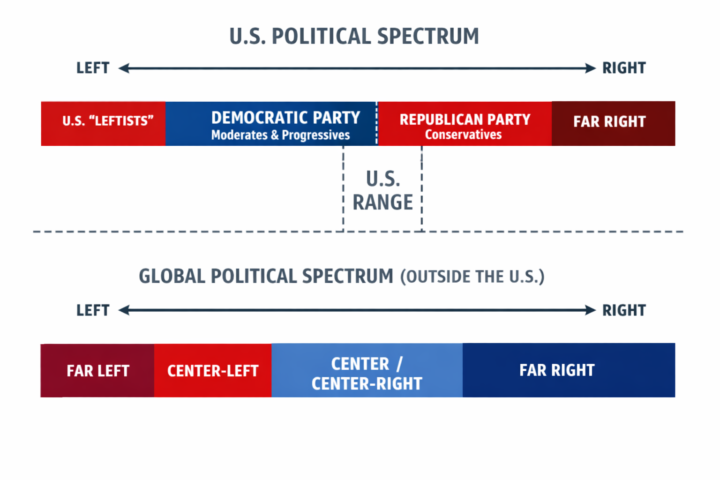
When “Leftist” Means the Wrong Thing: How Global Mislabeling Is Undermining U.S. Support
Quick summary: Much of the frustration over U.S. “leftist” support for the Iranian revolution is rooted in a basic mistake: American Democrats are not leftists by global standards. Misusing these labels distorts expectations, weakens solidarity, and obscures why support appears uneven. ————— As global conversations increasingly cross borders through journalism and social media, political language plays a powerful role in shaping understanding—and misunderstanding. One area where this is particularly evident is in how the terms “leftist” and “Democrat” are used by commentators outside the United States when referring to American politics. The issue is not one of intent, but of alignment. The U.S. political spectrum is structured differently from that of many other countries, and political labels that translate easily elsewhere do not always map cleanly onto the American system. When these differences are overlooked, confusion can arise—sometimes with real consequences for international engagement and cooperation. In much of the world, “leftist” is primarily an economic designation. It often refers to political movements or parties that support expansive social welfare systems, strong labor protections, and a more active role for the state in ensuring economic equity. These positions are common and well-established within left-wing politics internationally. In the United States, however, the term carries a narrower and more specific meaning. Most members of the Democratic Party do not identify as leftists in this global sense. Economically, many U.S. Democrats would be considered centrist—or even center-right—by international standards. The American political left, as understood elsewhere, exists within the U.S. but represents a relatively small segment of the broader political landscape. This distinction is important because expectations often flow from terminology. When international observers assume ideological alignment between U.S. Democrats and left-wing parties abroad, they may reasonably expect similar policy positions, rhetoric, or strategic priorities. When those expectations are not met, the gap can be misinterpreted as reluctance, inconsistency, or lack of support.
1 like • 1d
@Markus Zeitlhofer I couldn’t agree more! I vote based on issues, not along party lines. While many of my views align with those just left of center, I do not consider myself a democrat. I also tend to lean right of center on other topics. For those reasons, I refer to myself as an independent- independent of any party. However, supporting the Iranian revolution isn’t a left or right issue—it’s a human rights issue.

3d •
Secured myself and interview for channel 12 tomorrow
I tried to get it for Goldie and Armin but its taking too long. Meanwhile they offered me an interview tomorrow with me. What points should I focus on? Does anyone here (sadly) personally knows anyone that got murdered in the recent days in the protests? If you do you can send me the story and maybe I can bring it to awarness
0 likes • 3d
Did you give them @Armin Navabi [email protected]
4d •
Urgent—but Not Rushed: The Importance of Getting This Right
While we all recognize the urgency—and the desperate need—for intervention on behalf of the Iranian people, it’s also important to understand why this process cannot be planned overnight. Operations of this scale, involving the United States, Israel, and partner nations, require an unprecedented level of coordination. What many hope will be a decisive and successful operation to truly free the Iranian people would likely be one of the most complex military and intelligence efforts in modern history, possibly “1,000 years.” That level of complexity demands time, precision, and verification at every step. Before anything can move forward: - Plans must be coordinated across multiple governments, militaries, and intelligence agencies. - Intelligence must be confirmed and reconfirmed—including leadership locations, military assets, civilian risk zones, and internal power structures. - Potential targets must be validated, then validated again. If even one assumption is off, the entire plan may need to be reworked. - Civilian safety, humanitarian corridors, and post-operation stability must be planned in advance, not improvised later. - Cyber operations, communications disruption, airspace control, logistics, and regional escalation risks all have to be synchronized down to the minute. - Defensive measures and force protection must be fully in place to safeguard the service members and personnel carrying out the operation, as well as allied forces and regional partners. History has shown that rushed operations often lead to prolonged conflict, unnecessary civilian suffering, or power vacuums that ultimately harm the very people they were meant to help. Taking the time to get this right is not hesitation—it is responsibility. It’s also important to remember that the public typically sees only a small fraction of what governments and intelligence agencies know—often far less than 10%. By necessity, the most critical elements of any operation remain unseen and undisclosed until outcomes are already in motion.
0 likes • 3d
A good thing to keep in mind right now.
1-8 of 8