Activity
Mon
Wed
Fri
Sun
Aug
Sep
Oct
Nov
Dec
Jan
Feb
Mar
Apr
May
Jun
Jul
What is this?
Less
More
Memberships
AI Automation Society
425.5k members • Free
The Unspoken Advantage
49 members • Free
7 contributions to The Unspoken Advantage
Apr 9 •
"You get out what you put in."
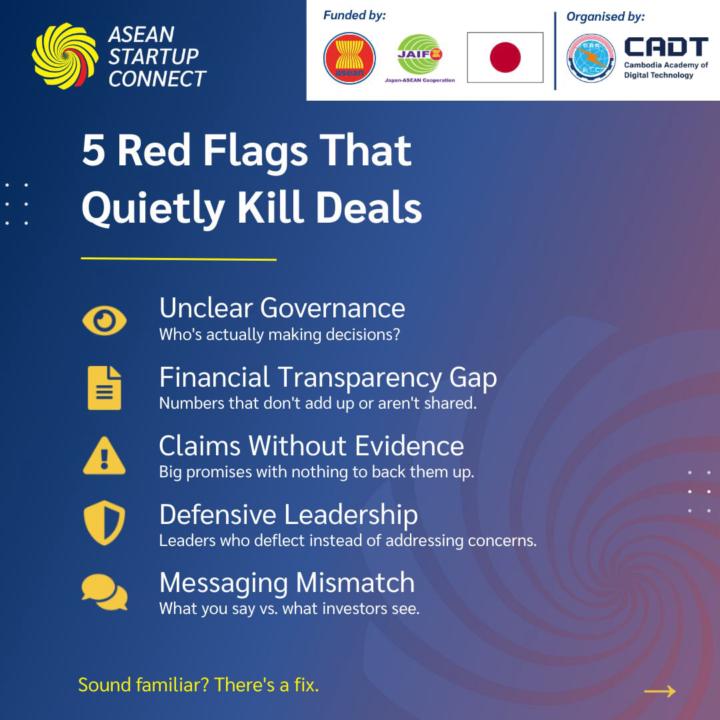
This line has been echoing all week. It's increased my awareness for the energy that was brought into a room... and the impact thereof. Today's ASEAN Startup Connect mentorship session was a positive example. Time-constrained founders, yet: cameras on, good wifi, a heads-up about possible distractions. What might sound like simple intentionalities became an open door to what followed: the presence, the honesty, the willingness to drop the defense and push back on each other's assumptions. We ended the call with the energy feeling rich in human connection and concrete, challenging next steps (shoutout to RATH SEREY for setting the tone)! A few things we worked through that might land for other founders: ➡️ Staying quiet about what you do, just means the people who need you can't find you. (cf. Seth Godin 🌔 video) ➡️ If you already have clients who like what you do, ask them why. Their answers are your sharpest differentiator, and a credible case for being worth a premium. ➡️ Speak your client's language, sometimes this means putting together an estimated financial impact case, not just a preference case. 👉 If you want to be part of the room, join our next session here

Mar 24 •
The choice now is not whether to transition.
It's what you transition to. Buy Russian oil and fund a war. Wait for Middle Eastern infrastructure to rebuild and pay record prices while you do. Or accelerate the renewable transition that was always the more sovereign, more stable, and more defensible option. The people loudest against renewables right now are often the ones feeling this most. They're not villains. They were sold a story about cheap energy that just collapsed. Meeting them with empathy rather than a scorecard is the only way this conversation moves forward. But it does need to move. Contact your local MP. Ask what the energy transition plan looks like now that the old one is on fire.
0 likes • Mar 24
Looking forward to hear Kelvin's insights moving forwards, now that he has a bit more renewables buy-in!
1 like • Feb 26
I can imagine how capital still remains an issue for people who don't have extra cash to put aside daily. If the clothes are sure to last long and we want to show buyers how little it ends up costing over time, I wonder whether it would make sense to buy sustainability items via an interest-free loan system supported by an impact-driven bank or even a community?
Feb 24 •
What are your learnings from investor pitches?
Joining the “Get Funded” webinar with @Galeno Chua today raised some great reminders and questions ! - Did you know that in a first impression when an investor is asking themselves “can I trust this person?” 55% of that answer comes from your body language, 38% from your tone, and only 7% from the actual content? - Investors are paying attention to how you show up: your presence, your awareness, the way you read the room, how you talk about people who aren’t even in the room. - Preparation matters way beyond your pitch deck: who are you actually pitching to? - How do you show up authentically when startup culture feels like you need to “have it all together / fake it till you make it”? Integrity and being forward-thinking will make you stand out. If you say you have no competitors? That sounds off. But if you’ve identified who does something similar, how you’re different, and how you could even learn from or collaborate with them? You sound realistic. Like a more mature, less risky company to invest in… and that’s worth trust coins. I’m curious too: what are things you’ve learned from your own investor pitches? 👇
1
0
Feb 16 •
Pt 1: 5 Spheres of Empathy: How to Build a Master Plan of Impact That Outlives You Part 1
We often treat empathy in business as a "soft skill", a virtue we aspire to because we want to be seen as "good" leaders. But in leadership, treating empathy as a mere nicety is a strategic error. True innovation, the kind that lasts for generations, requires more than just a good idea or brute force (outside of pure luck!). It requires empathy. Empathy is a skill that helps you make better decisions. It validates if your "game-changing" idea is actually useful, or just an expensive vanity project. Whether you’re solving a huge problem for people, or creating something incredible for the sake of it, it’s often something for people. This includes yourself! How could you possibly know if you’re on track without zooming out and considering perspectives of the people you’re trying to serve? Empathy here acts as the root source of data that helps you inspire, guide, and validate people-problems. Additionally, my experience with leaders at all levels in public office, corporations, NGOs and even royalty have led me to a fundamental conclusion: almost all business problems and all sustainability problems are people problems. Even the most powerful people on the planet are not immune to incompetence, poor communication, poor teamwork and bad intentions. Collectively, we have the technology, the financing, the authority and almost everything you can imagine to do incredible things today, but what blocks us, is each other. Without empathy, you’ll be stuck with the biggest roadblocks humanity has ever faced, other humans! On that note, simply "being empathetic" isn't enough. Most of us confuse empathy with kindness, and that confusion creates two specific risks that can destroy both ventures and visions: waste and manipulation. Before we start master planning your legacy, we need to clear this poor definition in two parts: 1. Empathy without kindness 2. Kindness without empathy 1.Kindness Without Empathy When empathy and values (like kindness) are decoupled, they become dangerous to leadership and the people you influence.
1 like • Feb 17
“Collectively, we have the technology, the financing, the authority and almost everything you can imagine to do incredible things today, but what blocks us, is each other.” This quote really hit hard… Also, I’m not sure I understood how the example around “Building expensive features nobody asked for because a decision-maker somewhere thought they were cool.” is a display of kindness? Or maybe I’m taking the definition of the word to literal?
1-7 of 7
@marika-v-7706
Business Sustainability Coach with a background in Communication, HR and recruitment for renewable energy startup.
Active 97d ago
Joined Feb 2, 2026