Activity
Mon
Wed
Fri
Sun
Nov
Dec
Jan
Feb
Mar
Apr
May
Jun
Jul
Aug
Sep
Oct
What is this?
Less
More
Abundance Wellness
52
Free
28 contributions to Abundance Wellness

Apr 13 •
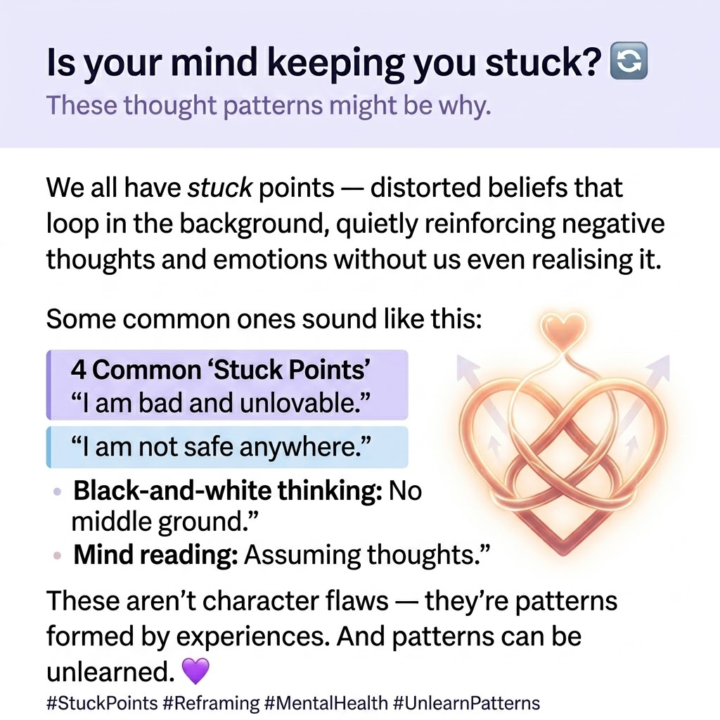
What we believe about ourselves shapes everything — our decisions, our relationships, and how far we go.
In my work, I've come to understand something powerful: many of the beliefs we hold aren't truly ours. They were formed in response to difficult or traumatic experiences — shaped by our need for safety, trust, esteem, and connection. Psychological research calls these schemas — deep-seated patterns of thinking that act as lenses through which we interpret the world. Some common trauma-related schemas include: - Believing you cannot trust others — ever - Feeling that your actions don't truly affect people around you - Assuming failure is inevitable, so why try - Feeling undeserving of good outcomes The good news? Beliefs can change. Awareness is the entry point. When we recognise that a belief was created by circumstance rather than being an objective truth, we gain the power to question it — and ultimately rewrite it. What's one belief you've successfully challenged? I'd love to hear in the comments. 👇

0 likes • Apr 19
I dont have friends up here I don't trust the way I speak Im not the best looking my clothes are rags honestly looking in the mirror is quite challenging. Moving through life isolated deliberately hurts. Im safe at home with my cat.
Apr 6 •
You Might Be Carrying Someone Else's Pain
How family trauma travels through generations — and what it means to finally put it down Have you ever felt a fear you couldn't explain — a sadness that arrived without reason, an anxiety that seemed to belong to someone older than you? You might have spent years trying to trace it back to something in your own life, and come up empty. Here's something science is only recently beginning to confirm: some of what we carry isn't ours. It belongs to the people who came before us. "Your body carries information that goes back not just to your childhood, but to your parents' childhoods — and even further back. This isn't mystical. It's science." In the framework of Internal Family Systems (IFS) therapy, we call these legacy burdens — extreme beliefs or feelings carried by parts of us that were inherited rather than formed from our own direct experience. The crucial thing to understand is: they are not your nature. They can be released. Four ways burdens travel through families Way 1 Merging with a parent's pain As a young child, you absorbed your parent's emotional state as if it were your own — and you may still be carrying it today. Way 2 Rejecting a parent When we cut off a parent entirely, we can inadvertently cut off a part of ourselves — because they live in our cells, our bones, our blood. Way 3 Early separation Disruptions in the mother–infant bond during the first years of life can create nervous system wounds that shape trust, safety, and joy. Way 4 The forgotten ancestor A later generation may unconsciously live out the life of someone whose story was never told — feeling their feelings, repeating their patterns. These patterns aren't flaws or weaknesses. They're a form of loyalty — the family system reaching across time, saying: this story matters. What healing looks like 1 Name what happened Silence keeps burdens in place. Giving something words — even privately — begins to loosen its grip. 2 Make the connection Notice how your current struggles might echo older family stories. Not to explain away your experience, but to understand its roots.
0 likes • Apr 10
Topic absolutely resonates with my life. Its really complicated where siblings have endured the same abuse then 1 decides to own the abuse and opts in to start dealing with it. Im way advanced than my brother. They dont get it I HAVE CHANGED Im past the old heading into the new healthy me . Its sad I gotta travel alone and get used it. All the above is most of my story. Im done being the victim, Im on my way to winning a Gold Star for being aggressively 😁 staunch to my life as it is right now 💖
Mar 26 •
What does trust have to do with healing from trauma?
This week in Yoga as Healing, we explored Trust. 🌿What if the most important relationship you need to rebuild trust in… is the one with yourself? 🌿 For so many people who've experienced trauma, self-trust quietly breaks down. You second-guess your feelings. You override your body's signals. You stop believing your own instincts. That's not a personal failing. That's what trauma does. In Yoga as Healing, we work gently on rebuilding that relationship — one breath, one sensation, one small choice at a time. Because trust in yourself doesn't come back all at once. It comes back in moments: ✦ When you listen to what your body needs ✦ When you choose rest without guilt ✦ When you say that didn't feel right and believe yourself ✦ When you meet your own pain with kindness instead of criticism You were never broken. You were protecting yourself. And you can find your way back. 🌸 That's exactly why we move through this work gently. In Week 8 we explore: ✦ What trust actually means through a trauma-sensitive lens ✦ How the breath becomes a reliable anchor ✦ Tree Pose + Arm Circles — rooted and flowing ✦ Trust affirmations you actually believe ✦ The Loving Eyes inner child practice Our mantra this week: I am rooted, but I flow. I trust in my body and breath to be my guide. Save this if it speaks to you.
0 likes • Mar 26
I am rooted, but I flow. I trust in my body and breath to be my guide. I really love this
Mar 11 •
Having free time on my calendar does not mean I have the capacity to take on more.
It took me several years to embody this truth: Having free time on my calendar does not mean I have the capacity to take on more. Urgency culture demands that we always be “on” and available, but always holding the default nervous system and being the emotional regulator everyone relies on takes a significant toll. May we all remember: - I am allowed to delegate and take breaks from it all. - I do not have to always take the lead. - I can practice getting more comfortable with letting some balls drop. As you read the following reminders from the nervous system, I invite you to notice: which one is resonating most with your heart today? Urgency culture says: Overriding the cues of my nervous system and neglecting my needs is just part of being of service to others. But perhaps your nervous system says: I do not need to live in a consistent state of hypervigilance and view everything as an emergency. I can slow down, rest often, and honor my boundaries. All of which support my resourcing, bandwidth, and ability to give. My trauma responses deserve healing and care. Urgency culture says: Just be more “resilient.” But perhaps your nervous system says: Resilience can be slowness for the nervous system, releasing urgency, and creating space. It can be letting myself fall apart without the pressure to quickly “fix” or “find a solution.” It can be honoring the needs of the current season and remembering that it won't always be this hard. It can be allowing myself to do less when I am coping with more. Urgency culture says: I am exhausted but I have to just power through. But perhaps your nervous system says: I do not need to prioritize myself last anymore or view my own health as an afterthought. I can practice gentleness with myself when I need more rest/recovery than others. I deserve so much more than survival mode. Urgency culture says: I measure my worth by how much I get done. But perhaps your nervous system says: I don't have to only associate a meaningful life with chaos and busyness or always filling the space. My productivity does not determine my worth. I can trust that my growth is still (and especially) happening in my moments of stillness.
0 likes • Mar 11
My nervous system is none being so poor is adding to my stress levels ages ago. If life was kinder in my beginning maybe I wouldn't be here today
Feb 24 •
Triggers don't have to control you. With the right tools, you can learn to take back your power. 💪🤍
A trigger can be almost anything — a smell, a sound, a time of year, a thought, even a body sensation. And when one hits, it can feel like the past is collapsing into the present all at once. But here's what's true: you have more choice than a trigger wants you to believe. ✨ Try this when a trigger strikes: Start by naming it. "I choose to distract myself from _____ by _____." Then try one of these in-the-moment strategies: - Hum, sing, or whistle a favorite song the moment it starts - Talk to yourself about what is real, right now, in this moment - Use the 5-4-3-2-1 method — name 5 things you see, 4 you hear, 3 you smell, 2 you feel, 1 you taste Grounding doesn't make the trigger disappear — it makes you bigger than it. 📊 Meet the Trigger Mapping Ladder: Think of your trigger response like climbing a ladder — each rung represents an escalation of tension in your thoughts, body, and actions. Understanding each rung helps you: - Spot your early warning signs - Intervene before full escalation - Separate the past from the present - Find meaning in your reactions You don't have to leap off the ladder. You can climb down, one slow and steady step at a time. Every trigger holds a clue. Every clue brings you closer to understanding — and healing. 🔑
0 likes • Feb 25
My triggers are starting to dwindle away, Im fighting bk using meditation. Im allowing harmony into my days now starting as soon as my brain is awake for the day I thank God for waking me with a mindful prayer to go with. For the first time in my life I am greatful for my achievements 🙏🏽 ✨️
1-10 of 28
Active 40d ago
Joined Nov 11, 2025