Activity
Mon
Wed
Fri
Sun
Mar
Apr
May
Jun
Jul
Aug
Sep
Oct
Nov
Dec
Jan
Feb
What is this?
Less
More
Memberships
Double R Labs
216 members • Free
Peptide Price
9.1k members • Free
191 contributions to Peptide Price

🔥
13d •
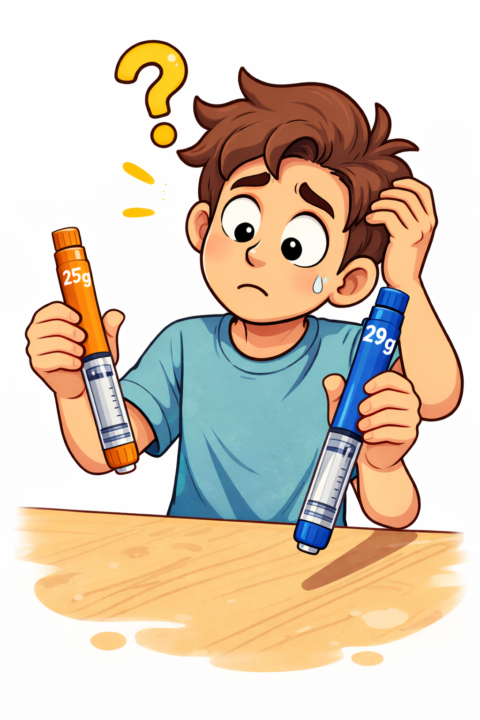
Syringe Gauges Explained: Why Your Insulin Syringe Won't Work for Everything 💉
For research use only. Not for human consumption. If you've ever tried to draw up L-carnitine or B12 with an insulin syringe and felt like you were trying to suck a milkshake through a coffee grinder—this post is for you. I see people get confused all the time. First, Understand This One Thing The gauge number tells you how thick the needle is. But here's what trips everyone up: Higher gauge = thinner needle So a 31 gauge needle is super thin (like an insulin syringe), while an 18 gauge needle is thick (like what they use to draw blood). Think of it like this: the higher the number, the smaller the hole. Why Insulin Syringes Work Great for Peptides Insulin syringes come with tiny 29-31 gauge needles built in. They're perfect for reconstituted peptides because when you mix a peptide with bacteriostatic water, you get a thin, water-like solution. Thin solution + thin needle = no problem. Why Insulin Syringes Fail with L-Carnitine and B12 These solutions are thicker. They're not mixed with just water—they often have different carriers that make them more viscous. Now you're trying to pull a thick solution through a tiny opening. What happens: You pull back on the plunger and barely anything moves. You're fighting the syringe the whole time. Air bubbles form because of all that resistance. What should take 5 seconds takes over a minute. You might even bend the needle from all that pressure. It's frustrating and unnecessary. The Fix: Draw with a Bigger Needle, Swap for Administration Here's the move that makes life easier: Step 1: Get syringes with removable needles (called luer lock syringes) Step 2: Attach a 22 or 23 gauge needle to draw up your solution. This is a wider opening, so thick solutions pull through easily. Step 3: Once you've drawn what you need, twist off that needle and swap it for a 27-30 gauge needle for administration. Smaller needle = more comfortable. That's it. Draw big, administer small. What Gauge for What? Reconstituted peptides (mixed with bac water): Insulin syringes work perfectly. No need to swap anything. The 29-31 gauge handles it fine.

0 likes • 10d
For large vials like bac water, mic b12 and glutathione I use a vial adapter it saves using multiple needles and quicker draws.
🔥
11d •
Will Peptides Make You Fail a Drug Test?
If you're researching peptides, you've probably wondered: "Am I going to fail a drug test?" It's a fair question, especially if you have a job that requires regular screenings or you're involved in competitive sports. Here's the short answer: It depends entirely on what KIND of drug test you're taking. Let me break this down in plain English so you understand exactly what you're dealing with. Two Completely Different Worlds of Drug Testing Before we dive into specific peptides, you need to understand that there are two completely separate drug testing systems that work in totally different ways: 1. Employer/Workplace Drug Tests — These are the standard screenings you take for jobs, DOT requirements, or random workplace testing. 2. WADA/Sports Anti-Doping Tests — These are the highly specialized tests used for competitive athletes at all levels, from college sports to the Olympics. These two systems are looking for completely different things, using completely different technology, with completely different goals. Let's break each one down. What Employer Drug Tests Actually Look For When your employer sends you for a drug test, they're using what's called a "panel" test. The most common ones are: The 5-Panel Test (Most Common) This is the standard test used by most private employers and all DOT-regulated positions. It screens for: - Marijuana (THC) - Cocaine - Opiates (heroin, codeine, morphine) - Amphetamines (meth, Adderall, ecstasy) - PCP (angel dust) The 10-Panel Test Used for more sensitive positions like law enforcement, healthcare workers, or government jobs. It adds: - Barbiturates - Benzodiazepines (Xanax, Valium) - Methadone - Propoxyphene - Methaqualone (Quaaludes) Notice anything missing? That's right — peptides aren't on any of these lists. Not even close. Why Peptides Don't Show Up on Standard Tests Here's the deal: standard drug tests use a technology called immunoassay. Think of it like a lock-and-key system — the test has specific "locks" (antibodies) that only react to specific "keys" (drug metabolites).

0 likes • 11d
@Derek Pruski I am currently in a clinical trial for the Moderna covid 19 vaccine and disclosed all my Pepetides and it did not disqualify me.
🔥
11d •
MOTS-C & Weight Training: A Practical Timing Guide for Researchers
I've been getting a lot of questions about MOTS-C and weight training lately. I've touched on this before, but let's break down the practical application so you can get the most out of your research. Note: This information is for research purposes only and is not intended as medical advice or guidance for human consumption. The Short Version Don't administer MOTS-C right before resistance training if the research goal involves building or retaining muscle tissue. Here's what the timing should look like instead: - A (Morning Training Protocol): Train → Post-workout meal → MOTS-C administration later in the day - Option B (Most Optimal Protocol): MOTS-C first thing AM → Fasted cardio → Resistance training in the afternoon Why Timing Matters: The Science Made Simple MOTS-C is an incredible energy and metabolic peptide, but it works through pathways that can interfere with muscle growth if timing isn't dialed in. Let me walk you through the mechanisms. 1. AMPK Activation (The Energy Switch) MOTS-C is a potent activator of something called AMPK. Think of AMPK as the body's "energy conservation mode." When AMPK is activated, the body prioritizes: - Burning fuel for energy - Breaking things down (catabolic processes) - Improving metabolic efficiency What gets deprioritized: - Building new tissue - Protein synthesis - Growth processes The problem: Muscle growth requires the opposite state. You want mTOR activated (the "building mode" switch), not AMPK. These two pathways essentially oppose each other. When one is on, the other is suppressed. In plain English: MOTS-C tells the body "let's be efficient with energy," while muscle building requires the body to say "let's invest energy into growth." Both can't fully happen at the same time. 2. Protein Synthesis Interference After resistance training, muscles have a window where they're primed to absorb nutrients and build new tissue. This is when protein synthesis rates are elevated. MOTS-C's AMPK activation can directly blunt this protein synthesis response. If MOTS-C is circulating during that critical post-workout window, it essentially puts the brakes on the very process that training just triggered.

7 likes • 11d
Today I did my first 5K and I took my Motsc and NAD fasted and had a lot of energy to easily complete the run. This a mile stone for me and 2 year weightloss and health journey. I did not once feel sluggish or wanting to stop due to lack of energy.
🔥
15d •
Do the Benefits from MOTS-C and SS-31 Stop When You Stop Researching Them?
This is one of the most common questions I get about mitochondrial peptides, and the answer is more nuanced than a simple yes or no. Let me break down what's actually happening at the cellular level. What These Peptides Actually Do MOTS-C and SS-31 work through different but complementary mechanisms to improve mitochondrial function. Your mitochondria are the powerhouses inside your cells that produce ATP, which is essentially the energy currency your body runs on. When your mitochondria work better, you have more energy, better metabolism, and improved overall cellular health. MOTS-C is a mitochondrial-derived peptide, meaning it's actually a signaling molecule that your mitochondria naturally produce. When you supplement with it, you're amplifying signals your body already recognizes. It activates something called AMPK, which is your cellular energy sensor—think of it like a thermostat that detects when energy is low and kicks on processes to produce more. MOTS-C also enhances glucose uptake (how well your cells absorb sugar from your blood for energy) and improves insulin sensitivity (how responsive your cells are to insulin's signal to take in that glucose). One of its most important functions is promoting mitochondrial biogenesis, which is simply the creation of brand new mitochondria. More mitochondria means more energy production capacity. It also helps regulate fatty acid oxidation (your body's ability to burn fat for fuel) and reduces oxidative stress (the cellular damage caused by unstable molecules called free radicals). SS-31, also known as Elamipretide, works differently. It targets the inner mitochondrial membrane directly, which is where the magic of energy production actually happens. It binds to something called cardiolipin, a special fat molecule that's essential for keeping the electron transport chain running smoothly. The electron transport chain is basically an assembly line inside your mitochondria that produces ATP. When SS-31 stabilizes this process, it reduces reactive oxygen species production (those damaging free radicals I mentioned) and improves ATP synthesis efficiency, meaning you get more energy output with less cellular damage.

1 like • 15d
I read that this is one the peptides you don’t have to cycle off - the clinical study had patients on it for years.
0 likes • 15d
@Derek Pruski I do take folate - it is by far the best and most effective peptide I have researched.
🔥
21d •
How To Make Your Own GHK-Cu Serum (It's Stupid Easy)
I've been getting a lot of questions about topical GHK-Cu so here's exactly how I make mine. What You Need: - Hyaluronic Acid (2oz): https://www.amazon.com/dp/B084X51ZPM?tag=onamzderekpru-20 - Germall Plus (preservative): https://www.amazon.com/dp/B08PKPQQQR?tag=onamzderekpru-20 - GHK-Cu Raw Powder: https://ionpeptide.com/product/ghk-cu-raw-1g/ (Code DEREK) - A small funnel - A cup or mixing container That's literally it. The Process: 1. Pour your 2oz of hyaluronic acid into a cup or small mixing container 2. Add a tiny amount of Germall Plus (follow the directions on the package - a little goes a long way, this is what keeps it from growing bacteria) 3. Dump in your GHK-Cu raw powder 4. Mix it like your life depends on it - you want that powder fully dissolved with no clumps 5. Use your funnel to pour it back into the original HA bottle 6. Done That's the whole process. No fancy equipment. No chemistry degree required. The hyaluronic acid acts as your carrier and helps with absorption, the Germall Plus preserves it so it doesn't go bad, and the GHK-Cu does its thing for skin/hair/healing. Store it in a cool dark place and you're set. If you don't want to make your own Throne has a great price: https://www.madebythrone.com/?ref=DEREK (Code DEREK) Questions? Drop them below 👇

0 likes • 21d
@Kimberly Snyder yes I have had success and do have new growth. I use it every other night. The kitsch is very handy.
1 like • 20d
@Tracey Calhoun not combined but I use both one for hair Ahk cu and ghk cu topi on face and body
1-10 of 191