Activity
Mon
Wed
Fri
Sun
Aug
Sep
Oct
Nov
Dec
Jan
Feb
Mar
Apr
May
Jun
What is this?
Less
More
Owned by Kim
StoryWork + Self-Leadership tools to untangle what's keeping you stuck.🌀 Grow your business by becoming the LEADER your stories have been blocking.🏆
Memberships
Mini-Project Magic™
94 members • $99,999
Your First $1K LIVE w/Arlan
219 members • $199
Magnetic Memberships
3.9k members • Free
Ultimate NLP Practitioner™
1.1k members • $54/month
Nervous System Experience Live
292 members • Free
Template Skool
3.7k members • Free
The Public Speaking Community🔥
5.1k members • Free
Freedom Empire by Maggie Giele
5.5k members • Free
Panda for Skool CRM +
434 members • $36/month
26 contributions to Income Without Burnout
🔥
6d •
Choose Your State of Mind
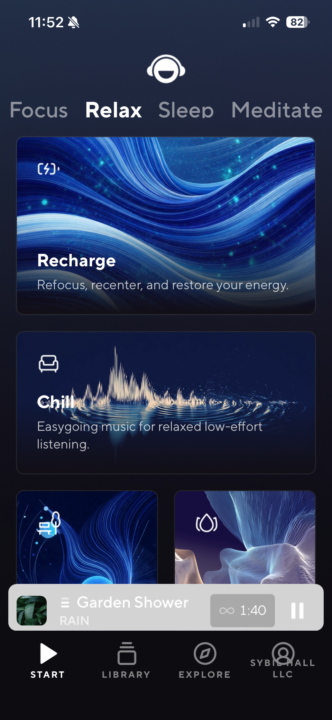
One of my favorite daily habits has nothing to do with my to do list. It starts with one simple question: What state of mind do I want to be in next? Before I hit play in Brain.fm, I choose. 🎯 Focus 🌿 Relax 😴 Sleep 🧘 Meditate Even within those, there are options. Right now, I’m listening to Garden Shower because I wanted to recharge and reset while in the shower. It made me realize that most of us let our environment determine our state. What if we did the opposite? What if we intentionally chose the state we wanted before we needed it? Need to write? Choose focus. Feeling overwhelmed? Choose calm. Need to recover after a hard meeting? Choose recharge. I’ve found that asking, “How do I want to feel 20 minutes from now?” is a much better question than asking, “How do I feel right now?” We have more influence over our state than we often realize. What’s one state of mind you will intentionally choose today?

🔥
1 like • 5d
My two favorite states: Lighthearted and Possibility!
🔥
Apr 14 •
One task
What’s one task on your list for tomorrow? It can be teeny, like posting on Pinterest. Or big, like finishing revisions on your journal. Both count. Both move you forward. In this community, we don’t wait for perfect days. We build momentum in small, doable steps. Drop your one task below 👇 Let’s make it real together 💛

🔥
2 likes • Apr 14
Tuesdays are Coaching Days for me. I have 3 laser sessions and a VIP Client Onboarding Call.
🔥
Apr 10 •
Friday gratitude
We just got to our investment property that we are preparing to sell, and I feel so humbled and grateful. I never dreamed we would own this gorgeous place. Twelve years ago, we bought it for $402,000 with $100,000 down. Since then, it has been a profitable Airbnb that covered all of its expenses and then some. What a chapter. Now we have made the difficult decision to sell, and we know the time is right. There is something emotional about this for me because I am not just selling a property. I am selling the first business I ever built. And when it sells, our take away should be over $500,000. That is business, people. And I’m so excited to say goodbye to paying for college stress amongst our other upcoming adventures. I am so proud of my husband and me. I ran all of the behind the scenes pieces, and he was the handyman. We brought our kids here through all these years, even while living outside the US for eight of them. And with eleven weeks each year spent in my parents’ basement in Denver, we filled this season of life with kayaks on the lake, trees, cute towns, and precious time with family across generations. I am just so grateful. And honestly, now that we are here, I can feel my nervous system settle. What a gift this place has been. 🙏🏻 https://www.airbnb.com/rooms/4260753 BTW- I’m probably going to be talking about this place all weekend. Sorry in advance! 🙄 If you have ever closed a chapter like this, I would love to hear… What is something you are proud of that you built over time? Or something you are learning to let go of right now? Share below. I would love to celebrate with you.

🔥
4 likes • Apr 11
Congrats! This is amazing. Isn’t it cool what we can create when we just trust and keep taking little steps?
🔥
2 likes • Apr 11
@Sybil Hall Yes! You don't have to know everything to start. The path is always made by walking.
🔥
Apr 9 •
My biggest takeaway with AI right now is simple, but it’s changing everything for me:
Give it data. Give it context. When I used to ask AI surface-level questions, I got surface-level answers. But when I slow down and actually share what I’m working on -my goals -my numbers -my messy thoughts -my real situation The output shifts completely. It starts to feel less like a tool… and more like support. It’s a good reminder for me as an educator and a builder, too clarity in → clarity out. If you’ve tried AI and felt underwhelmed, it might not be the tool… it might just need more of you. Curious… have you noticed this too?

🔥
3 likes • Apr 9
Yes. The real magic comes when you mix powerful prompting with your own expertise. Otherwise, what you get back is generic.
🔥
3 likes • Apr 9
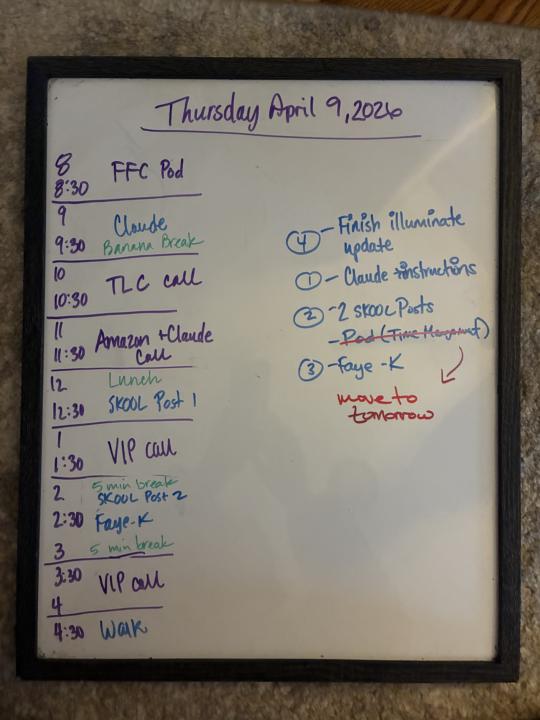
I only put appointments on my calendar. And I only have one appointment today. 3-5 pm: The 100: Season 2 Implementation Call (I promised my community a behind-the-scenes video every week as I participate, so I'll record that today.) The rest of my unplanned day will likely look like this: 5-7 Skool, Social Media, Client Voxers 7-8 Morning Routine 8-9 Breakfast and shower 9-11 Project Time 11 Afternoon Break & Lunch out with My Husband and resting until my afternoon call
🔥
3 likes • Apr 9
@Sybil Hall Haha! I'm all up in my feelings about it today. 😭 I'll share how I'm coaching myself through in my BTS video. Thank you for always being such a powerful champion for each of us.
1-10 of 26

🔥
@kimberlyjob
Self-Leadership & Master StoryCoach™️ shifting your world through StoryWork, Nervous System Safety, Business Rhythms, and Your Lighthouse Message!
Online now
Joined Feb 25, 2026
INFJ
Pleasant Grove, Utah