Activity
Mon
Wed
Fri
Sun
May
Jun
Jul
Aug
Sep
Oct
Nov
Dec
Jan
Feb
Mar
Apr
What is this?
Less
More
Memberships
The Homestead Hub
60 members • Free
Food Forest Homesteading Life
80 members • Free
The Healthy Coop Collective
45 members • Free
The Chicken Tenders
169 members • Free
23 contributions to The Healthy Coop Collective

2d •
Happy Sabbath! Sabbath Skool Animal Trivia 🐾
Happy Sabbath, Everyone! I’m starting a fun new series called Sabbath Skool Animal Trivia! Each Sabbath, I’ll post a question about an animal mentioned in the Bible. I’ll point you in the right direction, and you’ll have all day to answer. Everyone who answers correctly will be entered into a pool, and one person will be randomly selected to win a prize! 😊 This Week’s Question: With Passover and Resurrection Day just behind us, we’re diving into the book of Exodus! What animal is described as being the first affected by the 10 plagues of Egypt? Read carefully — it’s a tricky one! And just like trivia night, please no Googling! 😊 Hint: Start in chapter 7 of Exodus. 🌟 Fun Extra: After naming the animal, share a fun trivia fact about it! 😊 I’ll announce the winner tomorrow — good luck!


2 likes • 1d
I looked and Michelle is right! 😊 I didn't get a chance to answer before midnight lol.
Feb 17 •
🥚 Incubation Basics: Temperature, Humidity & Turning Requirements
Thinking about hatching your own chicks? Success comes down to three critical factors - let’s break down the science! 🌡️TEMPERATURE (Most Critical!) Still Air Incubators: 101-102°F measured at top of eggs Forced Air Incubators: 99.5-100°F Why it matters: Even 1°F off can affect hatch rates! 🐣Too high = early hatch, weak chicks, increased mortality 🐣Too low = delayed hatch, poor development, lower hatch rate 💦HUMIDITY (Two-Phase Approach) Days 1-18: 40-50% relative humidity (wet bulb: 85-87°F) 🥚Allows proper moisture loss from egg 🥚Egg should lose 13-15% of original weight Days 19-21 (Lockdown): 65-70% relative humidity (wet bulb: 88-90°F) 🐣Prevents membrane from drying/shrinking around chick 🐣Helps chick pip and zip successfully Why it matters: 🐣Too dry = chicks shrink-wrapped, can’t hatch 🐣Too wet = chicks drown, weak development 🥚TURNING (Days 1-18 Only) Minimum: 3 times daily (odd number prevents same side overnight) Ideal: 5+ times daily or automatic turner Angle: 45° tilt minimum Why it matters: 🐣Prevents embryo from sticking to membrane 🐣Ensures even heat distribution 🐣Promotes proper development STOP turning Day 18! Chicks position for hatching The Golden Rules: 📍 Calibrate thermometer/hygrometer BEFORE incubating 📍 Don’t open incubator unnecessarily (temp/humidity spikes!) 📍 “Lockdown” = NO opening Days 19-21 📍 Let chicks dry 12-24 hours before removing Timeline: 🥚Days 1-18: Turn, monitor temp/humidity 🥚Day 18: STOP turning, increase humidity, lockdown 🥚Days 19-21: Wait! Don’t help chicks hatch 🥚Day 21: Hatch day (can take 24-48 hours) Or you can just let a broody hen do her thing, like @Casey Balkcom ’s Grace just did even through the winter storm! Nice job! Your turn: 1. Still air or forced air incubator? Any strong preferences? 🌡️ 2. Interesting hatch stories? Share!🐣
1 like • 18d
If I ever decide to incubate eggs, I will definitely use this as a resource. 🙂
Feb 19 •
🦴 Skeletal Development in Growing Chicks: Nutritional Factors That Matter
Strong bones = healthy, productive chickens! Let’s explore what chicks need for proper skeletal development during those critical first weeks. The Critical Window: 0-8 Weeks Most skeletal growth happens rapidly in the first 2 months. What chicks receive NOW affects their entire productive life! Key Nutrients for Bone Development: CALCIUM & PHOSPHORUS ✔️Must be in proper RATIO (1.2-2:1 calcium to phosphorus) ✔️Chicks need: 0.9-1.0% calcium, 0.45-0.6% phosphorus ✔️Layers need: 3.5-4% calcium (NEVER feed layer feed to chicks - kidney damage!) ✔️Work together for bone mineralization VITAMIN D3 🐥Essential for calcium absorption from intestine 🐥Deficiency = rickets (soft, bent bones) 🐥Birds can synthesize from UV light, but dietary sources crucial 🐥Degrades in stored feed over time VITAMIN A 🐣Needed for bone cell development 🐣Affects bone remodeling and growth plate function MANGANESE 🐤Critical for bone matrix formation 🐤Deficiency causes perosis (“slipped tendon”) 🐤Legs bow outward, tendons slip from joints ZINC 🦴Required for bone growth and skeletal integrity 🦴Deficiency stunts growth, causes bone abnormalities PROTEIN & AMINO ACIDS 🐓Form the structural matrix bones mineralize onto 🐓Inadequate protein = weak bone structure Common Skeletal Problems: RICKETS 😞Soft, bendable bones 😞Bowed legs, difficulty walking 😞Caused by: Calcium, phosphorus, or Vitamin D deficiency PEROSIS (Slipped Tendon) 🐥Tendon slips off leg joint 🐥Caused by: Manganese, choline, biotin deficiency TIBIAL DYSCHONDROPLASIA 🦴Abnormal cartilage in leg bones 🦴Fast growth + nutritional imbalance Prevention: ✓ Feed age-appropriate, complete starter/grower feed ✓ Use feed within 6-8 weeks of milling (vitamin degradation!) ✓ Never feed layer feed to growing birds ✓ Ensure adequate Vitamin D through diet and sunshine Your turn: ❓Ever had an experience with any of these skeletal issues? ❓Any of these skeletal issues completely new to you?
1 like • 18d
Yes. I never heard of perosis and tribal dyschondroplasia (say that 3 times fast lol) before reading your post. Luckily, my chicks aren't displaying any of those symptoms.

Feb 21 •
Parrot Beak
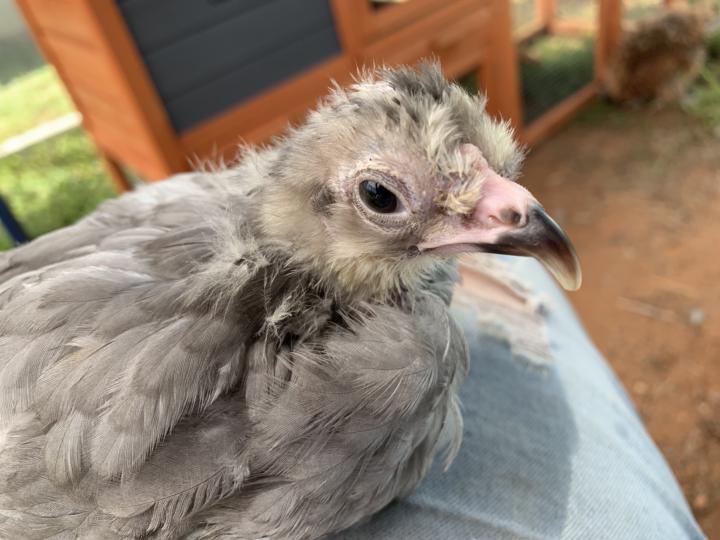
I have a little one who is currently 7 weeks old. He/She has what I've found out to be called Parrot Beak. When it was 3 weeks old I noticed it was very lethargic and didn't seem to be eating well. I started hand feeding it, and as it grew I noticed that it's beak was curved. I started doing some research and found that it's called Parrot Beak. I'm curious if that is a genetic trait and will be passed down to any offspring, or if it is just a simple birth defect. I have no clue if it's a male or a female, and I don't really care because I'll be keeping this little one since it's so sweet and comes when I call it's name. My Lil Bit is here to stay. It's molting bad in the photo I'm attaching and it's about 5 weeks there, so you can see what I'm talking about. I have started using a dog nail trimmer on the beak and it's quite content to sit and have it's beak trimmed. I use the sander style that makes no noise. In the image the beak is still long, but it had been trimmed back by then.
0 likes • 21d
No doubt! What a sweetie. That was really interesting as I didn't know about brachygnathia superior. Such an informative response.
Feb 26 •
♻️ Composting Poultry Manure: Safe Practices, Timeframes & Garden Benefits
Chicken manure is garden GOLD—but only if composted properly! Let’s break down the science of safe, effective composting. Why Poultry Manure is Valuable: NUTRIENT POWERHOUSE: 💩NPK ratio: approximately 1.1-0.8-0.5 (N-P-K) 💩Higher nitrogen than cow, horse, or sheep manure 💩Rich in calcium, magnesium, trace minerals 💩Improves soil structure and water retention Why You MUST Compost First: SAFETY CONCERNS: 🌱Raw manure burns plants (too much nitrogen!) 🌱Contains harmful pathogens: E. coli, Salmonella, parasites 🌱Can contaminate vegetables, especially leafy greens 🌱May contain antibiotic residues if birds were treated USDA ORGANIC STANDARDS: Raw manure must be composted OR applied 120 days before harvest (90 days for crops not touching soil). Proper Composting Method: THE HOT COMPOST PROCESS: Materials needed: 💩Poultry manure + bedding 🍃Carbon sources (leaves, straw, wood chips) - 25-30 parts carbon to 1 part nitrogen 💦Water Steps: 1. Mix ratios: 1 part manure/bedding to 2-3 parts carbon material 2. Moisture: Should feel like wrung-out sponge (40-60% moisture) 3. Pile size: Minimum 3x3x3 feet (smaller won’t heat properly) 4. Temperature: Must reach 130-150°F for at least 3 days 5. Turn pile: Every 7-10 days to maintain heat and aeration 6. Monitor: Use compost thermometer Timeline: 🗓️Minimum: 3-6 months with proper turning and temperatures 🗓️Better: 6-12 months for complete breakdown 🗓️Ready when: Dark, crumbly, earthy smell, original materials unrecognizable Signs of Proper Composting: ✓ Pile heats up (steam visible on cool days) ✓ Volume reduces by 50% or more ✓ No ammonia smell (indicates incomplete process) ✓ Earthworms move in (sign it’s cooled and ready) Application Rates: 🌱General gardens: 1-2 inches worked into soil 🌱Heavy feeders (tomatoes, squash): up to 3 inches 🌱Start light: You can always add more! What NOT to Compost: ❌ Manure from medicated birds (during/shortly after treatment) ❌ Manure with excessive moisture (causes anaerobic conditions)
1 like • 21d
We are currently in the beginning stages of composting and I found this to be very helpful, especially the steps. Thank you!
1-10 of 23

@kim-linman-2362
I'm grateful and blessed for my very loving family. I have 5 funny chickens and a psychotic dog and cat. Other interests: Homesteading. Gardening.
Active 13h ago
Joined Feb 5, 2026
Powered by