Activity
Mon
Wed
Fri
Sun
Aug
Sep
Oct
Nov
Dec
Jan
Feb
Mar
Apr
May
Jun
What is this?
Less
More
Memberships
The Success Club
13.7k members • Free
The AI Advantage
126.2k members • Free
2 contributions to The AI Advantage

Apr 30 •
Intro
Hi everyone, I am so happy to be in this community. I am Kessy from Harare, Zimbabwe and I am a DreamBuilder Coach. I am new to AI but have started to use it to create content. I want to learn more so that I can scale my business and buy back time. I have realised that there is so much I can do with AI, and I'm super excited to learn and grow.
1 like • May 4
@Chase Aldridge Thank you so much.
0 likes • May 4
@Abelardo Davide Sorry for late response, I use AI to create content for my social posts on FB, LinkedIn and also created two Masterclasses. Still trying to find my feet but I am enjoying myself.

Apr 30 •
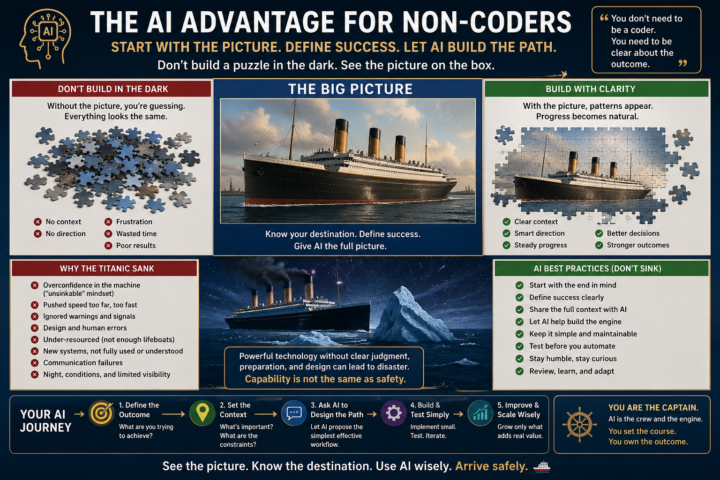
What I learned about AI, including AUTOMATION as a non-coder: THINK PUZZLES without a PICTURE
A SIMPLE AI ECOSYSTEM USED WELL, BEATS A COMPLICATED ONE USED BADLY You do not need to be a coder to work well with AI. You do not need to speak in technical language. You do not need to build complicated automations before you understand what you are actually trying to achieve. You need to talk to AI clearly. Tell it what you do. Tell it what you want. Tell it what success looks like. That is the bit many beginners miss. A lot of people approach AI like they are trying to solve one tiny puzzle piece at a time: “What prompt do I use for this?” “What command do I type?” “What tool do I connect?” “What automation should I build?” That can work, but it can also create confusion very quickly. A better way, especially for creative thinkers, is to start with the whole picture. Think of a jigsaw puzzle. If someone gives you a thousand pieces but does not show you the picture on the box, you might still make progress, but it will be slow, frustrating, and full of guesswork. Now imagine the picture is the Titanic. If the Titanic is still in Southampton, you have useful context. You can see the ship, the dock, the land, the colours, the structure. You can start to understand where the pieces belong. But if the Titanic is halfway across the Atlantic, surrounded by sea and sky, everything starts to look the same. Blue above, blue below, no landmarks, no clear edges. That is what happens when you ask AI for isolated pieces without giving it the picture. The AI may still help, but it is guessing with you. So my biggest learning is this: Do not start by asking AI for one puzzle piece. Start by showing it the picture on the box. Say something like: “I am trying to build a simple workflow that helps me create, organise, and publish content without overwhelming myself. I am not a coder. I want low friction, clear steps, and reusable prompts. Success means I can use this every week without getting lost.” That is much more powerful than asking: “What is the best prompt for automation?”
1 like • Apr 30
This is very good for a newbie like me and I really appreciate. Makes perfect sense.
1-2 of 2

@kessy-dumba-1334
Certified DreamBuilder Coach helping professional women move from outward success and inner disconnection to clarity, purpose, and intentional living.
Active 7d ago
Joined Feb 3, 2026
Powered by