Activity
Mon
Wed
Fri
Sun
Mar
Apr
May
Jun
Jul
Aug
Sep
Oct
Nov
Dec
Jan
Feb
What is this?
Less
More
Memberships
UTR
77 members • $3/month
BoomZeal Labs
28 members • Free
Biohackers Buyers Club
121 members • Free
Double R Labs
217 members • Free
Biohacking Peptide Playground
3.3k members • Free
BG
Biohacking Good Vibes Tribe 🧬
567 members • Free
Bio Health Peptides Proteins
1.5k members • Free
KRISTINA’S PEPTIDE JUNKIES 24
823 members • Free
The Peptide Tactical Playbook
237 members • Free
8 contributions to Peptide Price

🔥
Dec '25 •
🎄 AMC Holiday Sale - 25% OFF SITEWIDE (2 Days Only)
Quick heads up for anyone who's been waiting to stock up— AMC just dropped their holiday sale and it's a good one: 25% off EVERYTHING. No exclusions. The discount code "HOLIDAYSALE" is auto-applied at checkout so you don't need to do anything special. Ends Tuesday, December 9th at 11:59 PM EST — so you've got about 48 hours. One note: If you want to show some love to the community, you can add code DEREK in the cart. It won't stack an extra discount on top (just want to be upfront about that), but it does help support what we're building here. 👉 Code Derek 👉 https://amc-essentials.com/?ref=derek If you've been on the fence about trying them out or need to restock, this is the time. Let me know if you have any questions! PS Not Live on peptideprice.store yet it will be soon!

2 likes • Dec '25
I put Derek on everything even when I don’t buy😂🤣🤣🤣🤣🤣
🔥
Dec '25 •
🔥 CYBER MONDAY EXCLUSIVES (Today Only)
Most Black Friday sales end tonight at midnight. Here's everything still live. 🔥 CYBER MONDAY EXCLUSIVES (Today Only) His & Hers - 50% OFF 🚨 LIVE NOW TODAY ONLY (12:00 AM - 11:59 PM EST) - 50% OFF entire order with code derek - FREE shipping on orders $150+ (after discounts) - Lucky few get "page busters" - storage case and/or bac water 🔗 Shop His & Hers This sale expires at midnight tonight. Ion Peptide - 32% OFF 🆕 Cyber Monday Special - 15% OFF sitewide (automatic) - +20% OFF with code derek = 32% OFF total - $3,500 giveaway pool (10 winners) 🔗 Shop Ion Peptide 🛍️ BLACK FRIDAY & HOLIDAY SALES (A-Z) Alpha Omega - 36% OFF - BOGO 50% OFF + 15% with code derek = 36.25% total - FREE shipping over $100 - $25 store credit per $100 spent (up to $250) - Giveaway: Melt product of choice (1 winner) 🔗 Shop Alpha Omega Ends tonight AMP Peptides - Buy 4 Get 1 Free + 15% OFF - Code: derek15 (15% OFF) - Buy 4 Get 1 Free (auto-applied) - Stack both offers - Giveaway: $500 store credit (5 winners) 🔗 Shop AMP Peptides Ends tonight Ascension Peptides - 55% OFF The biggest discount I've ever seen from them. - Code: derek (55% OFF) - No exclusions - ALL peptides - Giveaway: Full kit + 4 half kits of Wolverine (5 winners) 🔗 Shop Ascension Ends tonight at midnight Atomik Labs - 25% OFF + BOGO GLPs - Code: derek25 (25% OFF) - BOGO on GLPs - Extra 5% OFF for ACH / 10% OFF for Crypto - $1,500 giveaway (shared with Solution Peptides) 🔗 Shop Atomik Labs Ends tonight Double R Labs - 32-52% OFF Standard: 32% OFF (20% auto + code derek)GLPs: 52% OFF (20% auto + code derek + 30% GLP code = triple stack) - Giveaway: $500 credit + Glutathione + NAD+ (3 winners)
0 likes • Dec '25
@Romeo Arabov I have yet to get a double discount on any of the sites. It always gives me just one discount code no matter what order I try

Nov '25 •
MOTS-c
Can MOTS-c be considered as a therapeutic agent specifically for insulin resistance, and what evidence supports its efficacy in this context?
0 likes • Nov '25
Oooh keep me informed on your journey!!
🔥
Oct '25 •
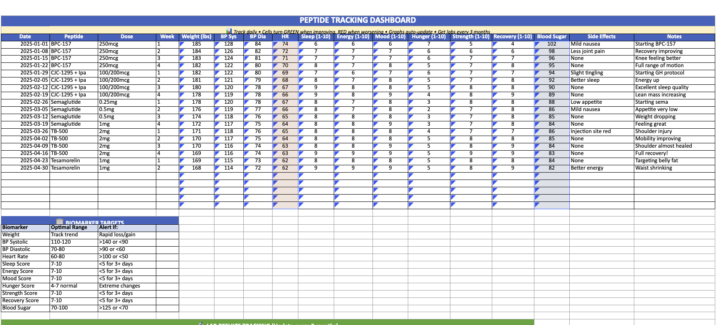
🧬 FREE Peptide Tracking Dashboard - Track Your Biofeedback
Following up on my recent post about research peptides requiring patience and personal responsibility... I built this tracking template because I genuinely want the best for you guys. If you're going to engage in peptide research, you need to do it RIGHT. That means proper documentation, baseline measurements, and systematic observation. ⚠️ CRITICAL DISCLAIMER: This is for RESEARCH and EDUCATIONAL purposes ONLY. These are research compounds for laboratory use - NOT for human consumption. This is a data collection tool, not medical advice or treatment recommendation. 📊 What Proper Research Documentation Looks Like Daily Observations: - Subjective metrics: Sleep, energy, recovery, strength, mood, hunger (1-10 scale) - Objective vitals: Weight, blood pressure, heart rate, blood glucose Quarterly Analysis: - Liver function (ALT/AST) - Kidney markers (Creatinine) - Metabolic panel (glucose, HbA1c, lipids) - Hormonal markers (IGF-1, thyroid) Key Features: ✅ Auto color-coding shows trends (green = improving, red = concerning) ✅ 3 graphs that update automatically ✅ Multi-compound filtering to compare protocols ✅ Example data from 5 research scenarios 💡 Why This Matters (And Why I Made It): Remember what I said about research being highly individual? You can't learn what works without thorough documentation. This template helps you: - Establish TRUE baselines before any intervention - Track whether expected outcomes actually occur - Monitor safety biomarkers over time (this is NON-NEGOTIABLE) - Make informed decisions based on data, not feelings - Take ownership of your research responsibly No shortcuts. No guessing. Just systematic observation. 📥 Get The Template: 👉 Attached to the Post Works in Excel or Google Sheets. Study the example data, then document your own research properly. 🎯 Research Methodology Essentials: 1. Baseline FIRST - You can't measure change without knowing your starting point 2. Document everything - Dose, timing, compounds, all variables 3. Monitor safety markers - Stop immediately if biomarkers deteriorate 4. Be objective - Track what actually happens, not what you hope happens 5. Medical oversight - Work with providers who can interpret your data
0 likes • Oct '25
Very nice 🤙🏽

Oct '25 •
Reta and appetite suppression
New to this adventure and looking for some personal experience and advice! I have been on Reta for about a month this Sunday. I started at 1mg (.5 Sunday and .5 Thursday) split dose. Is there a MG dose that you start to feel more of the appetite suppression? I know Cag is an option, but also understand I'm at a pretty low dose of Reta now. Just want to hear from you guys! Thanks!
0 likes • Oct '25
Can anyone HINT at where the best r quality & service is at without overpaying? I am new and finishing up my basic education on things. Not sure if I can ask or not
1 like • Oct '25
@Jeff Hunter thank you
1-8 of 8
Active 4h ago
Joined Oct 18, 2025