Activity
Mon
Wed
Fri
Sun
May
Jun
Jul
Aug
Sep
Oct
Nov
Dec
Jan
Feb
Mar
Apr
What is this?
Less
More
Memberships
Investing Accelerator
472 members • Free
Invest & Retire Community
3.6k members • Free
16 contributions to Invest & Retire Community

6d •
"You don't have to make it back the way that you lost it."
Financial investor Warren Buffett encourages us not to cling to our losing efforts or chase what isn't working and instead focus on the next best action Source: 1994 Berkshire Hathaway shareholder letter Especially not now. We just exited geopolitical uncertainty. The bull market is opening. And if you're still holding losers, you're leaving gains on the table. When fear dominated — Iran tensions, recession chatter — many positions got crushed regardless of thesis. Now that volatility is settling, capital is rotating hard into growth. This is the reset moment. Here's the trap: holding a 30% loser while the broader market rebounds 15% feels like a recovery story. It's not. You're still underwater and you're missing the move. The smarter play: - Accept the loss. Cut it loose. - Redeploy into high-conviction leveraged plays — QLD, other 2x,3x if you're bullish on tech/AI. - Let leveraged positions do the heavy lifting in a bull market. You don't recover by waiting. You recover by positioning for what's next. I used to think selling a loser meant admitting defeat. This is sunk cost bias! Then I realized: the best investors aren't afraid to harvest losses and rotate into the next big theme. That's how you actually make it back — faster, smarter, and better. What's one losing position you're holding that could be redeployed into a leveraged play you actually believe in?

0 likes • 3h
Not sure what to do with Microsoft. It was coming back up but not sure if I am better off just getting rid of it.

7h •
More tech job losses - Microsoft & Meta
9,000 Microsoft employees did everything right. Top schools. FAANG resumes. $200K salaries. Still got replaced by a line item in an AI budget. Senior engineers. Directors. PMs with FAANG resumes and 15-year careers. The memo called it “voluntary retirement.” Nobody volunteered. Here’s the part nobody’s saying out loud: Microsoft is cutting humans to pay for AI. The same people who built the company are now funding the technology that made them unnecessary. No performance review saves you from a budget decision. This is what the AI transition actually looks like. Not robots. Just a reallocation of spend ------------------------------------------------------------------------------------------------------------------------------------------- Meta, tells its staff that it is laying off 10% of its employees in a push for "efficiency." This is roughly ~8,000 employees who will be laid off. The ongoing impact of AI.
3 likes • 4h
Yeah. Lots of displaced people. Looks like a bleaky future for many. How do you confront this situation when there is not a clear vision of what you can do with this AI transition.

11d •
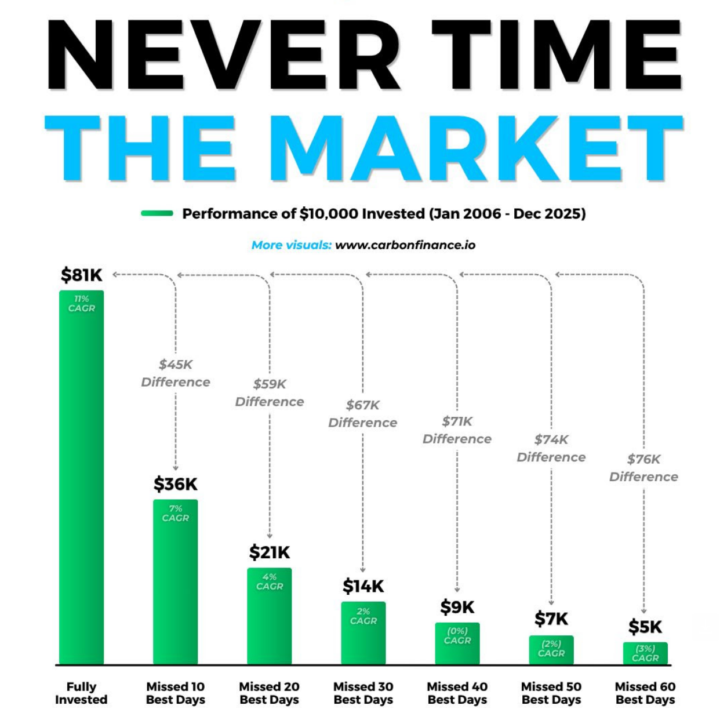
Never Time The Market
- Volatility can make the market feel unpredictable. - But the real risk is not being invested. - Missing just the 10 best days cuts returns by more than half, a difference of about $45K on a $10K investment. - And those best days are often clustered. - In recent markets, many of the biggest gains came right after selloffs tied to tariffs and geopolitical headlines. - Owning stocks on just those days would have returned about 52%, compared with roughly 12% for buying and holding, according to the Wall Street Journal. - But predicting when that relief comes is nearly impossible, and exactly what makes timing so difficult. - As Peter Lynch once said, “Far more money has been lost by investors preparing for corrections, or trying to anticipate corrections, than has been lost in corrections themselves.”
2 likes • 10d
@Kevin Esmati Yes. I have heard this from great investors that you really should not focus on timing market.
12d •
What Peaks and Valleys Taught Me About Surviving Market Volatility
One of the most useful investing books I’ve read lately is Peaks and Valleys. Not because it explains markets, but because it explains me in markets. That distinction matters. When things are going well, it is easy to feel confident. Sometimes too confident. When markets get volatile, it is easy to feel urgency, doubt, and emotional whiplash. What I’ve found helpful about this book is the reminder to separate: what is happening externally from what is happening internally That has become a very practical investing lesson for me. The goal is not to avoid every valley. That is impossible. The goal is to avoid making the valley worse with bad psychology. A few ideas from the book that have stayed with me: 📈 In the peaks, stay humble. Success can quietly turn into overconfidence. 📉 In the valleys, stay steady. Fear can make temporary pain feel permanent. 🧠 In both, protect your perspective. The market moves either way. The real question is whether your mind moves with discipline or emotion. What has helped me personally is having a few simple routines: - pause before reacting to market noise - ask: is this a market problem or an emotional reaction? - zoom out to the longer-term thesis - come back to process instead of impulse I’ve also found the weekly coaching calls invaluable for exactly this reason. They help me recalibrate, separate signal from noise, and not get too high in the peaks or too low in the valleys. That, to me, is one of the real edges in investing: Not predicting every move, but learning how to stay clear-headed through both the highs and the lows. Curious what helps you keep perspective when markets get noisy? A book, a routine, a framework, a cocktail, a question you ask yourself? 👇 #Investing #InvestorPsychology #MarketVolatility #BehaviouralFinance #LongTermThinking
5 likes • 12d
Yes, if you do not have many years to recoup your investment when markets go down, do your best to have cash and short-term treasuries to cover your living expenses, if you are retired or close to retirement. That's what I have gathered.
3 likes • 11d
@Sukhwinder Dhanoa Definitely valleys are opportunities to add more to portfolios. For me, I have not been overly aggressive. Perhaps I should have been. I have always been a long-term investor. I never had time to study the market and companies, but I always stayed in the market. I just know that a lot of investors had great gains, but a lot had great losses. Blue chip stocks are great investments and SPY and FXAIX have given me great returns. I like the philosophy that the companies doing poorly will drop off the list of top 500 companies.

17d •
Tweet driven market
As Iran and Donald Trump tweeting back and forth, the stock market has become a tweet driven market Oil price has been ranging from $109 to $115 simply because investors / funds are getting updates through tweets Donald said there's a 48 hours deadline for Iran to surrender Iran said there's a 48 hour deadline for US to surrender The back and forth between NY working hours and Iran working hours is causing most of the intra week swings This means the market will likely take some time to form a bottom instead of going up immediately This is within our expectation as usually large drops take some time for funds to buy in instead of a V shape recovery where funds are piling in cash immediately. The current Iran-US conflict will likely drag out and lead to a slower recovery. Cheers, Eric --- Eric Seto Chartered Professional Accountant (CPA) Chartered Investment Manager (CIM) Founder of 5MinInvesting.com In April, I’m helping 20 people build a retirement cashflow strategy using options. The 2 strategies you will learn in Investing Accelerator: 1. Long-Term Investing with Options → Find discounted blue-chip stocks → Use options to multiply your profits 2. Monthly Passive Income Strategy → Generate monthly cashflow from your portfolio by selling options → Designed to generate cashflow for retirement If you are interested in learning more advanced investing strategies, you can schedule a free strategy call here to see if you are a good fit. Schedule a free call Disclaimer: This communication is provided for educational and informational purposes only and does not constitute investment advice, a recommendation, or an offer to invest in any fund or strategy. No advisory relationship is formed by receipt of this content. Any references to strategies or markets are general in nature and do not reflect the performance of any client account or investment product.
4 likes • 16d
Based on history, market will eventually correct itself sooner or later and I want to prepare myself for downturns.
1 like • 15d
@Eric Seto The reason I am asking is because I have heard from various investors that if you know that you may need those funds in six years or so and you are already retired, you should have short-term treasuries, to avoid having to sell at that time when the market could be down. I know that you could miss opportunities have those funds in short-term investments in the meantime. I have heard enough about retired people losing monies and not having enough time to recoup. I am wondering if to set aside monies for these treasuries as I have been more aggressive in my investmemts.
1-10 of 16

@jean-eiley-7605
CPA, seeking more knowledge in how to invest in the stock market.
Active 3h ago
Joined Feb 1, 2026
Powered by