Activity
Mon
Wed
Fri
Sun
Jul
Aug
Sep
Oct
Nov
Dec
Jan
Feb
Mar
Apr
May
Jun
What is this?
Less
More
Memberships
AI Automation Society
407.3k members • Free
Investing Accelerator
485 members • Free
Invest & Retire Community
3.6k members • Free
85 contributions to Invest & Retire Community

23h •
Investment Thought Exercise: Is SpaceX Becoming Weyland-Yutani?
Hear me out. In the Alien universe, Weyland-Yutani is not just a company. It is basically a civilization-scale operating system: Space travel. Colonization. Defence contracts. Advanced robotics. Synthetic humans. Questionable ethics. Aggressive shareholder value creation. Now look at SpaceX. Reusable rockets. Starlink global communications. Government and defence contracts. Mars colonization narrative. Private infrastructure that nation-states increasingly depend on. A founder with main-character energy. I’m not saying Elon Musk is building Weyland-Yutani. I’m just saying that if, in 80 years, your grandchildren are working on a Mars mining colony under a corporate HR policy called “Frontier Productivity Optimization,” we probably should have seen the signs. The serious investing question underneath the joke is this: Are we entering an era where the most important companies are not just businesses, but infrastructure-layer civilizations? The last century rewarded ownership of energy, railroads, banks, telecom, and industrial giants. The next century may reward ownership of: - Space infrastructure - AI platforms - Compute - Robotics - Energy storage - Defence technology - Bioengineering - Global communications networks In other words, the companies that don’t just sell products - they control the rails everyone else has to use. So maybe the future investing question is not: “Which company has the best quarterly earnings?” Maybe it is: “Which companies are becoming impossible for governments, militaries, industries, and citizens to function without?” That is where the Weyland-Yutani analogy gets interesting. Because in a corporate-feudal future, you probably want to be one of three things: 1. An owner 2. A highly valuable operator 3. Nowhere near the xenomorph containment lab Personally, I’m aiming for 1 and 2. Curious what people think: Is SpaceX just an incredible company, or are we watching the early formation of a future corporate superpower?

0 likes • 2h
@Lindsay Talbot Thanks for sharing Lindsay. This aligns with another post I had on watching where policy is truly made.
2d •
SpaceX acquires Cursor for $60B just days after its historic IPO
SpaceX has exercised its option to buy Cursor all in stock, a deal that was first announced in April. The two companies have been jointly training a new model, which they plan to release in Cursor and Grok Build soon. The deal lands just days after SpaceX’s record-setting public offering — read all the details from the IPO. https://techcrunch.com/2026/06/16/spacex-is-public-everything-you-need-to-know-post-ipo/?_bhlid=4a884527b8c9e95c2d4c2918e208c5a28c5d3e81
6d •
Hyundai Deploys Boston Dynamics Spot Robots for FIFA World Cup 2026 Security
This integration into the civilian security field is going to go fast if this goes well. AI on 4 legs...coming to an event near you. https://www.designnews.com/automation/hyundai-deploys-boston-dynamics-spot-robots-for-fifa-world-cup-2026-security?_bhlid=da3703155cde57655b521b30535a522582bfdef3
7d •
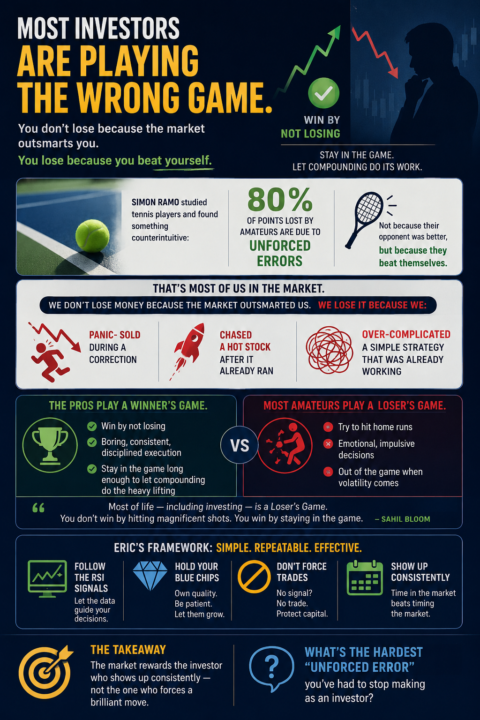
Most investors are playing the wrong game. And the scary part? They don't even know it.
An unforced error in tennis is a mistake made when the player had enough time, balance, and good court position to hit a routine shot successfully, but still missed—without the opponent putting intense pressure on them. Simon Ramo studied tennis players and found something counterintuitive: amateurs lose 80% of points on unforced errors, not because their opponent was better, but because they beat themselves. Sound familiar? That's most of us in the market. We don't lose money because the market outsmarted us. We lose it because we: - Panic-sold during a correction - Chased a hot stock after it already ran - Over-complicated a simple strategy that was already working The pros? They win by not losing. Boring, consistent, disciplined execution. Sahil Bloom calls this the difference between a Winner's Game and a Loser's Game. Most of life, including investing, is a Loser's Game. You don't win by hitting magnificent shots. You win by staying in the game. @Eric Seto framework nails this: follow the RSI signals, hold your blue chips, don't force trades. That is the strategy. The market rewards the investor who shows up consistently - not the one who forces a brilliant move. What's the hardest "unforced error" you've had to stop making as an investor?
7d •
Oracle stock drops 10% after $20 billion raise even though earnings beat expectations
Shares tumble after Oracle announces $20 billion equity and debt raise despite reporting $2.11 per share on $19.2 billion revenue for Q4 with strong AI cloud growth and rising remaining performance obligations supporting long-term investor confidence https://www.ynetnews.com/business/article/r1hgbvd11fg
5
0
1-10 of 85

@john-meaney-9141
Sales Executive in Healthcare Informatics
Bridging the gap between data and decision-making in healthcare.
Active 2h ago
Joined Jun 24, 2024
ENTJ
Burnaby, BC
Powered by