Activity
Mon
Wed
Fri
Sun
Aug
Sep
Oct
Nov
Dec
Jan
Feb
Mar
Apr
May
Jun
Jul
What is this?
Less
More
Memberships
Sunnyside Soil Collective
148 members • Free
Syntropic Sunlands w/ Milan
179 members • Free
Food Forest Family (FREE)
3.7k members • Free
Food Forest Fellowship
184 members • $1,000/y
3 contributions to Syntropic Sunlands w/ Milan

Apr 26 •
I planted 8000 trees & plants here in Portugal
Hi everyone, The last months were crazy, from 0 infrastructure to building and planting 800 meters of syntropic lines here in Portugal. I documented most of the process so people get a good understanding of the amount of work that goes into a project like this :) Hope you enjoy it, watch it here: https://youtu.be/rRQdmMZHpdo
1 like • Apr 27
@Milan Marquis all production, but spaced oneven with the next row to give fruit canopies more space to grow. We will learn in the future, and may thin out the ones that underperform to create the space needed for the top growers.
1 like • Apr 27
@Milan Marquis We went with a bulldozer + ripper through the lines (1m deep) and the grade discos over it after that. So when Marc was here with 15 students we planted 3500 plants in one day. But yes organizing everything, marking the spaces, laying everything in place takes most of the time usually.
Apr 15 •
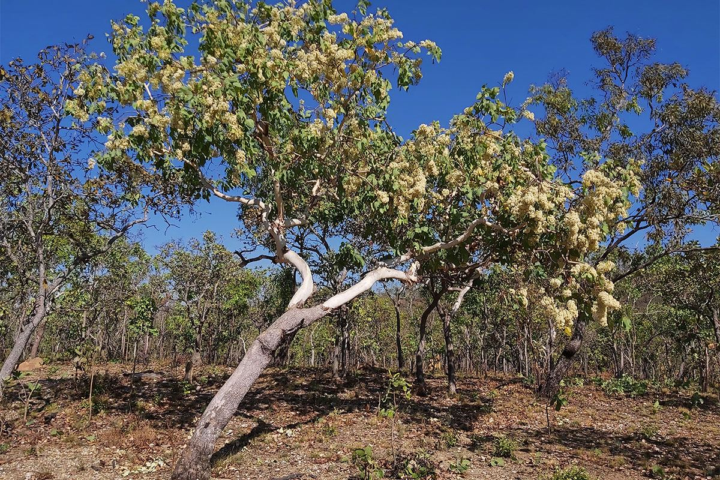
Making a case against the use of Eucalyptus in syntropic systems in the Mediterranean climate (and other climates with long drought periods)
I know that this is an unpopular statement but personally, I prefer basing my decisions and teaching on scientific evidence rather than on "opinions" and anecdotal "findings". Eucalyptus species are increasingly difficult to justify within syntropic farming systems operating under Mediterranean or seasonally dry climates (tropical and temperate climates are really another story), primarily due to their disproportionately high transpiration rates and their capacity to function as facultative phreatophytes. Empirical work published in Tree Physiology demonstrates that eucalyptus stands can maintain significant transpiration by accessing groundwater when it is available at relatively shallow depths (<9 m), effectively coupling canopy water demand directly to aquifer reserves . This behavior becomes particularly problematic in dry periods: rather than downregulating water use in synchrony with ecosystem scarcity—as is desirable in syntropic systems—eucalyptus can continue transpiring at elevated rates by mining groundwater, thereby decoupling plant water use from rainfall inputs. In Mediterranean trials, annual transpiration values on the order of 520–910 mm have been documented, even under constrained irrigation regimes . This level of water flux represents a substantial hydrological drawdown, especially when compared to mixed, stratified agroforestry systems designed to retain moisture and recycle atmospheric humidity locally.From an ecohydrological and successional perspective, this groundwater-dependent strategy directly conflicts with the core principles of syntropic agriculture. Syntropic systems aim to enhance infiltration, build soil organic matter, and stabilize the small water cycle; however, deep-rooted, high-demand species like eucalyptus can act as vertical drains, exporting water from soil profiles and lowering local water tables over time. The literature on eucalyptus plantations using shallow groundwater shows that these species readily exploit subsurface reserves even when saline or marginal , reinforcing their classification as aggressive water extractors rather than cooperative system participants. In practice, this can suppress understory development, reduce microbial and fungal activity in upper soil horizons, and exacerbate drought stress for co-planted species—precisely the opposite of the facilitative interactions sought in syntropic design. Consequently, while eucalyptus may offer rapid biomass accumulation, its hydrological footprint and competitive rooting ecology make it fundamentally misaligned with resilient, water-conserving agroecosystems.
1 like • Apr 21
I get your points and I would also reconsider using them in my system. I planted around 6 of them every 10 meters, but I will be using them with heavy management + thinning strategy from year 2-5. So just for providing that shade early on + biomass acceleration is key although leaving them too long will probably have all these negative impacts. For client installations I would rather not touch them as I'm not able to have that strong management guidance and they can easily harm a system rather than do good.

Apr 15 •
A Tip to Prevent Weeding - Video Filmed in February
The Fava Bean Trick ! Fava beans are great for smothering weeds, and they sprout easily with the first rains. In this video, I show how I use them - and how much easier they make the work. No need to get on your knees pulling grasses in the first year. You get 2 cuts with them, and each cut took me 20min/100m/1 person. It's really not that much work - about 2 and a half hours for these 3 rows of 240m each. By the time they phase out, it’s already Summer here in the Mediterranean, so there’s basically no need to weed anymore. Then when the rains return, your rows should be established enough that weeding becomes a minimal task. You might need a bit of weeding in year two if your trees haven’t grown enough - but in my experience, one more pass is usually enough - cutting them, not even uprooting them. After that, the trees outcompete the grasses and take over. What other plants do you think could do a similar job? I’m thinking artichokes or cardoons could work really well - but they’d need to be started as seedlings.
1 like • Apr 20
Interesting, I did both sides every 1 meter but still lots of weeds came trhough my 800m planted lines. Ofcourse the 1050mm rainfall helped witht hat
1-3 of 3

@jason-van-alphen-2624
Organic market gardener based in Portugal. Curious to learn more about syntropic agroforestry when developing my own land here.
Active 5d ago
Joined Feb 17, 2026