Activity
Mon
Wed
Fri
Sun
Mar
Apr
May
Jun
Jul
Aug
Sep
Oct
Nov
Dec
Jan
Feb
What is this?
Less
More
Memberships
The Grow Skool
676 members • Free
Elastic Perception Free
6.3k members • Free
4 contributions to The Grow Skool

21d •
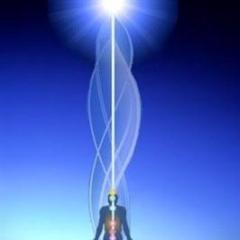
Our first inaugural Grow meditation session was held today!
Our first inaugural Grow meditation session was held today, and we had a terrific turnout. Big thanks to everyone who showed up and brought the good energy. We’re excited to keep building this with Inifiii (pronounced “infin eye”). If you’re feeling heavy, needing a bit of releasing, or you’re a farmer looking for some tranquillity in the engine, these sessions will make a real difference. No pressure, no perfection, just a space to breathe, reset, and come back to yourself. Join us next month and let’s keep nourishing our mind, body, and soul!
1 like • 19d
After participating in a few GROW sessions, I’ve noticed that the practice of Infinite Awareness can help initiate solutions to many long-standing problems and situations. We will explore this in the upcoming sessions.
0 likes • 1d
@Lisa Johnston There is a slight change in timing .. to an hour earlier. Did you notice that ?
11d •
Welcome to The Grow Skool 🌱 Introduce Yourself Below
If you’re new here, this is your first move. Drop a comment below and introduce yourself so the community can actually get to know you. Then reply to at least one other intro. That’s how connections happen here and how you level up fast inside Grow. Share: - Your name and where you’re located - What pulled you toward The Grow Community - Your next milestone with Grow or the project you’re working on where you see Grow adding value - One interesting fact about you This community works best when people talk to each other, not when they just consume content. Start here. 👇 Introduce yourself below, then reply to someone else’s comment 👇
0 likes • 1d
@Neil Smith The meditation helps to "embrace the resistance", work/deal with it ... to not only "ask God for strength" but also to receive it, and not just "lean in" on it but also to merge with it, be in Oneness with it .. and when so aligned dwindle "resistance" and the "hard" energies, and when so empowered, enable "pushing boundaries", making "fasting" more comfortable ... Good enough for a start ? 😊

15d •
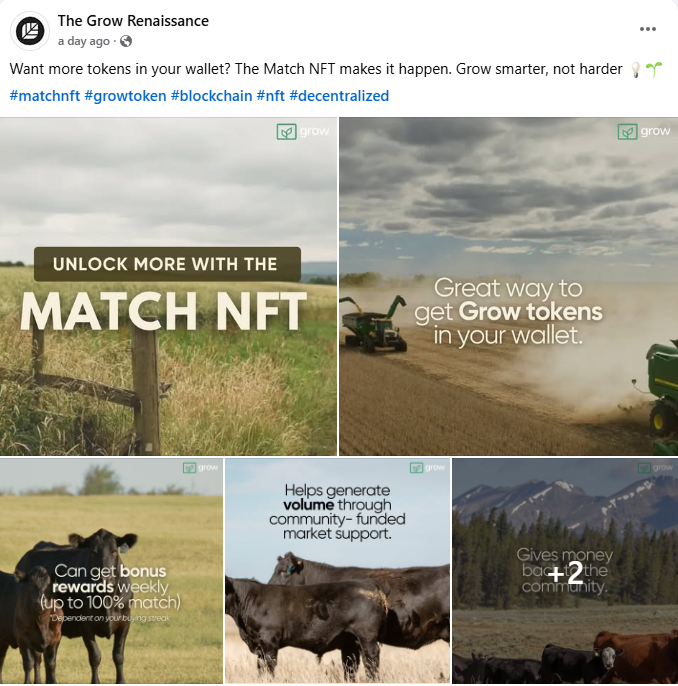
Want more tokens in your wallet?
Want more tokens in your wallet? The Match NFT makes it happen. Grow smarter, not harder Check out Grow socials for more info! #matchnft #growtoken #blockchain #nft #decentralized
1 like • 14d
How to do this @Lisa Johnston ? Where to find the "Grow socials" ?
17d •
David and Goliath story unfolding
There is a David and Goliath story unfolding in agriculture right now. Except this time Goliath is not a giant with a spear. It is a spreadsheet. It is consolidation. It is policy that keeps rewarding scale while starving the people who actually produce the food. Most people only notice agriculture when something breaks. When prices jump. When shelves look strange. When a headline says “supply chain issues” as if that is a surprise. But across global agricultural bioregions, the same thing is happening. A lot of ranchers have been put out of business. Not because they forgot how to ranch. Not because they stopped caring. But because the rules of the game changed. Processing concentrated. Market access narrowed. Margins thinned. And producers were told to “innovate” while someone else controlled every gate that mattered. You can be exceptional at raising cattle, managing grass, protecting water, and improving soils. If you cannot access fair processing, fair pricing, and fair routes to market, you are not competing in a marketplace. You are surviving inside a system designed for someone else. So here is the question that matters. How do you leverage yourself in the marketplace to take advantage of that? The answer is not becoming the next mega-corporation. The answer is rebuilding what consolidation stripped out. The decentralized middle. Small and mid-sized processors embedded across bioregions. Regional capacity that keeps value closer to the land. Infrastructure that allows producers to remain independent without being isolated. A resilient food system is not built by creating fewer chokepoints and hoping nothing goes wrong. It is built the same way resilience works in nature. Diversity. Redundancy. Local strength. That is why bioregions matter more than borders. Food security is not a flag. It is land, people, processing, and markets functioning together in the same place. The future of food will not be a larger version of what we have now. It will be a smarter one.
1 like • 17d
Let us bring this situation into Infinite Awareness @Neil Smith ; connecting the 'David's with the Infinite field and thus further empowering them !! 🌈 ... cos the Infinite is much powerful than all the 'Goliath's of the world combined. 😉
1-4 of 4
Active 3h ago
Joined Jan 10, 2026
Powered by