Activity
Mon
Wed
Fri
Sun
Jan
Feb
Mar
Apr
May
Jun
Jul
Aug
Sep
Oct
Nov
Dec
What is this?
Less
More
Memberships
AI Automation Society
208.1k members • Free
Max Business School™
261.5k members • Free
126 contributions to AI Automation Society

🔥
7h •
How I Process 6 Different Invoice Formats With One n8n Workflow 🔥
Client works with 6 vendors. Each sends invoices in completely different format. First thought: "I'll need 6 separate workflows." Then realized: Why? Built one universal workflow. Handles all 6 formats. Plus works for new vendors without code changes. THE SECRET: Schema-based extraction doesn't care about format. Extracts semantically, not positionally. Vendor A: Invoice total bottom right Vendor B: Invoice total top left Vendor C: Invoice total in table middle Vendor D: Labeled "Amount Due" Vendor E: Labeled "Balance" Vendor F: Different language Same schema finds "total amount" regardless of position, label, or language. THE SCHEMA: { "vendor_name": "string", "invoice_number": "string", "invoice_date": "date", "total_amount": "number", "line_items": [{ "description": "string", "quantity": "number", "amount": "number" }] } This extracts correctly from all 6 vendor formats. Modern processing understands semantic meaning. THE WORKFLOW: Gmail → Parse Document → Extract with schema → Validate → Switch on confidence → QuickBooks → Slack One workflow. Six vendors. Zero maintenance when they change templates. THE RESULTS: Month 1: 6 vendors, ~180 invoices Month 3: Added 2 new vendors, workflow handled automatically, ~280 invoices Month 6: Now 11 vendors, workflow unchanged, ~450 invoices Zero code changes for 5 new vendors. TRADITIONAL APPROACH: Would need 11 separate parsers to maintain. One template change from any vendor = emergency fix needed. SCHEMA APPROACH: One universal extraction. Vendor changes template? Still extracts correctly. Add new vendor? Already works. CLIENT REACTION: "Wait, when we add new vendors, we don't need to update anything?" Exactly. That's semantic extraction. Template here THE LESSON: Stop building format-specific parsers. Build semantic extractors. One workflow serves all formats. Scales infinitely without code changes. Modern document processing understands WHAT you want extracted, not WHERE it appears.

2 likes • 6h
@Duy Bui 👌
1d •
AI News – December 11, 2025 (Smart Summary)
UK doubles down on AI leadership: DeepMind signs major safety & public-sector deal with the government. Reality check for AI hype: Oracle’s massive AI infra spending missed profit targets → stocks tanked (Oracle –15 %, Nvidia/AMD –3 %, Bitcoin under $90K). Disney drops $1B on OpenAI equity — Mickey Mouse is officially coming to Sora video generation. 50+ U.S. state Attorneys General warn Big Tech: AI chatbots are triggering delusions and mental health crises; demand audits. Scientists’ adoption of AI jumps to 62 %, but 87 % fear hallucinations and loss of trust. Quick hits: New top-tier math-solving model, Mistral coding agent, Gemini voice upgrades, first LLM trained in orbit, and crypto-AI projects pumping. Boom meets caution — that’s today’s AI vibe in one breath.

💎
⭐
2d •
📊Which of the following strategies for getting clients is SCARIEST to you?
There are tons of ways to get leads/clients, curious to hear what you guys think is the scariest. There are no right or wrong answers here.
Poll
360 members have voted
0 likes • 1d
@Nate Herk number1👌
💎
⭐
2d •
🚀New Video: How I'd Learn n8n if I had to Start Over in 2026
If I had to start over and learn n8n from scratch today, this is the exact path I’d follow. The skills to focus on, the mistakes to avoid, and the fastest way to go from beginner to building real workflows that clients actually pay for. This is one of my most valuable videos yet, so I hope you guys enjoy!
3 likes • 1d
@Nate Herk thanks Sir 🙏

2d •
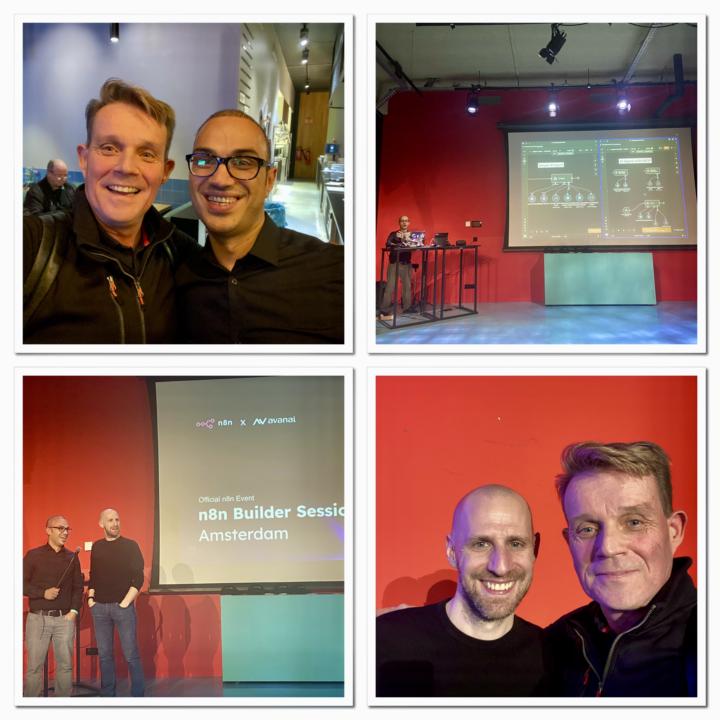
The Night of 11 December at the n8n Builder Session in Amsterdam!
This evening I had the privilege of attending the n8n Builder Session here in Amsterdam and what an evening it was. Full house, massive high energy, and a room full of automation enthusiasts ready to learn and connect. Huge thanks to Aemal Sayer for leading an incredibly handson session covering: # MCP (Model Context Protocol) # JSON fundamentals # Webhook data tables # Postman integration # Live building — learning by doing Great highlight was as well for me. Having a conversation with Jan Oberhauser, founder and CEO of n8n, about how I'm using the platform to empower students in Uganda. Sharing how open source automation tools can create real opportunities in emerging markets that's what this community is all about. Events like these remind me why I love this space. It's not just about workflows and nodes. It's about connecting with like minded people who share the same vision: building a better world, one automation at a time. Already looking forward to the next one.
1 like • 1d
@Frank van Bokhorst 👌
1-10 of 126

@hussein-ibrahim-9475
Digital creator, content writer, teacher. Self-designated human rights defender. Fiercely independent, yet a believer in interdependence.
Active 1h ago
Joined Oct 15, 2025
Powered by