Activity
Mon
Wed
Fri
Sun
Jan
Feb
Mar
Apr
May
Jun
Jul
Aug
Sep
Oct
Nov
Dec
What is this?
Less
More
Memberships
UnFUNDableAF!
406 members • $27/month
Wholesaling Real Estate
61.2k members • Free
12 contributions to Wholesaling Real Estate

15h •
One Year and Zero Deals --- What Am I Missing?
Hey all -- going to be transparent here and hope to get some genuine feedback and advice. I've been wholesaling for a bit over a year and cannot get a deal. Here's the approach I've taken and timeline it from when I started till now. - Pulled free lists cold called 5 days a week non-stop --- no real CRM system which was my biggest miss I'd say. - I've hired 2 VAs to cold call free list pulled but never really had a CRM system in place which I feel like was my biggest miss again. Spent about 6 months doing this process -- huge learning curve and wallet drainer. - I've been able to pull county records on tired landlords/probate records for a specific market and solely focused on that for the remaining 6 months. CRM was implemented late but def have a process going now where I am following up and funneling the sellers through a system before they're considered dead leads. I've had a buyer "steal" my potential first deal literally an investor -- I didn't have it under contract which is completely on me. I was banking on good faith to create some relationships with investors. Never doing that again. Finances have been tight due to my early days (VAs and softwares) and getting no financial ROI. Learned a lot for sure and would do things a whole lot differently now. I'm consistently calling and consistently working everyday. Mental toll for sure but staying resilient. I'd appreciate the genuine advice. Praying over 2026 that it will be a breakthrough. Inbox is open as well. I have the time the will the mindset to keep going --- I don't need a handout at all but man what am I missing? You are all appreciated.
1 like • 15h
@James Mick Yes please do and appreciate your input brother.
1 like • 15h
@Jasmine St. Julien I’ve done mix of pre-foreclosures tired landlords absentee owners when I was pulling lists. Contact rate was horrible very very low %. Even my VAs were telling me that. It’s why I even started stepping away from the free lists, felt like the contact rate was so low. I’d have to see if CallTools has the exact %.
Nov 7 •
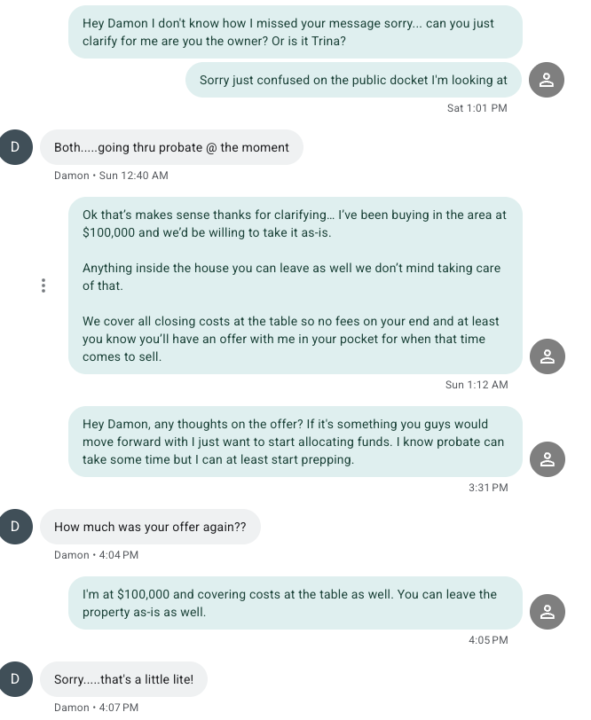
Feedback Request --- Text Log With Seller
What should I have done differently? What should I keep doing? Hope the transparency in this log can help others in the group as well. Keep grinding. Stay resilient. For context, this took me double texting as well as reaching out again after I sent out the initial offer.
Feb 25 •
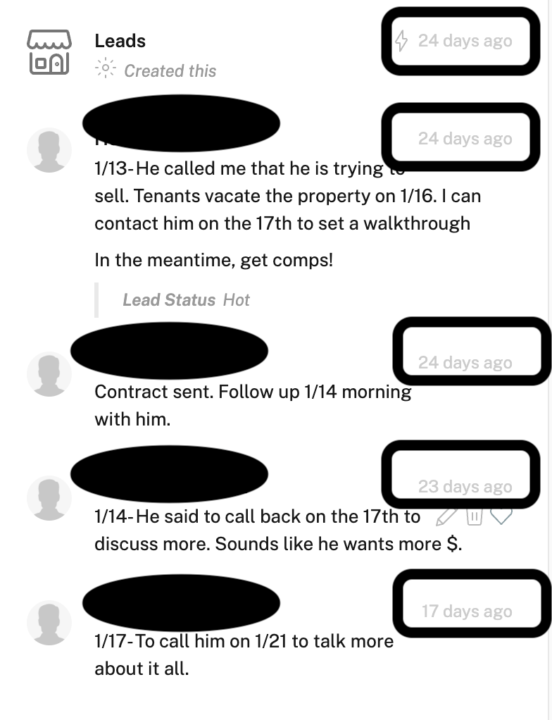
'Follow Up' is why I've turned a cold lead -> warm lead > hot lead
Just because someone isn't selling their home today, does not mean they won't sell tomorrow. Use a CRM to keep track and keep talking to those sellers. Just for some perspective, these were weeks/months of some of the follow ups that I did that finally led to next steps whether its pushing to get the property under contract or suddenly getting a hot lead. Any questions on anything feel free to reach out. Seller marketing can be gritty and a grind but stay resilient and don't quit. Some follows up took weeks to get to that next step whether it be sharing my contact so they know I'm interested for when that time comes to sell or even sending them a contract with an offer. Any questions let me know!
2 likes • Feb 25
@Hector G yup Podio!
2 likes • Feb 25
@Jagger Babuin currently using Podio!

Feb 22 •
TITLE COMPANIES (Part 1)
UNDERSTANDING TITLE COMPANIES IN REAL ESTATE WHOLESALING: A title company plays a crucial role in real estate transactions by ensuring the legitimacy of property ownership transfers. They verify the seller’s ownership, confirm the buyer’s identity, prevent fraud, and facilitate the closing process by ensuring all financial obligations (liens, taxes, etc.) are cleared before the deal is finalized. Why Use a Title Company? 1. They are licensed and insured – ensuring compliance with legal procedures. 2. They act as a neutral party – though not always fully unbiased. 3. They issue title insurance – protecting buyers from potential title defects. FINDING THE RIGHT TITLE COMPANY FOR WHOLESALING (VERY IMPORTANT) Most title companies cater to traditional real estate transactions involving realtors. However, wholesalers need title companies that handle cash transactions and assignment of contracts. To find an investor-friendly title company: - Search Facebook investor groups for recommendations. - Ask wholesalers in your area who they use. - Directly call and ask, “Do you work with investors?” If they hesitate or show reluctance, move on. - Follow up with, “Are you familiar with an assignment of contract?” If they confidently say yes, they may be a good fit. Title Company’s Role in a Wholesaling Transaction: 1. Providing the Contract & Earnest Money Deposit (EMD) Once a wholesaler secures a property under contract, they must: - Submit a copy of the contract to the title company. - Deposit the Earnest Money Deposit (EMD), which is negotiable (often $100-$500, sometimes $10). 2. Title Search & Clearing - The title company pulls title records to ensure clear ownership. - They check for liens, unpaid taxes, and legal issues. - Title commitments are issued (summarizing title status). The wholesaler should ask for a simple explanation from the title company. 3. Assigning the Contract - The wholesaler sells their contract to a cash buyer via an Assignment of Contract. - The title company facilitates the replacement of the buyer in the contract.
2 likes • Feb 23
Appreciate you sharing!
2 likes • Feb 23
@Chris Nguyen Anytime discord/or dm

Feb 22 •
Markets
Finally at level 3. Post your markets in the comments below and let’s work. I’m in Memphis, TN by the way.
3 likes • Feb 22
Tulsa,OK!
2 likes • Feb 22
@Kayleb Matthews Its been good... I personally chose the area because my mentor has done a lot of business there so he helps with connecting with people/investors etc
1-10 of 12

@henry-dominguez-3096
Owner of Aych Buy Solutions.
Real Estate Investor.
Proverbs 3:5-6.
Active 2h ago
Joined Dec 9, 2024
Powered by