Activity
Mon
Wed
Fri
Sun
Mar
Apr
May
Jun
Jul
Aug
Sep
Oct
Nov
Dec
Jan
Feb
What is this?
Less
More
Memberships
Front End Now Community
172 members • $47/month
13 contributions to Front End Now Community

16d •
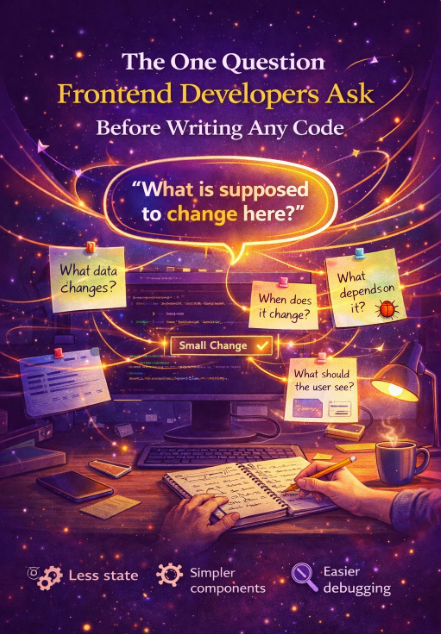
The One Question Frontend Developers Ask Before Writing Any Code
Before experienced frontend developers write a single line of code, they pause and ask one question: “What is supposed to change here?” That question sounds simple, but it does a lot of heavy lifting. Why this question matters Most frontend problems aren’t caused by missing syntax. They’re caused by unclear change: - What data is changing? - When does it change? - What depends on that change? - What should the user see as a result? If those answers aren’t clear, the code that follows is usually fragile. Beginners often skip this step When you’re early on, it’s natural to jump straight into: - Writing handlers - Updating state - Tweaking JSX or styles The goal is to “make it work.” But without clarity on what should change, you end up: - Adding extra state - Chasing bugs later - Fixing symptoms instead of causes That’s when frontend starts to feel unpredictable. How this question changes your code When you ask “What is supposed to change?” first, a few things happen: - You create less state - Your components become simpler - Bugs become easier to trace - Debugging becomes calmer You’re designing behavior before implementing it. That’s a core frontend best practice. A practical example Before writing code, try answering this in plain English: “When the user does X, what exactly changes, and what should stay the same?” If you can’t explain that clearly, the code will struggle too. Why this works long-term Frontend development is mostly about managing change: - State changes - UI changes - User-driven changes This question forces you to reason about those changes before the browser ever gets involved. That’s how frontend stops feeling messy and starts feeling intentional. 👇 What’s a recent bug where the real issue was unclear change, not bad code? Those moments are where good frontend habits are built.

0 likes • 16d
Agreed! Started to create a really complicated solution the other night ... then paused to note each change I was planning and how it would affect the other components. Found the solution in adjusting one element, rather than adding a new div and changing the entire flex. Just had to pause long enough to start at the top and ask "what else would move if..." Much simpler and more robust solution than my original herding-cats code.
Dec '25 •
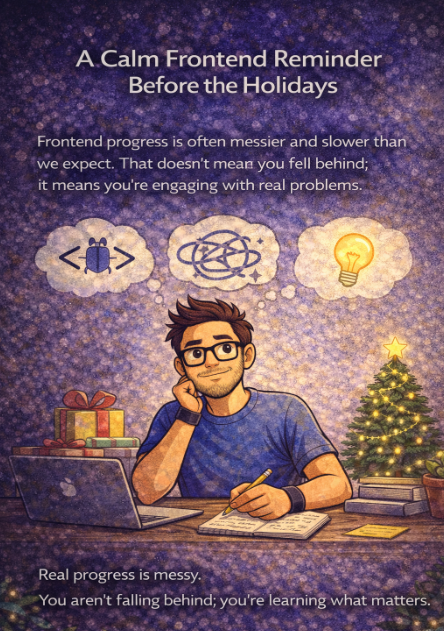
A Calm Frontend Reminder Before the Holidays
If frontend learning has felt slower or messier than you expected this year, I want to offer a small perspective before the holidays fully take over. Most people don’t fall behind because they’re doing things wrong. They fall behind because learning frontend is non-linear and no one tells you that early enough. What progress in frontend actually looks like Real frontend progress doesn’t feel like: - Constant wins - Clean upward momentum - “I get it now” moments every week It looks more like: - Confusion that later turns into clarity - Bugs that teach you more than tutorials - Concepts that don’t click… until suddenly they do That’s not failure. That’s how engineers are built. December is a bad month to judge yourself This time of year compresses everything: - Less time - More noise - More comparison So if you’re feeling behind right now, be careful with the story you tell yourself. Feeling slow in December doesn’t mean you are slow. It usually just means you’re human. One technical habit to carry into the new year If I could recommend one thing to focus on, especially during quieter days, it’s this: Before changing code, pause and ask: - What do I expect to happen? - What actually happened? - What changed? - What depends on that change? That habit matters more than any framework you could “catch up on.” It’s how frontend stops feeling chaotic and starts feeling predictable. You don’t need to grind this week You don’t need to: - Finish a course - Learn a new library - “Make up for lost time” Sometimes the best thing you can do is let your brain rest so the concepts you’ve already touched can settle. Understanding often arrives after the pause. If you truly want to make a difference as 2025 closes, What’s one frontend concept that felt confusing earlier this year, but makes a little more sense now? That quiet progress counts, even if no one else saw it. Wishing you a calm holiday and a clear start to what comes next 🎄
0 likes • Dec '25
WP/Elementor! That one took a minute - esp figuring out globals and spacing (padding/margins) - but I like what I'm creating. It's a lot different than I remembered and I LOVE that I can have so much control over the styling right in the builder. Totally different experience for sure.
Dec '25 •
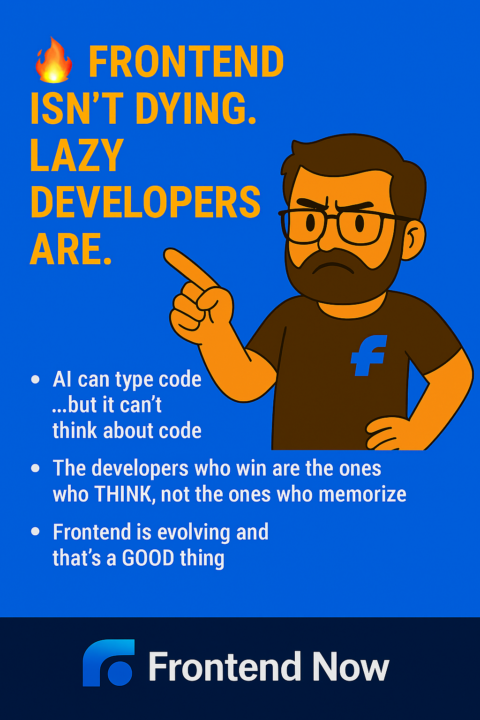
🔥 Frontend Isn’t Dying, Lazy Developers Are.
I’ve seen this fear everywhere lately: “Is AI going to replace frontend developers?” Here’s my honest take after working with hundreds of students and watching the industry up close: Frontend isn’t dying. Lazy developers are. Let me explain because this is way more empowering than it sounds 🧠 AI can type code but it can’t think about code Everyone’s acting like ChatGPT is going to stand up one day and start building full products. But guess what? AI has no clue: - Why a layout should flow a certain way - How a user thinks when they land on a page - What a business actually needs from a feature - Which trade-offs make sense in the real world - When simplicity beats cleverness AI replaces typing, not judgment. Frontend is judgment. 💡 The developers who win are the ones who THINK, not the ones who memorize If your value is “I can follow tutorials and Google my way through a app” Yeah, AI is going to outpace you. But if your value is: - Clear thinking - UX intuition - Problem-solving - Clean, maintainable code - Understanding the user - Communicating with designers & product Then AI becomes your sidekick, not your replacement. The devs who think in systems and user flows? They’re about to become 10× more valuable. 🚀 Frontend is evolving and that’s a GOOD thing Frontend has always changed fast: - jQuery → ES6 JavaScript - Tables/CSS Floats → Flexbox → Grid - Static Pages → Server Side Rendering - CSS in JS → Tailwind CSS AI is just the next evolution and guess who thrives during evolutions? The people who adapt, not the people who cling to what’s comfortable. 🛑 Here’s who should be worried: People who: ❌ copy/paste code without understanding ❌ rely on tutorials to think for them ❌ don’t know how to break down a problem ❌ don’t understand users ❌ can only follow instructions, not create solutions Those roles are disappearing 🔥 Here’s who wins big: People who: ✅ can make decisions ✅ can communicate with clarity ✅ can simplify complexity
0 likes • Dec '25
100% - it's like photoshop for coding

Dec '25 •
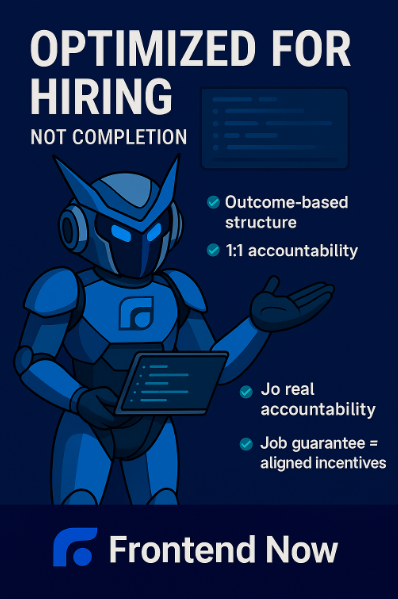
How Our Students Are Landing Jobs Faster Than Traditional Bootcamps
I want to be very transparent here, because this matters if you’re deciding where to invest your time and money. Our students aren’t landing jobs faster because they’re “smarter” They aren’t coding 12 hours a day And it’s not because we have some secret hiring hack The real reason comes down to structure, incentives, and accountability. Here’s what traditional bootcamps get wrong: 1️⃣ They optimize for teaching, not outcomes Most bootcamps are designed like schools: - Fixed curriculum - Fixed timeline - Same projects for everyone - Little to no individual feedback You can “graduate” without being job-ready. At that point, they’ve already won, you paid. 2️⃣ No real accountability once you fall behind Life happens. When students miss a week or get stuck: - They quietly fall behind - Confidence drops - Momentum dies That’s why bootcamps have massive drop-off rates (they just don’t advertise them). 3️⃣ Portfolios that look like everyone else’s Hiring managers can spot bootcamp portfolios instantly. Same layouts, same projects, same patterns. That’s not a skill issue, it’s a system issue. Here’s why our students move faster 👇 ✅ Outcome-based structure Everything we do is reverse engineered from one goal: “Would this help you get hired?” If the answer is no, it doesn’t make the curriculum. ✅ 1:1 accountability + pressure (in a good way) Students don’t disappear for weeks. They have: - Clear weekly expectations - Someone checking progress - Someone calling out avoidance early This alone speeds people up more than any “better content.” ✅ Job guarantee = aligned incentives This is the uncomfortable truth most programs avoid: When a school guarantees outcomes, they’re forced to: - Filter for commitment - Fix broken systems fast - Care deeply about results If you don’t get hired, we haven’t finished our job That changes everything. ✅ Portfolios built to win interviews, not impress beginners Students build: - Targeted portfolios - Senior-looking projects - Work that makes recruiters pause
1 like • Dec '25
@Chibuzor Ezeufoh They have a money back guarantee after a year as long as you meet certain criteria (in the contract, so you know in advance). For what it's worth, I'm about 2 mos into the program from no prior formal training, just finishing my first solo site, and already have people asking about contracts because they heard my husband talking and saw my UNFINISHED site on his phone.
Dec '25 •
10+ years in tech, and here's the one thing I'd tell every newbie
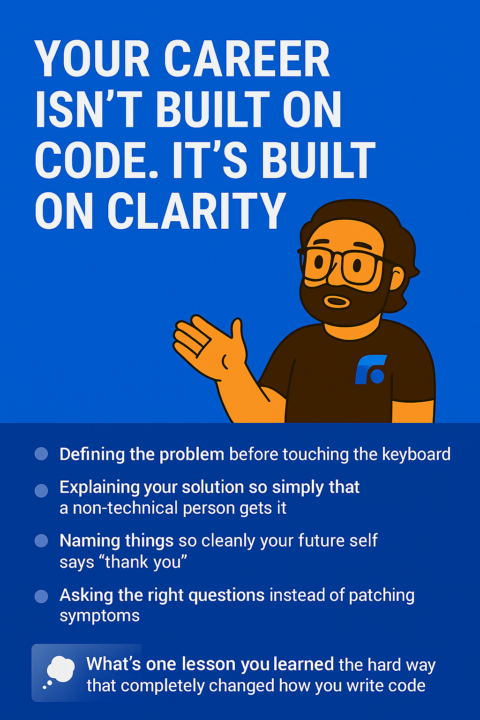
If there’s one lesson I had to learn the hard way across startups, enterprise teams, government contracts, and AI labs, it’s this: Your career isn’t built on code. It's built on clarity. When I was early in my career, I thought being “good” meant knowing everything. Every framework. Every language. Every shortcut. Every obscure config hidden 9 folders deep. But the developers who actually moved the needle the ones people trusted, the ones who shipped the work that mattered, they weren’t walking encyclopedias. They were the ones who thought clearly. And clarity shows up in ways beginners often overlook: - Defining the problem before touching the keyboard - Explaining your solution so simply that a non-technical person gets it - Naming things so cleanly your future self says “thank you” - Asking the right questions instead of patching symptoms Once you master that, your code gets better. Your collaboration gets better. Your entire career gets better. Because here’s the truth most people don’t tell junior devs: Companies don’t hire you to write code. They hire you to solve problems and communicate why your solution works. And if you’re just getting started, here’s the advice I wish someone had drilled into me years ago: 👉 Don’t chase tools… chase understanding. Tools change. Fundamentals don’t. 👉 Don’t fear being wrong… fear not learning from it. Mistakes are tuition. You’re meant to make them. 👉 Don’t copy patterns blindly… understand WHY they exist. That’s when you go from “I can code” to “I can architect.” Frameworks, libraries, AI tools, they’ll all come easier when your thinking is sharp. Clarity is the skill that compounds. it. It's the one that turns juniors into seniors, and seniors into leaders. So let me ask you: 💭 What’s one lesson you learned the hard way that completely changed how you write code? Drop it below. someone in this community needs to hear it. #frontenddevelopment #webdevelopment #softwareengineering #codingjourney #reactjs #nextjs #careertransition #learncoding #techcommunity #devadvice #programmingtips #softwaredeveloper
1 like • Dec '25
Systematic file names without spaces, and YYYYMMDD order. Nothing like trying to upload 60K files that aren't in the order you need them, and I'm pretty sure it's a rule that anything you don't rename from 1230057u45773423.jpg will be needed in original format at least twice a year until you rename it. To that end, keep a backup copy of everything you ship. Doesn't matter how deep something's buried, at some point the client WILL find it and WILL delete it. 😆
1-10 of 13

Active 1d ago
Joined Oct 14, 2025
CA USA
Powered by