Activity
Mon
Wed
Fri
Sun
Mar
Apr
May
Jun
Jul
Aug
Sep
Oct
Nov
Dec
Jan
Feb
What is this?
Less
More
Memberships
70 contributions to Front End Now Community

15h •
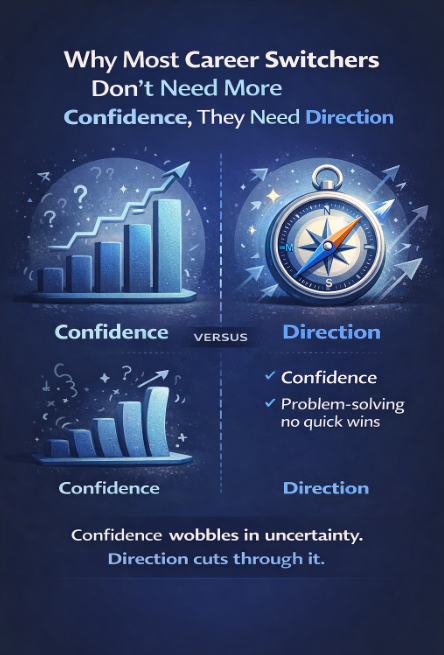
Why Most Career Switchers Don’t Need More Confidence, They Need Direction
One of the most common things I hear from people thinking about a career switch into tech is: “I just need to feel more confident first.” That sounds reasonable. It’s also usually wrong. Most career switchers don’t lack confidence. They lack direction. Why confidence is overrated at the start Confidence is a byproduct, not a prerequisite. People think confidence comes before action. In reality, it shows up after momentum. When you don’t know: - Which role you’re aiming for - What skills actually matter - What “progress” looks like week to week Your brain fills the gap with doubt. That’s not low confidence. That’s unclear direction. What direction actually gives you Direction answers questions confidence never can: - “What should I work on today?” - “What can I ignore for now?” - “How do I know if I’m on track?” Once those are clear: - Overthinking drops - Consistency improves - Confidence follows naturally Not because you suddenly feel brave but because you’re no longer guessing. Why people mistake fear for a confidence issue When people say: “I’m not confident enough to start” What they often mean is: “I don’t want to start without a plan.” And that’s fair. Starting randomly should feel uncomfortable. But starting with structure feels very different. What actually moves career switchers forward People who successfully transition into tech don’t wait for confidence. They: - Pick a clear direction early - Commit to a realistic weekly cadence - Measure progress by output, not feelings - Adjust based on feedback instead of emotion That’s how clarity is built. A better question to ask yourself Instead of: “Why don’t I feel confident?” Try: “Do I know exactly what I’m supposed to be doing right now?” If the answer is no, confidence isn’t the problem. Direction is. Take a moment and reflect on this: If someone asked you what you’re focused on this month to move toward a tech career, could you explain it clearly? That answer usually tells you where to look next.
0
0
2d •
How to Know If You’re Choosing Tech for the Right Reasons
A lot of people ask: “Is tech actually right for me?” What they’re really asking is: “Am I making a smart decision or chasing hype?” That’s a fair concern. Here’s the truth most people miss 👇 Choosing tech for money, flexibility, or remote work isn’t wrong. But those reasons alone won’t carry you when things get hard. The better question is this: Do I like the process tech requires not just the outcome? Because tech means: - Sitting with confusion - Solving problems that don’t work the first time - Improving systems, not getting instant wins You don’t need passion. You need tolerance for that process. If you relate to this, tech might be a fit: - You’re okay being bad before you’re good - You value progress over perfection - You’re willing to trade short-term discomfort for long-term leverage That’s what actually sustains people. Here’s the real filter to sit with: Are you choosing tech because you’re running from something or because you’re building toward something?
0
0

3d •
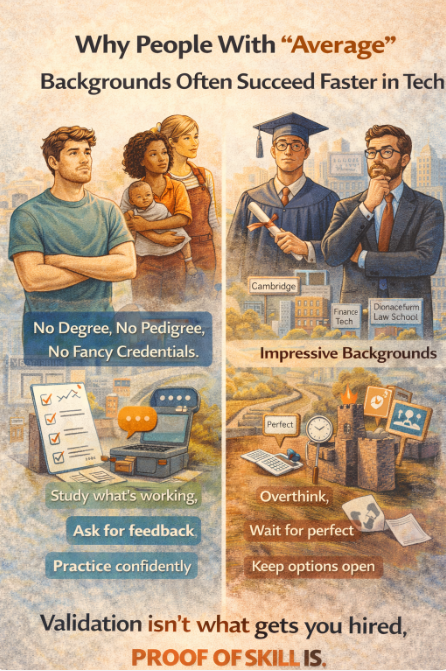
Why People With “Average” Backgrounds Often Succeed Faster in Tech
One of the biggest surprises I’ve seen over the years is this: People with so-called “average” backgrounds often break into tech faster than people with impressive resumes. No degree No tech pedigree No fancy credentials. And it’s not luck. The advantage most people don’t see People with average backgrounds usually don’t assume anything will be handed to them. So they: - Follow instructions closely - Stick to the plan instead of freelancing it - Ask for feedback early - Don’t overthink whether they “belong” They’re not trying to prove how smart they are. They’re trying to get results. That mindset compounds quickly. Why “smart” or highly credentialed people often move slower People with strong academic or professional backgrounds tend to: - Overanalyze decisions - Keep too many options open - Delay applying because things aren’t “perfect” yet - Optimize for certainty instead of momentum They’re capable but they hesitate. In tech, hesitation is expensive. Tech rewards execution, not pedigree Breaking into tech isn’t about: - Where you went to school - How impressive your background sounds - Knowing everything upfront It’s about: - Learning what the market actually needs - Building proof of skill - Showing up consistently - Improving based on real feedback That’s why people who don’t have a degree or “perfect” background often do well, they focus on what’s controllable. The hidden strength of average backgrounds When you don’t expect shortcuts, you: - Respect the process - Build resilience early - Develop practical problem-solving habits - Stop waiting for validation That’s exactly what tech careers reward long term. A simple truth worth remembering Tech doesn’t care where you came from. It cares: - Can you learn? - Can you execute? - Can you adapt? If you’re willing to do those three things, an “average” background is not a disadvantage. It’s often an edge. Take a moment and be honest with yourself:
0
0
4d •
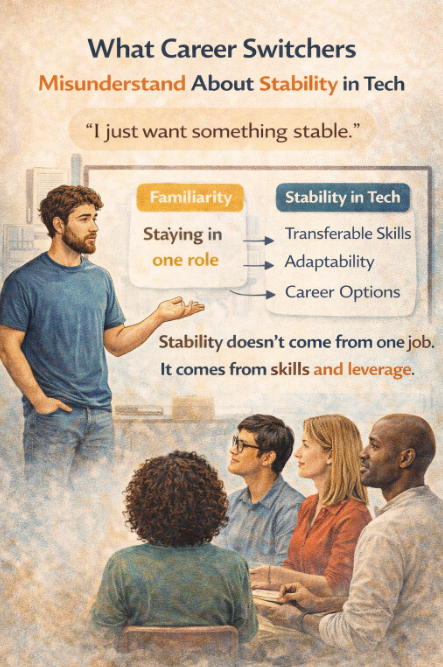
What Career Switchers Misunderstand About Stability in Tech
When people think about switching careers into tech, they usually say one thing: “I just want something stable.” Totally fair. But here’s what most career switchers misunderstand: Stability in tech doesn’t come from one job. It comes from skills and leverage. The common mistake Many people compare tech to their current job and think: - “Tech companies do layoffs” - “The market seems volatile” - “My current role feels safer” What they’re really comparing is: - Known discomfort vs unknown opportunity Familiarity doesn’t equal stability. It just feels predictable. What stability actually looks like in tech In tech, stability isn’t about staying in one company for 20 years. It’s about: - Having skills that transfer across companies - Being able to re-enter the market quickly - Not being locked into one industry or employer - Having options when things change That’s a very different kind of security. Why tech feels “less stable” from the outside Tech moves fast. That visibility makes change obvious. But what most people don’t see is this: - Engineers who get laid off often land faster - Skills carry across roles and industries - Demand shifts, but it rarely disappears Instability is loud. Opportunity is quieter. The real tradeoff career switchers face Traditional roles often offer: - Short-term predictability - Long-term ceilings Tech offers: - Short-term uncertainty - Long-term optionality Neither is “right” for everyone. But they’re not the same thing. A better question to ask yourself Instead of: “Is tech stable?” Ask: “If my job disappeared tomorrow, how quickly could I adapt?” That’s real stability. If you’re considering a career switch into tech, don’t just optimize for comfort today. Think about leverage, skills, and options over the next 5 - 10 years. That’s where stability actually comes from.
1
0
5d •
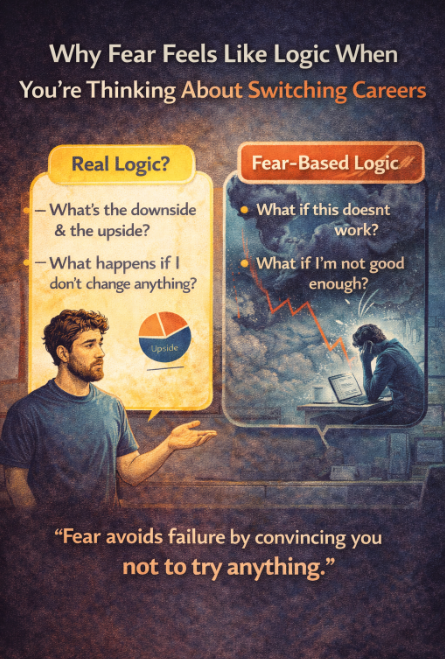
Why Fear Feels Like Logic When You’re Thinking About Switching Careers
When people think about switching careers, especially into tech, they rarely say, “I’m scared.” Instead, fear shows up dressed as logic. It sounds like: - “The market is risky right now” - “I should wait until I’m more prepared” - “This might not be the smartest move” - “I can’t afford to make a mistake” All reasonable statements. All emotionally convincing. And that’s exactly why they’re so effective at stopping action. Why fear disguises itself as logic Fear doesn’t want to be obvious. If it showed up as panic, you’d question it. So it borrows credibility. It uses: - Data without context - Worst-case scenarios only - Hypotheticals framed as certainty The goal isn’t to protect you from danger. It’s to protect you from uncertainty. And career changes are full of uncertainty. The difference between real logic and fear-based logic Real logic asks: - “What’s the downside and the upside?” - “What happens if I don’t change anything?” - “How can I reduce risk instead of avoiding it?” Fear-based logic asks: - “What if this doesn’t work?” - “What if I’m not good enough?” - “What if I regret trying?” Notice the pattern. One evaluates options. The other only argues for staying put. Why this matters for switching into tech People don’t get stuck because tech is impossible. They get stuck because fear convinces them that: - Waiting is responsible - Staying comfortable is rational - Starting later will be easier In reality, waiting often: - Increases pressure - Shrinks confidence - Makes the move feel bigger over time That’s not logic. That’s fear playing defense. A more honest way to think about it If you’re considering a career switch into tech, try this filter: Instead of asking, “Does this feel safe?” Ask, “Is my reasoning helping me move forward or helping me avoid discomfort?” That question cuts through a lot of noise. Here’s something worth sitting with today: What’s one “practical” reason you’ve been telling yourself for not starting yet and if you’re honest, how much of it is fear trying to sound responsible?
0
0
1-10 of 70
@alex-p-8947
I help beginners land remote jobs in tech without a degree or previous experience 🚀 https://learnfrontendnow.com 💻
Online now
Joined Feb 4, 2025
Powered by