

2d •
Why Most Frontend Developers Get Rejected (Even When They Can Code)
Quick reality check. Most frontend developers aren’t rejected because they lack talent. They’re rejected because they accidentally signal risk. What companies quietly screen for: - GitHub that shows real progression (not tutorial dumps) - Portfolios that look like real company work - Resumes that show impact, not long lists of tools - Strong fundamentals in layout, state, and communication What gets people rejected fast: - Generic projects - Messy GitHub profiles - Overstuffed resumes - Applying blindly with no tailoring These are strategy mistakes, not ability problems. We put together a clear breakdown of the 10 most common mistakes that get frontend developers rejected and what good actually looks like instead. If you want the document, 👉 DM me “REJECTED” and I’ll send it to you. Fixing the right things once beats guessing for months.

17h •
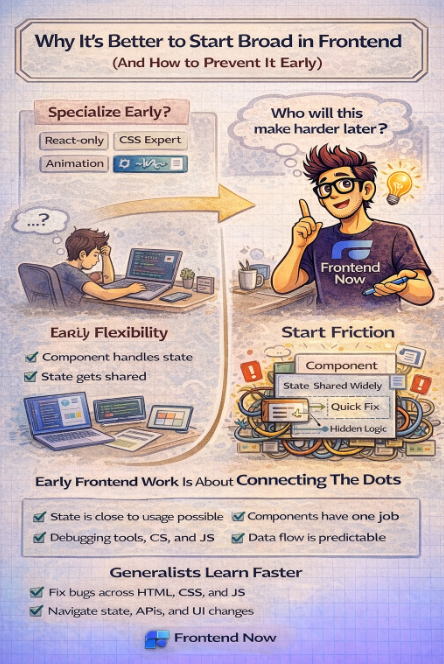
Why Frontend Development Rewards Generalists More Than Specialists Early On
Early in a frontend career, it’s tempting to specialize fast. You see people branding themselves as: “React-only” “CSS expert” “Animation-focused” “Performance specialist” That can make sense later, but early on, frontend rewards generalists far more than specialists. Here’s why. Junior frontend roles aren’t about being exceptional at one thing. They’re about being useful across the surface area of a real app. Most early frontend work involves: - Reading existing code - Making small UI changes - Fixing bugs across HTML, CSS, and JavaScript - Working with APIs and data - Understanding state, events, and rendering - Collaborating with designers and backend devs That work doesn’t live in one narrow lane. It lives in the connections between things. Specializing too early creates blind spots. If you only focus on one area: - You struggle when bugs cross boundaries - You miss how data, state, and UI affect each other - You rely more on others to fill gaps Generalists, on the other hand, can trace a problem end to end. They might not know everything deeply yet, but they know where to look and how pieces fit together. That’s incredibly valuable early on. Frontend development also has a fast feedback loop. When you understand a bit of everything: - Debugging gets easier - Learning new tools feels less intimidating - Frameworks make more sense - You adapt faster as requirements change That adaptability is what teams look for in junior developers. Not perfection. Not deep specialization. But the ability to move, learn, and contribute across the stack of the UI. This doesn’t mean specialization is bad. It means timing matters. Strong frontend specialists usually start as solid generalists. They build depth later, once they understand the full system they’re optimizing within. If you’re early in your frontend journey, a good question to ask isn’t: “What should I specialize in?” It’s: “Do I understand how the whole frontend fits together yet?”
0
0
4d •
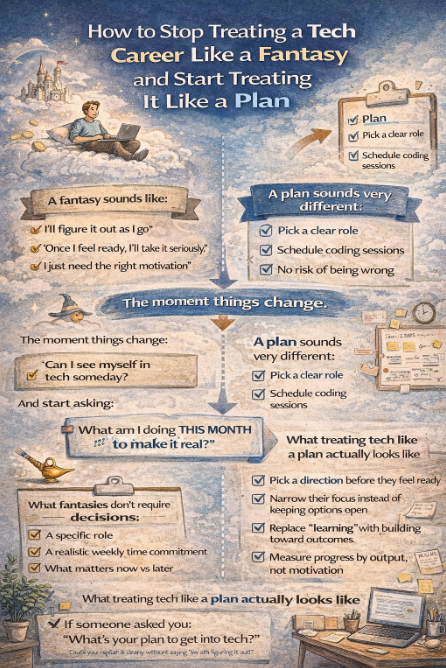
How to Stop Treating a Tech Career Like a Fantasy and Start Treating It Like a Plan
A lot of people say they want a tech career. But if you listen closely, what they really have is a fantasy, not a plan. A fantasy sounds like: - “I’ll figure it out as I go” - “Once I feel ready, I’ll take it seriously” - “I just need the right motivation” A plan sounds very different. The moment things change The shift happens when you stop asking: “Can I see myself in tech someday?” And start asking: “What am I doing this month to make it real?” That’s where most career switchers get uncomfortable and where progress actually starts. Why fantasies feel good (but go nowhere) Fantasies are exciting because: - There’s no pressure - No tradeoffs yet - No risk of being wrong But fantasies don’t require decisions. Plans do. Plans force clarity around: - A specific role - A realistic weekly time commitment - What matters now vs later - What progress looks like in 30 - 60 - 90 days That clarity is what turns effort into momentum. What treating tech like a plan actually looks like People who successfully switch careers into tech don’t wait to feel confident. They: - Pick a direction before they feel ready - Narrow their focus instead of keeping options open - Replace “learning” with building toward outcomes - Measure progress by output, not motivation It’s less exciting at first and far more effective. A simple reality check If someone asked you: “What’s your plan to get into tech?” Could you explain it clearly without saying “I’m still figuring it out”? If not, that’s okay. It just means you’re still treating it like a possibility instead of a priority. Here’s the challenge for today: Stop asking whether a tech career is possible for you.Start deciding whether you’re willing to plan for it. That one shift is where real career changes begin.
2d •
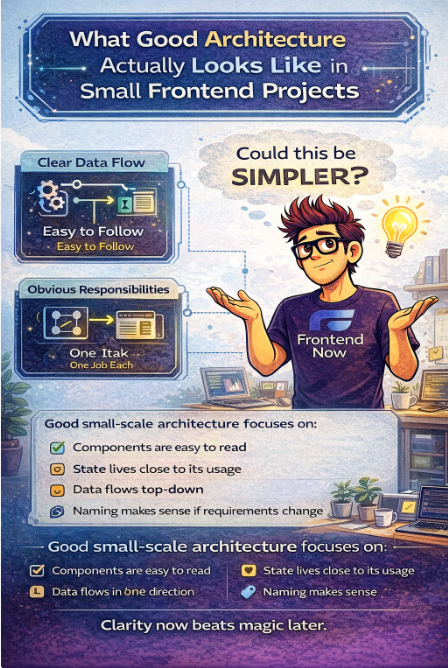
What Good Architecture Actually Looks Like in Small Frontend Projects
When people hear “frontend architecture,” they often picture something complex. Folders everywhere. Layers of abstractions. Patterns they barely understand yet. That’s not what good architecture looks like in small frontend projects. In fact, most small projects don’t suffer from too little structure. They suffer from too much structure too early. Good frontend architecture at a small scale is mostly about one thing: Making the code easy to understand and easy to change. That’s it. If your project has: - Clear data flow - Obvious component responsibilities - Minimal indirection - Predictable state ownership You’re already doing architecture well, even if the folder structure looks simple. In small frontend projects, good architecture usually means: Components do one job clearly. State lives close to where it’s used. Data flows in one direction. Files are named based on responsibility, not patterns. You shouldn’t need a diagram to understand what’s happening. If reading the code requires jumping across ten files to follow a single interaction, the structure is working against you. Here’s a mistake I see often. Beginners try to “future-proof” small apps by adding: - Shared abstractions before repetition exists - Global state before coordination is needed - Generic utilities before requirements are clear That usually increases complexity without solving real problems. Architecture should emerge from usage, not anticipation. Experienced frontend engineers start simple on purpose. They let the project grow until patterns repeat naturally. Only then do they extract shared logic. Only then do they introduce structure that earns its place. That restraint is what keeps small projects flexible instead of fragile. A good rule of thumb for frontend project structure: If removing an abstraction makes the code easier to understand, it probably wasn’t needed yet. Small projects benefit from: - Fewer layers - Clear boundaries - Local reasoning
1
0
6d •
The 100-Day Frontend Developer Roadmap (What to Learn, When to Learn It, and What to Skip)
Most people who say “I want to become a frontend developer” don’t actually have a learning problem. They have a direction problem. They jump between: ● YouTube tutorials ● Random courses ● “What should I learn next?” threads And months later… they’re still unsure if they’re even on the right path. So let me ask you something honestly: Do you know what you should be learning right now or are you just staying busy so it feels like progress? That’s why we put together a 100-Day Frontend Developer Plan. No fluff. No trend-chasing. No “learn everything just in case.” It breaks down: ● What to focus on first (and what to ignore) ● How real frontend skills are built in the real world ● When freelancing actually makes sense (and when it doesn’t) ● Why skipping fundamentals is the fastest way to get stuck later It’s the roadmap we wish more beginners had before wasting months guessing. If you’re: ● Learning frontend and feeling scattered ● Unsure if your current path leads to a job ● Tired of watching content without confidence 👉 DM me the word “Roadmap” and I’ll send it to you. Sometimes clarity isn’t about motivation it’s about finally seeing the path laid out in front of you.
1-30 of 169

skool.com/front-end-now
Helping beginners learn how to create websites and sign clients. Get feedback, portfolio reviews, AMAs & career tips to launch your frontend career.
Leaderboard (30-day)
1

+3
2

+2
3

+1
4

+1
Powered by