Activity
Mon
Wed
Fri
Sun
Mar
Apr
May
Jun
Jul
Aug
Sep
Oct
Nov
Dec
Jan
Feb
What is this?
Less
More
Memberships
#TheTechHustle Community 🤝🏽
292 members • Free
Closers.io - Remote Sales Reps
13.2k members • Free
Front End Now Community
172 members • $47/month
136 contributions to Front End Now Community

11h •
The 100-Day Frontend Developer Roadmap (What to Learn, When to Learn It, and What to Skip)
Most people who say “I want to become a frontend developer” don’t actually have a learning problem. They have a direction problem. They jump between: ● YouTube tutorials ● Random courses ● “What should I learn next?” threads And months later… they’re still unsure if they’re even on the right path. So let me ask you something honestly: Do you know what you should be learning right now or are you just staying busy so it feels like progress? That’s why we put together a 100-Day Frontend Developer Plan. No fluff. No trend-chasing. No “learn everything just in case.” It breaks down: ● What to focus on first (and what to ignore) ● How real frontend skills are built in the real world ● When freelancing actually makes sense (and when it doesn’t) ● Why skipping fundamentals is the fastest way to get stuck later It’s the roadmap we wish more beginners had before wasting months guessing. If you’re: ● Learning frontend and feeling scattered ● Unsure if your current path leads to a job ● Tired of watching content without confidence 👉 DM me the word “Roadmap” and I’ll send it to you. Sometimes clarity isn’t about motivation it’s about finally seeing the path laid out in front of you.
1d •
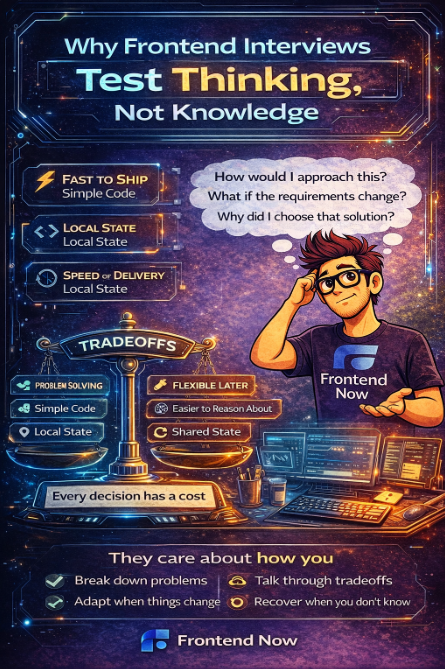
Why Frontend Interviews Test Thinking, Not Knowledge (And How to Prepare Properly)
One of the biggest misunderstandings about frontend job interviews is thinking they’re knowledge tests. They’re not. Interviewers aren’t trying to see how many APIs you’ve memorized or whether you remember the exact syntax for something under pressure. They’re trying to understand how you think. That’s why so many capable developers walk out of interviews feeling confused. They studied hard, reviewed concepts, and still felt like they didn’t “perform.” It’s usually because they prepared for the wrong thing. In real frontend interviews, what’s being evaluated is your reasoning. Interviewers are listening for: - How you break problems down - How you reason about state and change - How you handle ambiguity - How you explain decisions and tradeoffs - How you recover when you don’t know something That’s why you’ll often hear questions like: “How would you approach this?” “What happens if this requirement changes?” “Why did you choose this structure?” Those aren’t trivia questions. They’re thinking questions. This is also why memorization-heavy prep backfires. If your preparation is mostly: - Watching interview walkthroughs - Memorizing solutions - Practicing perfect answers You’ll struggle the moment the problem looks slightly different. Real interviews are intentionally messy. They want to see how you navigate uncertainty, not whether you’ve seen the exact question before. So how do you prepare properly? You practice explaining your thinking out loud. You get comfortable saying: - “Here’s how I’m breaking this down.” - “This assumption might change, so I’d design it this way.” - “I don’t know the exact API, but here’s how I’d reason about it.” That’s not weakness. That’s competence. Another important shift: stop aiming to be fast. Interviewers aren’t impressed by speed if it comes without clarity. They’d much rather see slow, structured reasoning than quick, brittle answers. Pausing to think. Clarifying requirements. Talking through tradeoffs.
0
0
2d •
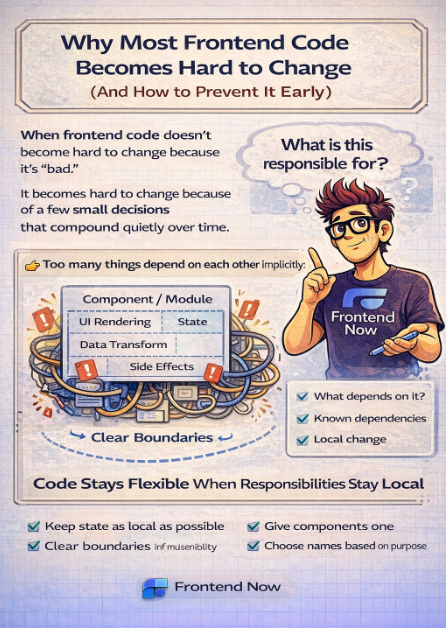
Why Most Frontend Code Becomes Hard to Change (And How to Prevent It Early)
Most frontend code doesn’t become hard to change because it’s “bad.” It becomes hard to change because of a few small decisions that compound quietly over time. Early on, everything feels flexible. You can tweak a component. Move some state. Add a condition. Then a few weeks later, even small changes feel risky. That’s not accidental. Frontend code usually becomes hard to change for one main reason: 👉 Too many things depend on each other implicitly. State is shared more widely than necessary. Components assume things about data shape or timing. Logic is spread across places without clear ownership. Nothing is wrong in isolation but together, it creates friction. Here’s a common example. A component starts simple: It renders UI and handles a bit of state. Over time, it also: - Fetches data - Transforms that data - Handles edge cases - Coordinates with other components Now changing one thing means understanding everything. The code still works but it resists change. The way to prevent this early isn’t adding more patterns. It’s being intentional about responsibility. Maintainable frontend code usually has: - Clear boundaries around state - Components with one primary job - Data flowing in predictable directions - Fewer hidden assumptions When responsibilities are clear, changes stay local. When responsibilities blur, changes ripple outward. Experienced frontend engineers constantly ask one quiet question while coding: “What will this make harder later?” That doesn’t mean overengineering. It means: - Keeping state as local as possible - Avoiding abstractions before patterns repeat - Naming things based on what they do, not how they’re implemented - Letting structure emerge from usage Those habits don’t slow you down, they protect future progress. If your frontend code keeps getting harder to change, here’s a simple habit to try: Before adding new logic, pause and ask: - Who depends on this? - What assumptions am I creating? - Could this responsibility live somewhere smaller?
0
0
3d •
Upwork Profile Review By a Senior Developer
Most people fail on Upwork for one simple reason…And it has nothing to do with talent, years of experience, or “not being good enough.” In this video, I did a real Upwork profile review, the kind I usually only do privately with students. I broke down the following: - Why good developers get ignored - The exact mistakes that quietly kill response rates - What clients actually look for (it’s not what you think) - How to position yourself when you’re new without lying or faking experience Here’s the uncomfortable truth👇 Most profiles don’t fail because the person can’t code. They fail because the profile doesn’t communicate trust. And trust is a skill you can learn. If you’re: - New to freelancing - Struggling to get replies - Or feel like you’re “doing everything right” but still stuck 👉 Watch this before you change anything else. I’ve been on both sides; applying and hiring and this video will save you months of guessing. 🎥 Watch here: https://www.youtube.com/watch?v=Xzd9hfP1w1g If you watch it, comment “PROFILE” and I’ll know you’re serious about fixing this instead of hoping it magically works.
0
0
5d •
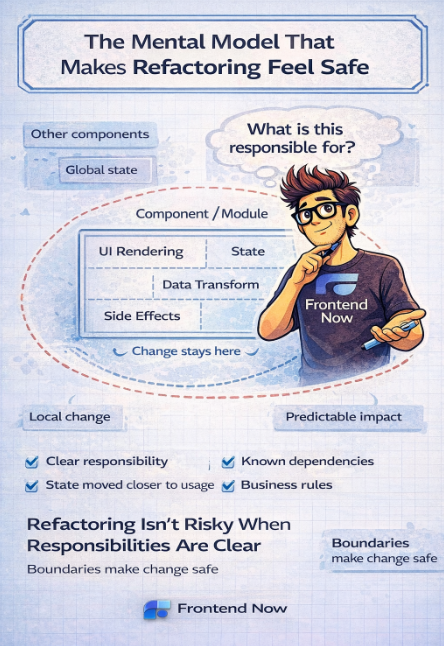
The Frontend Mental Model That Makes Refactoring Feel Safe Instead of Scary
Refactoring is one of the scariest moments for newer frontend developers. You open a file, see code that works, and think: “If I touch this, something else is going to break.” That fear isn’t irrational. It usually means you don’t fully understand what depends on what. The mental model that makes refactoring feel safe is simple, but powerful: 👉 Think in terms of responsibilities and boundaries, not files or components. Here’s what I mean. Most frontend bugs during refactors happen because a piece of code is doing more than one job. A component might: - Render UI - Manage state - Transform data - Handle side effects - Encode business rules When all of that is mixed together, change feels dangerous. You don’t know which behavior you’re about to affect. Refactoring feels risky because the boundaries are blurry. Senior frontend developers approach refactoring differently. Before changing anything, they ask: - What is this code responsible for? - What does it depend on? - Who depends on it? - What assumptions are baked into it? Once those answers are clear, refactoring becomes controlled instead of chaotic. You’re not “changing code. ”You’re adjusting one responsibility at a time. Here’s the key shift: Refactoring isn’t about rewriting everything. It's about shrinking the blast radius of change. Good frontend structure makes it obvious: - What can change safely - What must remain stable - What will ripple outward if modified When responsibilities are clear, changes stay local. This is why small, incremental refactors are so powerful. You extract one responsibility. You move one piece of state. You simplify one data flow. Each step makes the next one safer. Over time, refactoring stops feeling like a gamble and starts feeling like maintenance. If refactoring currently feels scary, try this habit: Before editing any code, write down: - What this code is responsible for - What it should not be responsible for If you can’t answer that yet, refactoring should feel risky.
0
0
1-10 of 136

@harry-ashton-2348
I help beginners land remote jobs in tech without a degree or previous experience 🚀
https://learnfrontendnow.com 💻
Active 23m ago
Joined Feb 4, 2025
Powered by