Activity
Mon
Wed
Fri
Sun
Jul
Aug
Sep
Oct
Nov
Dec
Jan
Feb
Mar
Apr
May
Jun
What is this?
Less
More
Owned by Lee
You've written the books and you're wondering "Where's the money?" Join us to learn how to market your book.
A community of leaders. This is where we heal ourselves so we can heal the world.
Memberships
Sonder
81 members • Free
Book Marketing Masterclass
224 members • $5/month
The Broadcast Room
1.4k members • $27/month
Self-Concept Practitioner™
240 members • $320/month
Skoolers
171.8k members • Free
Ultimate NLP Practitioner™
1.1k members • $54/month
Scroll Stopping Creative
188 members • $55/month
10 contributions to Scroll Stopping Creative

2d •
We almost killed our own momentum by getting bored
We almost killed our own momentum once by getting bored. Things were working. Sales were climbing. And I got the itch to experiment, to change the very thing that was already winning. Here's what I learned the hard way: the time to experiment is before you have momentum, or after you've fully exhausted it. Not during the window when the wave is carrying you. When something is working, your job is to ride it, not redesign it. Are you riding a wave right now, or in an experimenting season? Tell me where you are. I'm curious how many of us are mid-wave and tinkering anyway.

0 likes • 2d
Ha I feel this. I know if I get 5 more mafia romance written after this one it'll be a solid series I can advertise profitably. And yet....
2 likes • 2d
Me
6d •
What readers actually want from you
One of the biggest mindset shifts that changed everything for us: Readers buy familiarity with a fresh twist. They are not hunting for something nobody has ever seen. They want the comfort of their favorite trope, delivered through characters they haven't met yet. Give them the thing they love. Then surprise them with how you do it. What is the ONE trope your readers come to you for? Say it in five words or less. I'll go first in the comments.
2 likes • 5d
fated mates! Hot dominant heroes who take their shirts off a lot? I'm finally writing more forced/arranged marriage which is my fav mafia trope
0 likes • 5d
@Jill Cooper lol! Nailed it
21d •
When you start recording a video.....
And the electrician starts hammer drilling. I swear I'll get this done eventually! 😭
0 likes • 21d
@Tj Muir lol I was going to say the drilling can work depending on what you're writing....but you beat me to it!
21d •
New AI Laws effecting your FB Ads
Nothing too clickbait-y here. Learn the rules, decide to do with your own risk tolerance. On this one, my risk tolerance is very high.
2 likes • 21d
"no real werewolves are depicted" 😂
21d •
Grow your Direct Sale Platform AND Email List
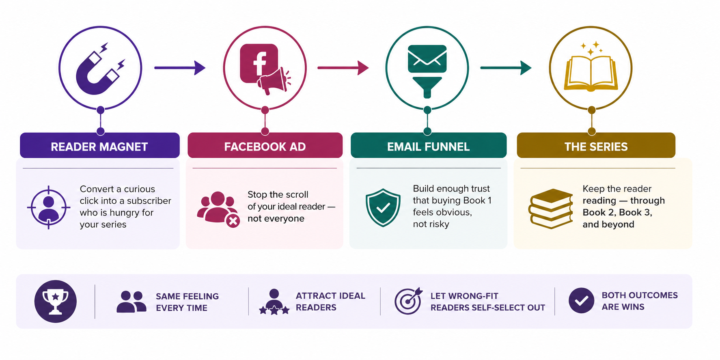
Raise your hand if this is you. 🙋♀️ You've been told to "build your list" — but nobody told you how to actually get readers into your ecosystem without spending a fortune or feeling like a used car salesman. Or maybe you're running ads, but they're driving people to Amazon... and you have zero idea if it worked. Or you have a reader magnet sitting in a Google doc, gathering digital dust, because the tech side (Pixel? BookFunnel? Lead ads??) feels like a foreign language. Direct Sales for Authors is for you. This course walks you through the entire author-reader ecosystem from scratch: ✅ How to write a reader magnet that gives readers the feels — and leaves them hungry for Book 1 ✅ Why Facebook Lead Ads beat link-click ads every single time (and how to set one up) ✅ How to connect your Meta Pixel to BookFunnel so Facebook actually learns your readers ✅ The 5-email sequence that turns a new subscriber into a buyer who trusts you ✅ Ad creative, tracking, and what to do with your list once you have it This isn't theory. Every module comes with a handout, a cheat sheet, or a skill — so you can implement as you go. And right now, you can get 10% off. Learn more about the course here: https://directsalesforauthors.com/ (but don't buy here) Checkout with the special discount code here automatically at checkout: https://buy.stripe.com/eVqfZidQU81mbKK5NYfIs00?prefilled_promo_code=COOPER PLUS get a special Claude Skill to help you just as part of this class Drop a COMMENT in the comments if you're thinking about it — happy to answer any questions about whether this is the right fit for where you are right now.
0 likes • 21d
I'm so excited about this!
1-10 of 10
Active 9h ago
Joined Oct 5, 2025
Powered by