Activity
Mon
Wed
Fri
Sun
Nov
Dec
Jan
Feb
Mar
Apr
May
Jun
Jul
Aug
Sep
What is this?
Less
More
Bedrock Nation
177
Free
18 contributions to Bedrock Nation

Aug 1 •
More Than Just a Sweat: How One Sauna Session Mobilizes Your Immune System
For years, researchers have observed something fascinating. People who use a traditional Finnish sauna several times each week tend to experience lower rates of: - Hypertension - Cardiovascular disease - Fatal heart attacks - Dementia - Alzheimer’s disease - Pneumonia - All-cause mortality The question has always been… Why? Is it simply relaxation? Better circulation? Lower stress? Or is something much deeper happening inside the body? A new study published in Temperature offers another important piece of that puzzle. The Study Researchers recruited 51 middle-aged adults, all with at least one cardiovascular risk factor. Participants completed a single 30-minute Finnish sauna session at 73°C (163°F). The researchers measured: - Body temperature - White blood cells - Plasma volume - 37 different inflammatory cytokines Measurements were taken: - Before the sauna - Immediately afterward - Thirty minutes later The results were surprising. Your Immune Cells Respond Immediately Body temperature increased from 36.4°C to 38.4°C (97.5°F to 101.1°F). Importantly, plasma volume did not change significantly. That means the increase in immune cells wasn’t simply due to dehydration concentrating the blood. Instead… The immune system actually mobilized. Researchers found significant increases in: - White blood cells - Neutrophils - Lymphocytes - Monocytes - Eosinophils - Basophils Neutrophils and lymphocytes returned to normal within about 30 minutes. However, monocytes, eosinophils, and basophils remained elevated even after the recovery period. Think of it like this: The heat appears to temporarily “deploy” immune cells into circulation—almost like calling additional responders into active duty. What About Inflammation? This is where things became even more interesting. Researchers measured 37 inflammatory cytokines—chemical messengers that help coordinate immune activity. You might expect those markers to rise dramatically.


0 likes • Aug 2
Yes, In Florida I get a steady sweat for 8 hours each day outside. Wonder if it “qualifies” for anything (sauna)....
Jun 4 •
Book Launch: Rooted in Faith, Restored by Nature: A 90-Day Devotional to Becoming Your Own Physician
📖 It’s Official: The Book Is Finally Here! Bedrock Nation, Today is a special day. After months of writing, editing, reviewing, revising, and praying, Rooted in Faith, Restored by Nature: A 90-Day Devotional to Becoming Your Own Physician is officially published and available on Amazon. This book represents so much of what we teach here every day. That health is not something we outsource. That symptoms are signals. That the body is intelligently designed. That faith and function were never meant to be separated. That healing often begins when we stop fighting our bodies and start understanding them. Over 90 days, we’ll walk through: 🌱 God’s original design for health🌱 How modern life disrupts that design🌱 Practical restoration through nutrition, light, movement, rest, and community🌱 Reclaiming wisdom and stewardship over your own health journey Each day includes: ✅ Scripture✅ Faith Reflection✅ Function Insight✅ Faith in Action✅ Prayer My prayer is that this book becomes a tool that helps people move from fear to faith, from confusion to clarity, and from dependency to discernment. Whether you’ve been part of Bedrock Nation for years or you’re just beginning your journey, I believe this message will encourage you. 📖 Available now on Amazon:https://a.co/d/0ehzbAzb If you purchase a copy, I’d love for you to: 1. Drop a photo in the comments. 2. Leave an Amazon review once you’ve read it. 3. Share it with someone who needs encouragement and hope. Thank you all for being part of this mission. Become your own physician—rooted in faith, restored by design. 🌿💚 — Leanna CappucciRooted Faith Wellness by Bedrock Nutrition

1 like • Jun 4
Congrad’s!! ordered
May 31 •
Food for Faith 5/31/26: Stop treating discomfort like an emergency
Food for Faith: Stop Treating Discomfort Like an Emergency Recently, my church is in a series called “God meant it for Good,” discussing the deeper, meaningful purposed of obstacles, challenges and hard times. Today, I was reflecting on some of the comments and questions I’ve received from you, and this seemed particularly relevant. One of the most impactful statements I have heard from my pastor is this: “God is not interested in your comfort. He is interested in your character.” At first glance, that sounds harsh. Most of us spend our lives trying to become more comfortable. We pursue comfort financially. We pursue comfort physically. We pursue comfort emotionally. We pursue comfort in our relationships. We pursue comfort in our schedules. We pursue comfort in our health. We assume that comfort is the reward. But Scripture paints a very different picture. Romans 5:3-4 tells us: “We also glory in our sufferings, because we know that suffering produces perseverance; perseverance, character; and character, hope.” Notice what God says produces character. Not comfort. Not convenience. Not easy circumstances. Not getting our way. Suffering. Difficulty. Resistance. Challenges. The very things most of us spend our lives trying to avoid. The Great Illusion of Control One of the greatest sources of suffering in modern life is our belief that we are somehow entitled to control the outcome. We want life to go according to our plan. We want our timeline. We want our expectations. We want our preferred outcome. And when life refuses to cooperate, we become frustrated, angry, anxious, discouraged, or fearful. But Scripture repeatedly reminds us that we are not in control. Isaiah 55:8-9 says: “For my thoughts are not your thoughts, neither are your ways my ways,” declares the Lord. The truth is that God does not operate according to our timeline. He does not ask our permission before allowing challenges into our lives. He does not consult our comfort level before developing our character.

1 like • May 31
For those, that cry they that want it.., But aren’t wiling to take the path to reach it...,exceptionally said!, Amen.
May 15 •
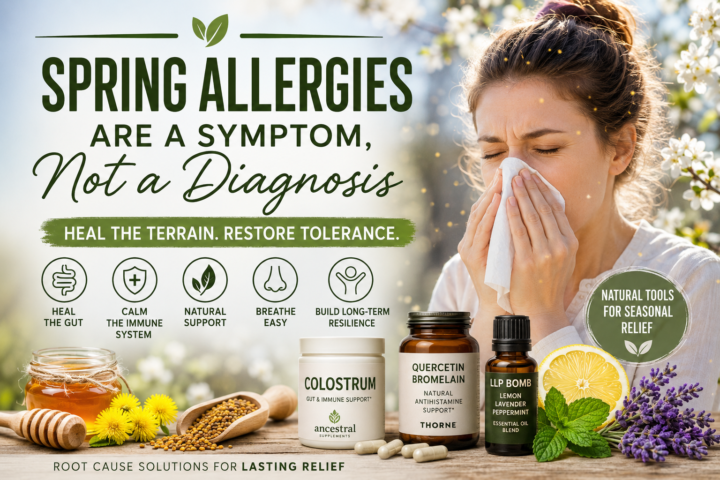
Spring Allergies, Histamine & the Terrain Connection
Why “Allergy Season” Is Really an Immune Resilience Conversation Every spring, the same pattern repeats itself. Pollen counts rise… and suddenly millions of people are dealing with: - Sneezing - Congestion - Watery eyes - Sinus pressure - Fatigue - Itchy skin - Asthma flares - Brain fog The conventional model says:“You have allergies. Take an antihistamine.” But from a terrain perspective, allergies are not the root problem. They are a symptom. Your body is reacting to something it has lost tolerance to. And that changes the entire conversation. Allergies Are a Terrain Issue — Not a “Pollen Deficiency” Pollen itself is not inherently dangerous. Two people can walk through the same field: - one has no symptoms at all - the other has severe reactions Why? Because the issue is not simply exposure. The issue is immune regulation. At the center of that immune regulation is the gut. The Gut Controls Immune Balance Around 70–80% of the immune system is associated with the gut and gut-associated lymphatic tissue (GALT). Your gut lining acts as a protective barrier between: - the outside world - and your immune system When that lining becomes damaged or permeable (“leaky gut”), particles that should remain contained begin crossing into circulation. That creates: - chronic immune activation - cytokine signaling - histamine dysregulation - inflammatory responses - increased immune hypersensitivity Over time, the immune system begins overreacting to harmless substances: - pollen - grasses - pet dander - dust - certain foods - mold - fragrances - environmental triggers In other words: The body loses tolerance. That’s what allergies really are. Histamine Is Not the Enemy Histamine itself is not “bad.” Histamine is part of a normal immune response. It helps regulate: - inflammation - stomach acid - neurotransmitters - immune communication - blood vessel dilation The problem occurs when the immune system becomes chronically overreactive.
3 likes • May 16
That was like a “semester” of material; thank you
May 6 •
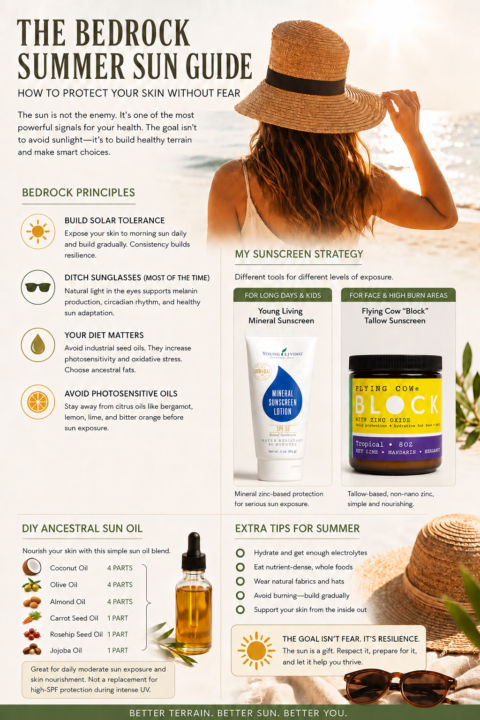
THE BEDROCK SUMMER SUN GUIDE
THE BEDROCK SUMMER SUN GUIDE How to Protect Your Skin Without Fear For years, we’ve been taught to fear the sun. Avoid it. Block it. Hide from it. But the truth is more nuanced than that. The sun is not the enemy. Sunlight is one of the most biologically important signals your body receives: * It regulates circadian rhythm * Supports mitochondrial function * Helps regulate hormones * Supports nitric oxide production * Helps produce vitamin D * Improves mood, metabolism, sleep, and immune function The problem is not the sun itself. The problem is modern terrain. Today’s skin is often: * inflamed * overexposed to processed seed oils * nutrient depleted * chemically burdened * disconnected from natural light cycles That combination changes how the body responds to UV exposure. So instead of fearing the sun… we should focus on building healthier terrain. ⸻ ☀️ BEDROCK PRINCIPLES FOR HEALTHIER SUN EXPOSURE 1. Build Your Solar Tolerance Gradually Your skin adapts to sunlight over time. One of the worst things you can do is: ❌ spend months indoors → then suddenly spend 8 hours in intense summer sun That is not ancestral living. Healthy sun adaptation looks more like: * daily morning sunlight * regular outdoor exposure * gradual seasonal adaptation * avoiding sudden overexposure The body builds resilience when exposure is consistent. ⸻ 😎 2. Avoid Wearing Sunglasses During Normal Daily Sun Exposure This one surprises people. Your eyes help regulate your body’s response to sunlight. Light entering the eyes influences: * circadian rhythm * melanin signaling * hormone production * seasonal adaptation Constantly blocking natural light with dark lenses may interfere with these adaptive signals. Now to be clear: This does NOT mean stare into the sun. And there are situations where eye protection absolutely makes sense: * snow glare * high-altitude reflection * boating/open water * safety/work environments But for normal daily outdoor exposure, allowing natural light into the eyes may support healthier light adaptation and melanin signaling.
0 likes • May 8
I wondered if folks in the tropic’s eating coconut had a build up of the coconut oils in their systems protecting them naturally
1-10 of 18

Active 4d ago
Joined Nov 13, 2025