Activity
Mon
Wed
Fri
Sun
May
Jun
Jul
Aug
Sep
Oct
Nov
Dec
Jan
Feb
Mar
Apr
What is this?
Less
More
Memberships
Liberty Politics Discussion
4.3k members • Free
9 contributions to Liberty Politics Discussion

2h •
Prince Harry - Speech in Ukraine
Prince Harry's speech in Kiev, a good speech and I hope this marks a turning point in our rather wimpy attitude of late. There are several points I was drawing comparisons to Iran and hoping it could make an impact on current European standpoints there too, don't know if that was just my wishful thinking or not though.
0
0

10d •
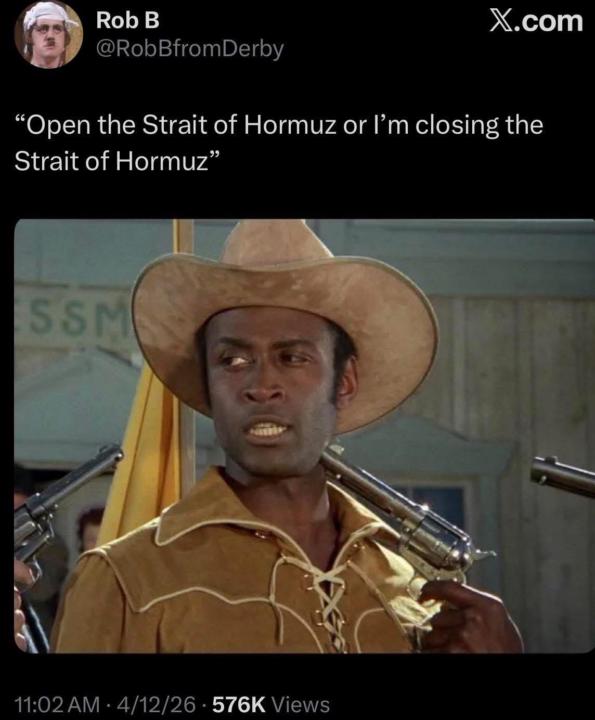
Found this meme in the FB group “Astrology Shitposting”
It was posted by people who apparently support the Iranian regime and think this meme is an own, but it’s actually the funniest shit I’ve seen about this war yet. Trump blockading the Straight of Hormuz has me ROLLING 🤣🤣🤣🤣 YESSSS queen
0 likes • 8d
Kudos points for the attempt though, love that film...

9d •
It Started With Marriage
On April 1st, 2001, the Netherlands became the first nation in human history to legalize same-sex marriage. Years later, in 2015, the U.S. Supreme Court likewise declared marriage a fundamental right protected by the Constitution. President Barack Obama, in a speech at the Rose Garden, declared "love is love" as he celebrated the ruling as "a victory for America." And most Americans seem to agree. A gallop poll suggests that approximately 88% of democrats and nearly 50% of Republicans support gay marriage. So it seems the debate is over. But should it be? In 2007, an Assumptionist priest by the name of Barry Bercier wrote in his book, Skies of Babylon, that if traditional marriage were re-defined to include same sex couples, "the result would be nothing less than the end of the world of man." Sound dramatic? Well -- what is marriage? If marriage were merely a proclamation of love, and if the fundamental purpose of marriage were to reward people who love each other, then gay marriage should be legal. But society does not give certain legal rights, financial benefits and tax breaks to people simply because they fall in love. At least, until two decades ago, that's not how it worked. Barry Bercier defines marriage as "the public and legal recognition of the pre-political duality of the sexes and the significance of the duality for human beings and the social and political order." In other words, marriage -- traditional marriage as it existed across every civilization for nearly all of human history, is the recognition of a unique relationship that pre-exists law and human constructs. That is, the institution of marriage - from Mesopotamia, to Egypt, China, Rome and every Western nation until 2001 -- recognized the duality of the sexes through law because the duality is the nucleus from which life emerges. The relationship between male and female -- man and woman -- whether you are gay, straight, black, white, bisexual, asexual, rich or poor, is our beginning; our source. For every human being, the duality of the sexes is our 'sine qua non' -- without it, life would not exist.
2 likes • 8d
I'm not entirely sure I agree with you here, I think that the problem is more that the people getting married nowadays don't really value what it stands for anymore, if it doesn't work out just get a divorce! Thus people get married to quickly. It's not sexuality but religiosity that's the issue. If the religion is willing to marry two people of the same sex, that's up to the church, there are still some that won't. Rights wise, at least in the UK, a civil partnership and a marriage hold equal weight.

9d •
Real talk
When you speak with a real person who supposedly belongs to a different 'camp' than yours—a group you hold negative views toward. While talking here, you discover that on a variety of topics, his conclusions actually align with your own. He likely arrived there for different reasons than yours, shaped by a different worldview. Please, I’m asking you: don't resort to name-calling, and don't be tempted to immediately dismiss him or pin your own 'camp's' labels on him just because it's convenient. That is intellectual laziness. Try to truly engage with him out of genuine curiosity. Explore how he reached a conclusion similar to yours from an opposing starting point, through a prism you aren't familiar with. Thank you for your attention to this matter :)
1 like • 9d
Agreed, I generally try to think of things in life as houses and my thoughts on them as looking at drawings of the house. From one view point the house may look a certain way, from the other side it may look completely different so in order to get a good understanding of that house you need as many viewpoints as possible. I agree with Blake in that if you have an idea or belief the best way to see if it's correct is to attack it and see if it holds water, so in a way it's a good thing when people oppose you. But this approach is dependant on who you are talking to, some people are natural debaters who thrive on this and don't take it personally. Some people on the other hand are not good in that environment, and will shut down when under perceived pressure. So this is where socratic or other open questions come in handy at getting them talking and feeling comfortable allowing a decent conversation to take place. We are all on different paths....
17d •
The Parable of the Two Arrows
The Buddha taught that in life, we are often struck by two arrows. The first arrow is the actual event or pain—something we often cannot control. The second arrow is our mental reaction to it: the negative thoughts, the worry, and the "story" we tell ourselves. While the first arrow causes pain, the second arrow causes suffering. Buddhism teaches that we don't have to listen to that second arrow. By choosing not to feed those negative thoughts, we prevent ourselves from being struck twice. Wisdom from the Dhammapada (Chapter 1) "What we are today comes from our thoughts of yesterday, and our present thoughts build our life of tomorrow: our life is the creation of our mind. If a man speaks or acts with an impure mind, suffering follows him as the wheel follows the hoof of the ox... If a man speaks or acts with a pure mind, joy follows him as his own shadow." The "Gatekeeper" Approach: Choosing Your Focus In Buddhist practice, the mind is often compared to a house and thoughts to uninvited guests. Here is how to apply the principle of focus: - Recognition, Not Reception: You cannot stop a negative thought from appearing, but you are not obligated to "invite it in for tea." You can acknowledge its presence without believing its message. - The Power of Redirection: Instead of arguing with a bad thought (which only gives it more energy), you practice Right Mindfulness. This means gently shifting your focus back to the present moment—your breath, your body, or the task at hand. - Non-Identification: Buddhism teaches that you are the observer of your thoughts, not the thoughts themselves. Just as you wouldn't be upset by a storm passing outside your window, you don't have to be upset by a "stormy" thought passing through your mind.

1 like • 17d
I like that, like the saying life if 10% what happens to you , 90% how you react to it.
1-9 of 9