Activity
Mon
Wed
Fri
Sun
Aug
Sep
Oct
Nov
Dec
Jan
Feb
Mar
Apr
May
Jun
Jul
What is this?
Less
More
Memberships
Grounded Permaculture Academy
55 members • Free
Syntropic Sunlands w/ Milan
178 members • Free
Food Forest Family (FREE)
3.7k members • Free
6 contributions to Syntropic Sunlands w/ Milan

26d •
Growing the Platform: What's Coming Next
Hey everyone ! I've finally figured out what I want to do with this platform. It will remain free to use, but I'm excited to announce that I'm working on several courses and resources that will help fund my work and allow me to dedicate more time to it. These will be available through one-time purchases for the most part. What I'm currently working on (in order) 1 - The Syntropic Paradigm Course A foundational course that dives deep into the philosophy and principles behind regenerative agriculture. -60 short video lessons (around 5 minutes each) -Available in both video and eBook format (eBook will be cheaper) -An encyclopedia of real-world applications of the philosophy (practical examples and counter-examples) 2 - Stratification Course A systematic and applied course on how to get the most out of stratifying your systems. -Approximately 10 videos -20–30 minutes each -Practical and detailed -Focused on real-world implementation and design, not pure theory but good practice. 3 - Mediterranean Plant Database A detailed plant database built specifically for Mediterranean climates (from semi-arid to wet) -Launching initially with around 50 plants -Expanded gradually through regular updates (already have 350 species listed) -Including support species, crops, ornamentals, and climbing plants -Detailed information on functions, management, ecology, and uses 4 - Food Forestry Tools Course A practical course covering essential food forestry tools and how to use them effectively. 5 - Seed Shop A small seed shop focused on Mediterranean support species. Planned offerings: -Acacia saligna (already started, 5 EURO/100 seeds) -Physalis -Up to around 10 species 6 - Consultancies I'm also beginning to offer consultancy services. This summer: I've already completed my first consultancy, two more are already planned for July, and around four additional people have expressed interest ! If you're interested, feel free to get in touch. Extra details The paid courses will be available through the Mini Courses section of the platform.

2 likes • 26d
You are the only one beside Scott that is doing Successional Accumulation and sharing it. Great stuff!
Apr 17 •
Infestation Block of Acacias
After a year and a half of thinking about it -and after visiting Scott Hall on his farm, as well as the Permadynamics family in New Zealand - I finally took the leap and planted an infestation block of Acacia saligna. In this video, I am breaking down what Infestation actually means, and why it can be such a powerful lever - especially in brittle climates (Arid, Semi-arid or Mediterranean climates) Infestation isn’t a standalone method. It’s the first step in a broader framework called Successional Accumulation, a concept developed and coined by Scott Hall. The process unfolds in these three stages: - Infestation - Stabilisation - Succession We’ll dive deeper into each of these steps here on the platform as we go ! What I’ve found is that this approach is far more practical at scale than trying to plant everything all at once - especially when you’re limited in water, amendments, or access. And Scott covers his experience with it on his platform. It’s a way to work with constraints instead of fighting them, and it can significantly reduce costs while setting up a long-term resilience strategy. I’d really love to hear your thoughts. What species have you seen that could play a similar role in your climate ?
3 likes • Apr 17
Hi Milan, I’m in Scott’s platform. Doing it in Singapore. 8 x 4 meter plot. Start with infestation of banana + Tithonia. Mombasa grass in the interrow. Still early but I really like the simplicity. No way I’m doing plant-all-at-once. The Tithonia is growing faster than the banana. The Mombasa was transplanted by slips, so growth is fast too.
Mar 4 •
The Infestation - How to do syntropic ag amendments free
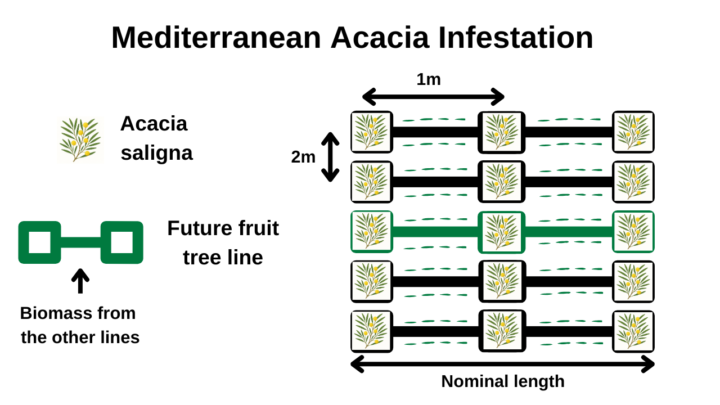
Hey everyone ! For the past two years I’ve been working toward something I’m finally beginning to implement: "the Infestation" a term coined by Scott Hall. Those of you on his platform will likely be familiar with it. Scott actually shared a design with me, and I’m currently in the middle of preparing the soil. - What is an infestation, and what’s the purpose? The concept of an infestation is simple—it’s essentially how nature most efficiently drives succession forward from bare or infertile soil. In natural ecosystems, a tough, fast-growing pioneer species colonizes poor ground because it’s the most adapted to those harsh conditions. It rapidly occupies space, outcompetes other plants, and establishes dominance so effectively that even grasses have little impact on its growth. After a few years, this often results in a dense hedge or stand of that species—you can clearly observe this along many roadsides. In my area, the species that naturally behaves this way is Acacia saligna. It self-seeds readily and is extremely resilient. Successional Accumulation Inspired by this natural process, Scott has been developing the concept of “Successional Accumulation.” The goal is to run syntropic agroforestry systems without external amendments by harnessing the initial growth and biomass production of the infestation phase. The system progresses through: - Infestation phase (pioneer dominance and biomass buildup) - Stabilisation phase - Succession phase - The end goal is the same abundance we seek in syntropic ag - but achieved only through plant power rather than external inputs. I won’t dive too deep into each phase here, but I’m happy to discuss further. Why acacias in the Mediterranean? Scott and I have discussed extensively how to adapt this to Mediterranean climates. We both see Acacia species as particularly promising pioneers (e.g., Acacia saligna, Acacia dealbata, Acacia pycnantha, etc.).
1 like • Mar 7
To clarify the image, 4 acacia rows to support 1 production row? And how high you will pollard the acacia?
Feb 28 •
Interview with Scott Gallant !
Hey you all ! I've been super busy planning out some interviews lately and working on developing my Instagram account to draw more members to the platform, while planting out the last systems for this year on the farm. Over time I'll cover them all here ! This interview with Scott is a gem, Scott is a really practical guy with a real proficiency with Syntropic ag, he's been installing many syntropic systems in Central America over 16 years of practice ! Enjoy the conversation !
1 like • Feb 28
Thank you for the videos. A little technical issue: I cannot heard your voice that well Milan. A better mic well help a lot. Cheer Could you interview A Little Wild in Malaysia? 6 years old Syntropic farm. https://alittlewild.com/
Jan 21 •
Powerhouse Plants for the Mediterranean Climate
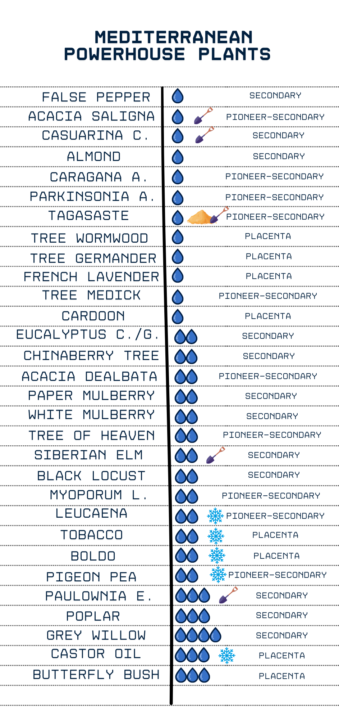
Electing your plant species for your syntropic system is a very difficult process for many. It's this typical overwhelming process where you don't know which plants to choose, that's why I aimed at making it much easier for you; condensing it down to 30 plants that grow very fast. Bear with me, it doesn't include later succession species, but don't worry, it's much more important to elect the right species entering into the secondary phase of a forest rather than thinking too much about which species will come later, as you can plant these later anyway. Most important advice here, don't overthink it, use whatever species grows fastest in your context to establish your system ASAP. I've separated the low water needs plants from the moderate water needs from the high water needs plants - symbolized by the water droplets. To be clear this is about water requirements at establishment, many plants in the moderate water needs will become tough as nails over time but if not watered enough at establishment, they will die. As well, the pile of sand (only tagasaste) symbolizes the need of the plant to be in loose or sandy soil. The shovel means these plants require good decompaction to get a good headstart - meaning breaking down the hardpan in a clay compacted soil - ex: using a subsoiler. Also, the snowflake means that these plants are frost sensitive, typically when temperatures go lower than 2 degrees they can exhibit damage. these plants are truly meant for a mild Mediterranean climate - especially mild winters. Lastly, the successional role of these plants is added at the end : - Placenta : Short-lived - Usually about 5 years maximum within a Mediterranean syntropic system. They can reach maturity within 6 months to a year and provide the fastest growth at establishment of your system. - Pioneer - Secondary : Plants that consolidate the transition from scrubland to forest. They are fast-growing too - but not as much as the placenta plants, usually reaching maturity around year 2 or 3. They create these conditions for the secondary forest to take place by providing high amounts of biomass and shade for the secondary seedlings below.
1 like • Feb 16
Hi Milan, what program you used to make tha chart? Very nice chart :)
0 likes • Feb 16
@Miquel Santandreu Cool!
1-6 of 6
Active 13h ago
Joined Jan 5, 2026
Malaysia